The vending machine business attracts first-time operators for good reasons: low staffing requirements, recurring income, and a relatively straightforward operational model. But the gap between a machine that pays for itself and one that drains your time and capital usually comes down to a handful of avoidable decisions made in the first few months.
Most of these mistakes share a common thread: they come from assumptions rather than data. This guide covers the most damaging errors new vending operators make, and what a more deliberate approach looks like in practice.
Mistake 1: Choosing a Location Based on Gut Feel
Location determines roughly 70% of a machine’s performance. A well-stocked, well-maintained machine in the wrong spot will still underperform. Yet many new operators choose locations based on convenience, personal connections, or the simple fact that no machine is already there.
What actually qualifies a good location:
- Consistent daily foot traffic above 50 to 100 people in the immediate area
- A captive audience with limited nearby alternatives, such as office buildings, factories, gyms, or transit hubs
- Accessible power supply and a secure, covered installation point
- A site operator willing to agree to reasonable commission or flat-fee terms
Visiting a location at different times of day gives you a more realistic read on traffic patterns. One visit on a Tuesday morning tells you almost nothing about Friday afternoon volume. If the data suggests weak fundamentals, move on early. Committing to a poor location locks your capital and your time simultaneously.
Operators using Neuroshop’s telemetry platform can benchmark new location performance against the rest of their network from week one. That comparison makes it much easier to identify underperformers before they become a sunk cost.
Mistake 2: Overestimating Returns in the Early Months
Supplier materials and online case studies tend to present optimistic projections. New operators often budget based on these, then find that real-world performance in the first three to six months falls well short. The result is cash flow pressure that forces bad decisions, such as skipping maintenance visits or buying cheaper restocking inventory to reduce costs.
A conservative model for a single snack and drink machine in a moderate-traffic location is €300 to €600 per month in gross revenue. True net margin depends on your product costs, location fees, and route efficiency.
Costs that first-time operators frequently underestimate:
- Location commissions, which typically run 10 to 25% of revenue
- Fuel and time costs for restocking visits
- Payment processing fees on card and mobile transactions
- Machine servicing and spare parts
- Spoilage and expired stock write-offs
Build your projections from documented benchmarks at comparable locations. Do not rely on best-case scenarios from marketing materials.
Mistake 3: Buying the Wrong Machine at the Wrong Price
Cheap machines from low-cost manufacturers create predictable problems: frequent jams, unreliable coin and card mechanisms, and limited software compatibility. The upfront saving of €500 to €1,000 tends to disappear quickly in repair time and lost sales during downtime.
At the other extreme, some new operators overbuy. A feature-heavy machine designed for high-volume locations is not the right fit for a 30-person office.
What to evaluate before purchasing:
- Reliability record. Look for machines with documented operational history, not just spec sheets. Talk to other operators who use the same model.
- Payment compatibility. Cashless payment is a standard expectation in most European markets. A machine that only accepts coins is already behind.
- Software and connectivity. Remote monitoring and telemetry capability becomes important once you operate more than two or three machines. Retrofitting this later costs more than buying for it upfront.
- Parts availability. Niche or import-only machines can leave you waiting weeks for a replacement coil motor or bill validator.
Neuroshop’s AI fridge vending machines include built-in telemetry and remote monitoring as standard. That removes one category of technical debt from the start, and means operators have actionable data from the first week of placement.
For locations that support a wider product range, Neuroshop’s AI micromarkets offer a format that handles high foot traffic, fresh products, and real-time inventory tracking through computer vision technology.
Stop Guessing. Start Tracking from Day One.
Neuroshop machines include built-in telemetry, cashless payments, and remote monitoring.
Mistake 4: Stocking the Same Products in Every Machine
Product mix is location-specific. Operators who treat it as a fixed decision made once during setup leave consistent revenue on the table. A machine in a logistics warehouse serves a different buyer at different peak hours than one in a corporate office park or a gym.
The most common stocking errors:
- Offering price points that do not match the location’s demographic
- Keeping slow movers in slots too long without rotation
- Undersupplying fast-moving SKUs, which causes stockouts before the next service visit
- Ignoring what customers reach for when a preferred item is empty
Without sales data at the SKU level, you are making restocking decisions based on what was left in the machine when you arrived. That is not the same as knowing what actually sold and when. A slot that looks empty could have sold out two days before your visit or in the final hour before you arrived, and those two scenarios call for different responses.
Tracking velocity per product per location lets you set appropriate par levels and adjust the assortment over time. Neuroshop’s telemetry platform surfaces this data at the SKU level across all machines in a route, so restocking decisions are based on actual demand. For a deeper look at how to act on this data, see how to use vending machine sales data to make smarter business decisions.
Mistake 5: Running on a Fixed Restocking Schedule
Calendar-based restocking is the default for most new operators. The visit happens every Monday, or every three days, regardless of what is actually in the machine. This produces two problems at once: stockouts on fast-moving items before the visit, and wasted trips to machines that are still 80% full.
A demand-based restocking model works differently:
- Set minimum threshold alerts per SKU per machine
- Build restocking routes around actual need across the network, not the calendar
- Prioritise by urgency: machines approaching stockout on high-velocity items get serviced first
This approach reduces unnecessary visits and cuts the fuel and time costs that erode margin on low-performing stops. For operators with three or more machines, the route efficiency gains alone justify moving to a connected monitoring system. Neuroshop’s frozen vending machines and fridge units send live stock alerts so restocking is always driven by demand, not by dates.
Mistake 6: Scaling Too Fast, Too Early
The appeal of passive income leads some operators to buy five or ten machines before they have proven the model with one or two. Scaling a process that has not been validated produces more of the same problems at higher cost. Stockouts become more frequent, maintenance falls behind, and location relationships suffer when service quality drops.
Start with two machines in contrasting location types, such as one office building and one gym or transit location. Run them for three months and document what the numbers actually show.
Key questions to answer before expanding:
- Which products moved fastest, and which slots consistently underperformed?
- What were the real net margins after location fees, fuel, and spoilage?
- Which location type produced better revenue per restocking visit?
New operators in Europe should also factor in the compliance layer before scaling. Licensing requirements vary by country and municipality, covering trade registration and food business notification among other obligations. The Neuroshop guide to vending machine licensing in Europe covers the country-by-country requirements in detail.
Mistake 7: Ignoring the Data Your Machines Produce
Connected machines generate useful information that most operators never act on. Sales by time of day, product velocity, stockout frequency, and payment method breakdowns are all available in a telemetry dashboard. Each data point supports a concrete operational decision.
Practical uses for vending machine data:
- Adjust product mix based on what actually sells at each location
- Time restocking visits to match predicted stockout dates, not fixed schedules
- Identify underperforming locations before committing further capital to them
- Spot pricing opportunities in captive locations where demand is consistent
The operators who grow vending networks profitably treat this as a data-informed business. The machines provide the inputs. Acting on those inputs consistently is what separates routes that grow from routes that plateau. For a detailed breakdown of which data points matter most and how to use them, see the Neuroshop guide on AI technology in vending machines.
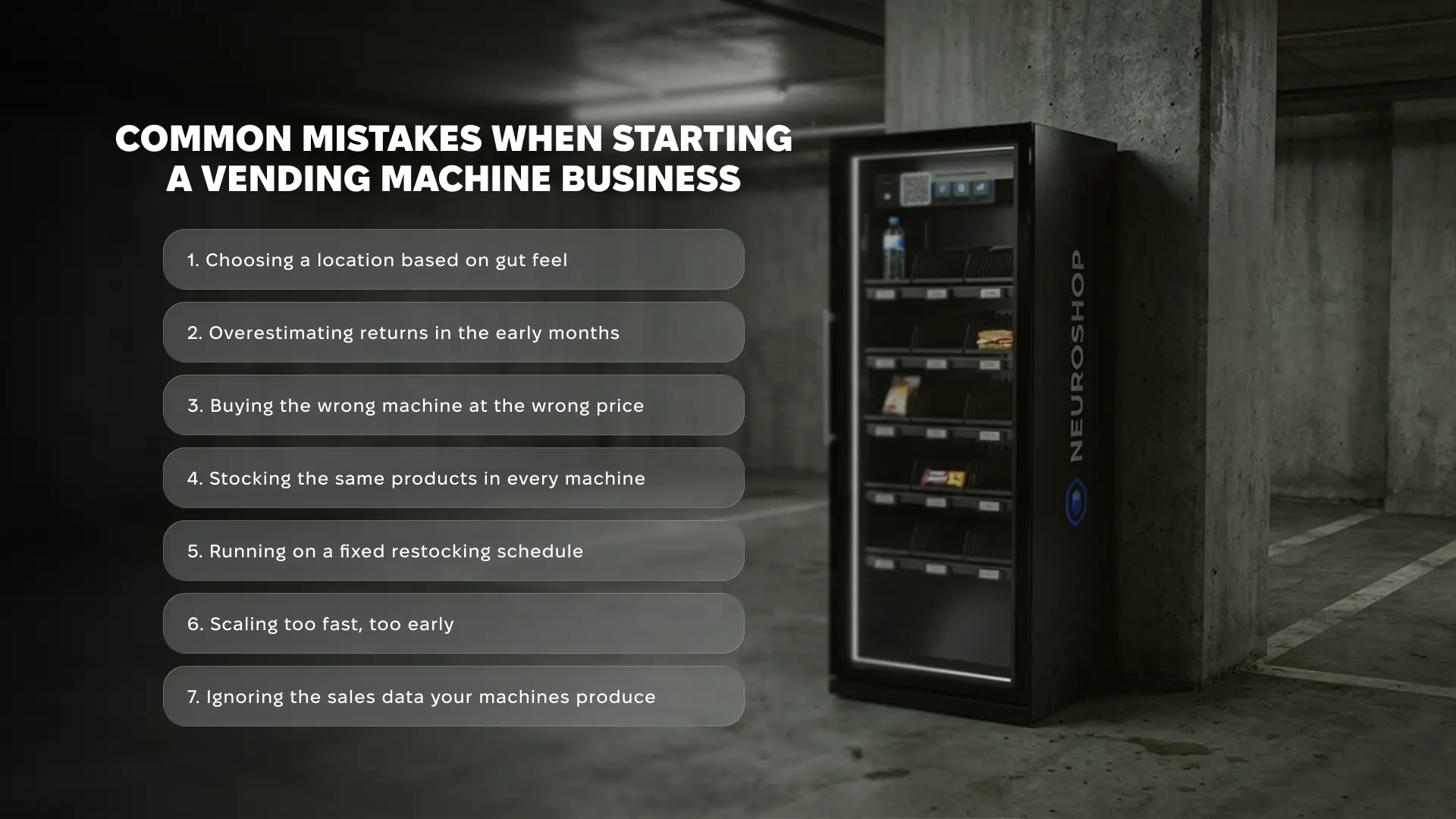
Starting Smart: A Practical Checklist
Before placing your first machine:
- Confirm foot traffic at the location across multiple days and times
- Verify power access, installation clearance, and commission terms in writing
- Choose a machine with cashless payment and remote monitoring built in
- Build a conservative financial model using documented benchmarks
- Plan your product mix around the specific location’s demographic and peak hours
- Set up telemetry from day one so you have data to act on from the first week
Final Thoughts
The vending machine business has genuine income potential, and most of the common failure points are avoidable with deliberate planning. The operators who build profitable routes do so by treating each machine as a data point in a system, adjusting based on what they observe, and scaling only when the fundamentals are proven. Neuroshop’s platform is built for operators who want to manage their machines the way a retail business manages shelf space.
Frequently Asked Questions
How much does it realistically cost to start a vending machine business?
A single quality machine with cashless payment capability typically costs €2,000 to €6,000. Adding location fees, initial inventory, insurance, and route costs, a realistic starting budget for two machines sits between €6,000 and €15,000, depending on machine type and market.
How do I find good locations for vending machines?
Target environments with 50 or more daily visitors and limited nearby food or drink alternatives, such as office buildings, factories, gyms, and transit facilities. Visit at different times of day to verify actual traffic, and agree on commission terms before committing to any site.
How often should I restock my vending machines?
Frequency depends on sales velocity at each location. Demand-based restocking, triggered by stock threshold alerts, is more efficient than calendar-based scheduling. Connected machines with telemetry let you build routes around actual need, which reduces unnecessary visits.
What products sell best in vending machines?
This depends heavily on location type and customer demographic. Office locations tend to favour premium snacks and coffee. Gyms often see stronger sales on protein bars and sports drinks. Tracking sales data at the SKU level for each location is the reliable way to optimise product mix over time.
Do I need a licence or permit to operate a vending machine?
In most European countries, yes. Requirements vary by country and municipality, covering trade registration, food business notification, and in some cases local placement permits. The Neuroshop vending machine licensing guide for Europe covers the country-by-country requirements in detail.
When should I consider upgrading to an AI micromarket?
An AI micromarket makes sense when a location has consistent daily traffic above 80 to 100 people, limited food options nearby, and a demographic that responds well to a broader product range. The format supports higher average transaction values and provides richer sales data for ongoing optimisation.

