Adding machines feels straightforward at first. One becomes three, three becomes eight, and somewhere around ten the strain starts to show. Restocking takes longer, locations underperform without a clear reason, and tracking revenue across the route becomes a spreadsheet exercise that eats your evenings. Scaling a vending machine business depends less on how fast you add machines and more on whether your systems can support them. This guide covers the decisions operators face at each growth stage, from choosing the right expansion order to building the infrastructure a 50-machine route actually needs.
Establish Your Unit Economics Before You Expand
Most operators who struggle at scale made the same error early on: they added machines without confirming what their profitable locations had in common. Before buying machine number two or three, you need a clear picture of what’s working.
For each location in your current network, track:
- Gross revenue per machine per month
- Cost of goods sold, including spoilage
- Time spent on each restocking visit
- Location commission or rent as a percentage of revenue
Once you have that data, you’ll see which machine types and location categories generate real margin. That clarity shapes every purchasing and placement decision that follows. Operators who skip this step often find themselves owning 20 machines, only half of which are pulling their weight. Neuroshop’s guide to using vending machine sales data covers how to read machine-level performance and act on it practically.
Plan Your Growth in Stages
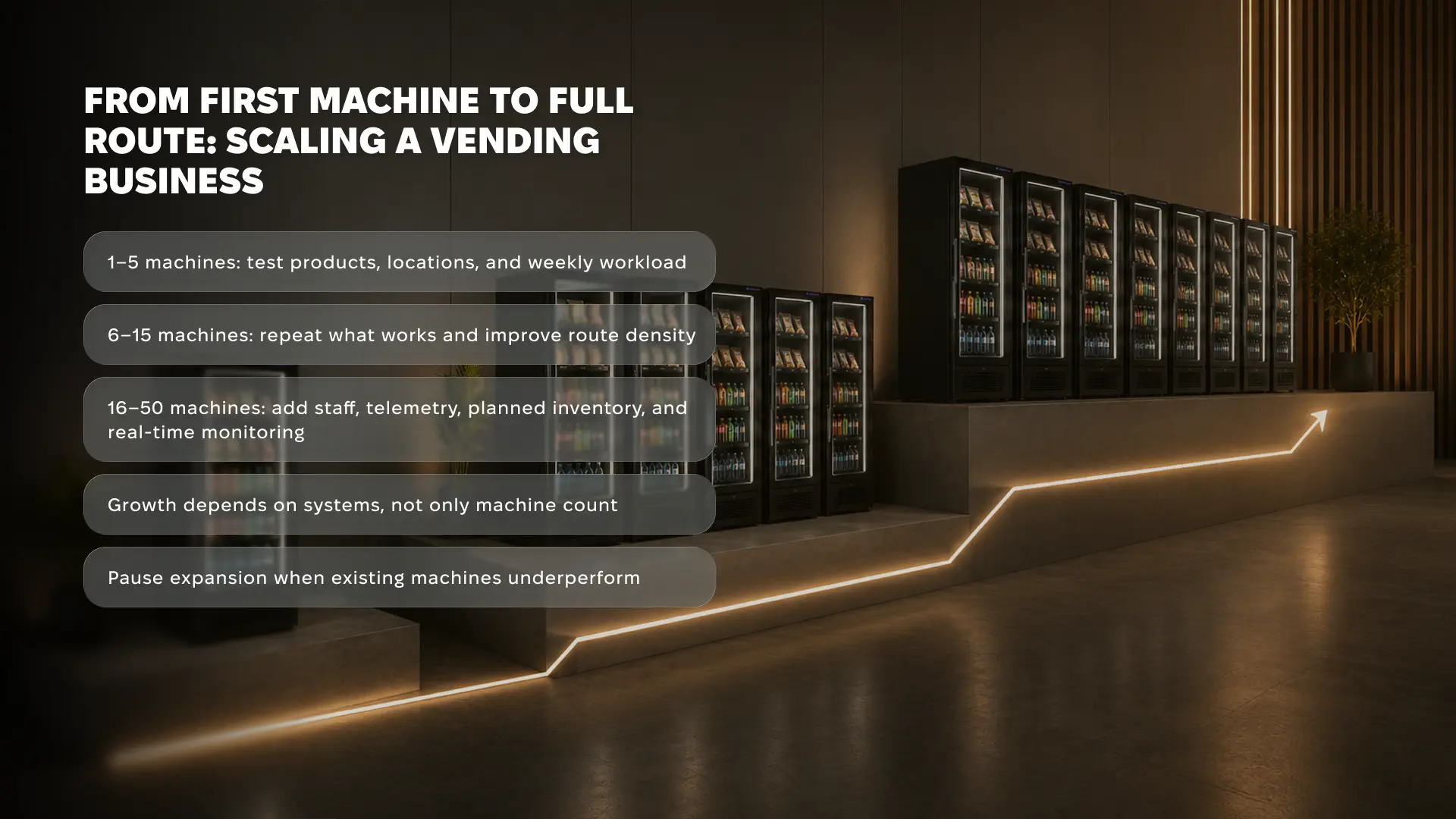
Scaling from 1 machine to 50 works best when structured in deliberate phases, each with a specific goal before moving to the next.
Phase 1: Machines 1 to 5
This phase is about learning. You’re establishing which product mixes sell, which location types perform, and how much time your route actually requires each week. Keep machine types consistent at this stage. Mixing formats too early makes it harder to draw useful conclusions from the data.
Phase 2: Machines 6 to 15
Here the goal is proving repeatability. Identify two or three location profiles that reliably generate strong volume, such as office buildings with over 100 staff, mid-size gyms, or logistics warehouses. Machines in this phase should follow a template: same product range, pricing structure, and restocking schedule as your best performers.
Route efficiency also starts to matter more at this point. If you’re covering eight locations in a van, the order in which you visit them directly affects how much of your day restocking consumes. Plan geographically and build in density where possible.
Phase 3: Machines 16 to 50
This is where operations become a management job. You’ll likely need to hire a driver or part-time technician. Inventory purchasing has to move from ad hoc orders to planned buying cycles. And your visibility across the network needs to be real-time, not retrospective.
Operators running 20 or more machines without telemetry software typically find out about problems after the fact: an empty machine on a Monday, a card reader that’s been offline for three days, a location underperforming for six weeks without anyone noticing. Neuroshop’s telemetry platform gives you live visibility across your entire network, so you can manage by exception, responding only when alerts flag a genuine issue.
The Location Strategy That Holds at Scale
Good locations carry a growing route. Poor ones drag it down.
As you expand, apply a consistent qualification process before committing to any new site. One visit at one time of day tells you very little. Spend time at a site across different hours and days, count foot traffic, and assess whether the people there actually buy vended products.
A scalable location checklist:
- Daily active foot traffic above 80 people in the machine’s immediate area
- Limited nearby food or drink alternatives during working hours
- Secure, covered installation point with accessible power supply
- Site contact willing to sign a written placement agreement
- Commission terms that keep the location viable during lower-revenue months
Formal agreements from the start protect you as the route grows. Informal arrangements that work fine at one machine become disputes at scale, when revenue is higher and there is more at stake on both sides. Our post on common mistakes when starting a vending machine business covers location errors in detail.
Building a vending machine route across Europe?
Neuroshop's AI vending machines give operators real-time data, remote diagnostics, and hardware built for high-volume locations.
Machine Selection and Technology at Scale
Machine choice matters more at 30 machines than it does at 3. When you’re covering a large route, servicing time and downtime frequency are real operational costs.
Older or low-cost machines tend to generate a disproportionate share of maintenance calls, jams, and payment failures. At small scale, you absorb that friction. At large scale, a machine needing attention twice a month across 15 units is a significant labor cost.
When evaluating machines for a growing route, prioritise:
- Cashless payment support, including card, contactless, and mobile
- Remote telemetry and low-inventory alerts
- Reliable mechanisms suited to your product range and temperature requirements
- Parts availability and service support in your operating region
Neuroshop’s AI micromarkets and fridge vending machines are built with route operators in mind, with remote monitoring integrated into the hardware from the start.
Staffing, Inventory, and Cash Flow
At five machines, one person manages everything. At twenty-five, that stops being realistic.
Hiring your first employee, usually a driver or restocking assistant, typically becomes necessary somewhere between machines 12 and 18. The key is to document your process clearly before that hire. Training becomes a bottleneck if your methods only exist in your head.
On the inventory side, bulk purchasing pays off once enough machines are consuming the same products consistently. Establish supplier relationships early, understand your lead times, and keep a small buffer on your fastest-selling lines. One stockout at your best location during a peak week is a recoverable problem. Recurring stockouts affect both margin and location relationships.
Cash flow planning also grows more critical as you expand. Buying three machines at once means capital going out before revenue comes in. Model your expansion schedule against your actual cash reserves, not just your projections.
Operating food vending machines across Europe?
Neuroshop's AI vending machines produce the compliance records inspectors require.
Knowing When to Pause Before Adding More
Fifty machines is not the right target for every operator. Some routes are highly profitable at 20 machines with one person running them efficiently. Others require significant infrastructure to support 50. At each stage, the useful question is whether the next machine adds to your margin or only to your workload.
If existing machines are underperforming and you respond by adding more locations, you’ll compound the problem. Fix the current network first, then grow.
Conclusion
Scaling a vending business is a sequential process. Each phase introduces new demands: sharper data at the start, route efficiency in the middle stages, and operational infrastructure toward the top end of a large network. The operators who build profitable 50-machine routes tend to have one thing in common: they spent time at each stage making sure the foundation held before adding more machines to it. That discipline, applied consistently, is what separates a well-run growing route from one that’s simply bigger.
FAQ
How many machines do I need to make vending a full-time income? Most operators reach full-time income levels somewhere between 15 and 25 well-placed machines. The exact figure depends on your location quality, product margins, and how efficiently you run the route day to day.
What’s the biggest operational challenge when scaling a vending machine business? Route efficiency and real-time visibility are the two most common pressure points. Without telemetry software, operators spend significant time on reactive visits instead of planned restocking cycles, which limits overall route capacity.
Should I hire staff before or after reaching a certain machine count? Most operators find their first hire necessary somewhere between machines 12 and 18. Hiring slightly before that point gives you time to train properly, without service quality suffering during the handover period.
How do I fund machines 4, 5, or 6 without taking on too much debt? Reinvesting profits from existing machines is the lowest-risk method. Some operators negotiate payment plans with suppliers directly, or apply for equipment financing once they have documented monthly revenue to present to lenders.
What technology do I need to manage a vending route at 30 or more machines? Telemetry software providing live sales data, low-stock alerts, and machine diagnostics is the minimum. Route planning tools and a structured inventory system significantly reduce the time each machine demands per week.

