For vending machine operators in the US, ADA compliance is a legal requirement with real financial consequences. A first violation can cost $55,000. This guide covers what ADA compliance means for vending machines, which operators it applies to, and the practical steps to bring machines up to standard, whether you manage one unit or a fleet of fifty. Each section maps directly to the rules inspectors and auditors use, so you can work through your operation with confidence.
Why this matters beyond the fine
The ADA was enacted in 1990 to prevent discrimination against the roughly 61 million US adults who live with some form of disability. For vending operators, the practical effect is straightforward: a machine someone cannot physically reach or operate excludes paying customers. Fines are the enforcement mechanism, but the underlying obligation is simple. If your machine is in a public or semi-public setting, it needs to work for everyone who walks up to it.
What Is ADA Compliance for Vending Machines?
The Americans with Disabilities Act (ADA), enforced by the Department of Justice (DOJ), sets accessibility standards for facilities and services open to the public. These rules apply to vending machine operators, not manufacturers. The responsibility sits with you once a machine is installed.
The ADA is administered by two federal bodies. The US Access Board develops and maintains the technical guidelines. The DOJ and the Department of Transportation (DOT) translate those guidelines into enforceable law. For vending operators, the relevant enforceable document is the ADA Standards for Accessible Design, which sets the physical specifications your machines must meet.
ADA vending machine requirements focus primarily on accessibility for wheelchair users, covering the physical placement of controls, the floor space around the machine, and how operable parts are positioned.
Who Needs to Comply?
Not every machine automatically falls under ADA rules. The key test is often called the “Upside Down Rule.”
If a vending machine is bolted down, secured to the wall, or connected to the building via electrical or plumbing, it is considered a permanent fixture and must comply. If the machine would fall if the building were flipped upside down, meaning it is entirely freestanding and unattached, it may be exempt.
In practice, most commercial vending machines are secured. If yours are, the requirements below apply to you.
ADA-compliant vending machines are required in:
- Government and public-sector facilities
- Hotels, hospitals, and healthcare settings
- Schools, universities, and educational campuses
- Retail environments, malls, and shopping centres
- Airports, transit hubs, and entertainment venues
If you have multiple machines of the same type at one location, at least one of each type (snack, drink, food, coffee) must be fully ADA compliant.
Key ADA Requirements for Vending Machines
The physical specifications below come from the ADA Standards for Accessible Design, administered by the US Access Board and the Department of Justice. These remain the current enforceable law for vending machine hardware. The regulatory picture is actively moving for modern touchscreen units — covered in the next section.
Reach Range
All operable parts, including buttons, coin slots, card readers, bill acceptors, and product dispensing areas, must fall within the accessible reach range:
- Minimum height: 15 inches from the floor
- Maximum height: 48 inches from the floor
The previous standard allowed a maximum of 54 inches. Any machine installed or significantly altered after March 2012 must meet the 48-inch ceiling.
Floor Clearance
Wheelchair users need physical space to approach and use the machine. The minimum requirements are:
- 30 inches × 48 inches of clear floor space directly in front of the machine
- The user must be able to get within 10 inches of the machine to reach all operable components
- 48 inches of clearance when positioned parallel to the machine, to accommodate mobility devices
Operable Parts
Controls must not require tight grasping, pinching, or twisting of the wrist to operate. The maximum force allowed to activate a control is 5 pounds. Touchscreens present a particular challenge. If your machine uses a touchscreen interface, it must offer alternative input methods such as physical buttons or voice guidance, or be designed with height and reach in mind.
What’s Changing: Proposed Rules for Modern Vending Machines
The physical reach and clearance requirements above still apply. However, they were written before touchscreen vending became standard, and the US Access Board has formally acknowledged this gap.
In September 2022, the Access Board issued an Advance Notice of Proposed Rulemaking specifically covering Self-Service Transaction Machines (SSTMs), a category that now explicitly includes modern touchscreen vending units. A proposed rule followed in May 2024. Once the Access Board finalises its technical standards, the DOJ runs its own rulemaking before anything becomes enforceable law, so formal changes may still be some time away.
What the proposed rules are likely to add, based on the Access Board’s published guidance:
- Speech output and audio assistance for users with visual impairments, covering transaction confirmations, error messages, and product information
- Braille instructions or tactile keypads as alternatives to touchscreen-only interfaces
- Screen privacy so that audio output can be used without broadcasting personal information to bystanders
- Timeout extensions so users with motor impairments are not timed out mid-transaction
None of these are enforceable requirements yet. Operators buying new equipment or planning fleet upgrades who build these features in now will be ahead of the curve when the rules are finalised.
Operating food vending machines across Europe? Neuroshop's AI vending machines produce the compliance records inspectors require.
Safe Harbor Rules: When Existing Machines Are Exempt
If your machine was installed before the 2012 standards came into force, and the building has not been altered and the machine has not been replaced or moved, safe harbor rules may apply. You are not required to retrofit the machine to meet the current standard.
The moment a machine is relocated, the location undergoes renovation, or you replace a unit, the current standards apply in full. Worth knowing if you are planning any site changes or equipment upgrades. Understanding common mistakes vending operators make, including overlooking compliance during machine swaps, can save significant cost down the line.
How to Audit Your Machines: A Step-by-Step Checklist
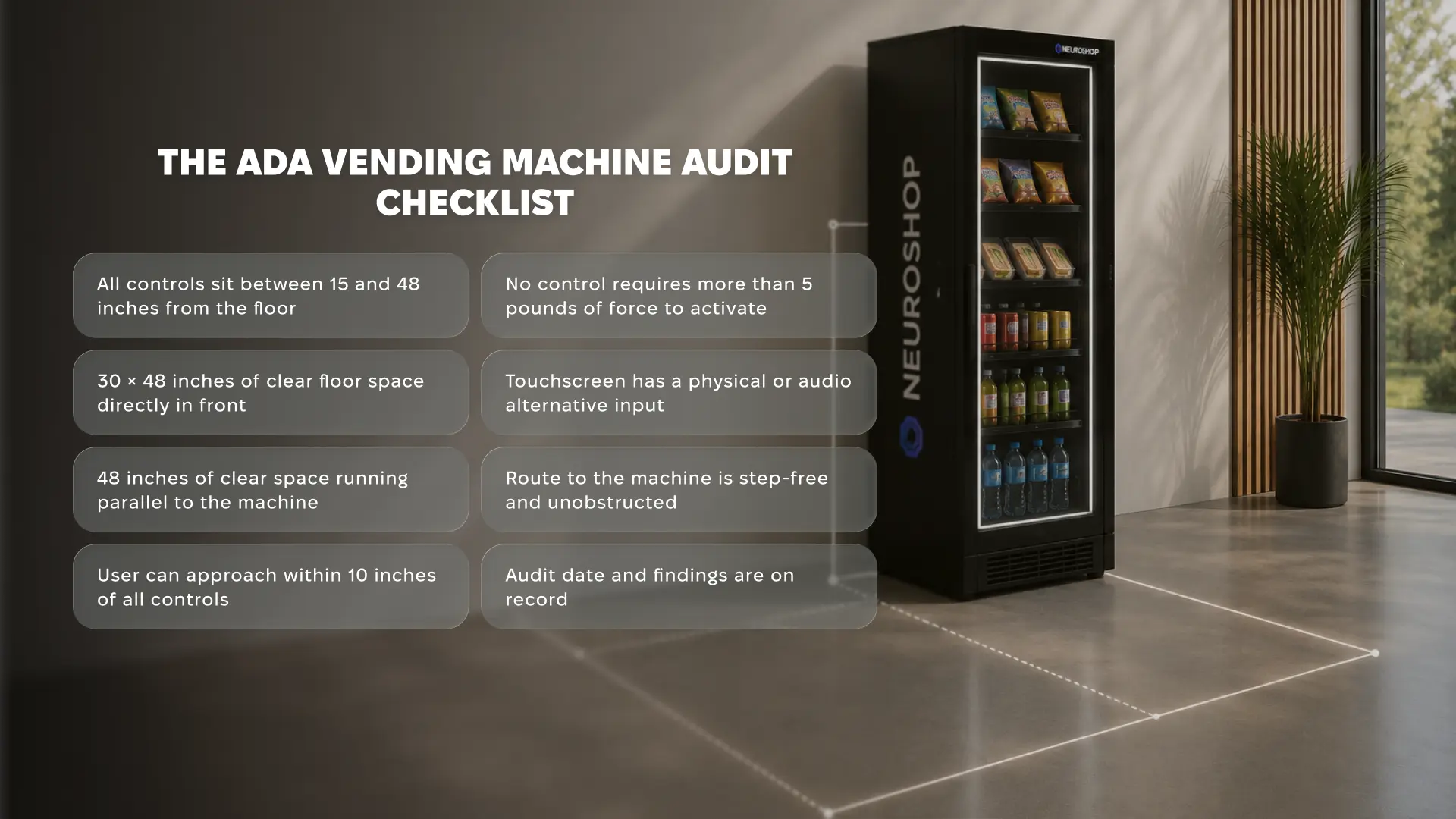
A compliance audit does not need to be complex. Work through each machine with a tape measure and the following checklist:
- Identify the machine type. Confirm whether it is bolted, secured, or connected to the building. If yes, proceed.
- Measure operable part heights. Check every button, coin slot, card reader, and dispensing opening. All must fall between 15 and 48 inches.
- Check floor clearance. Measure the clear floor space in front of the machine — 30 × 48 inches minimum.
- Test side clearance. Confirm 48 inches of unobstructed space running parallel to the machine.
- Verify approach distance. Ensure a wheelchair user can get within 10 inches of all controls.
- Assess the route to the machine. Check for stairs, narrow doorways, or heavy doors without automatic openers. An accessible machine placed behind inaccessible infrastructure is still non-compliant.
- Test operating force. Confirm that buttons and controls can be activated with 5 pounds of force or less.
- Document everything. Keep dated records of your compliance checks. This is useful if a complaint is ever filed.
Neuroshop’s AI vending machines are built with accessibility in mind from the hardware up. Payment terminals are positioned within the ADA-compliant reach range, open-door browsing removes the need for button-heavy selection interfaces, and app-based checkout gives users with limited dexterity a frictionless alternative to physical controls. If you are sourcing new equipment and want to avoid retrofitting for compliance later, get in touch with the team to discuss your location requirements.
Going Beyond Minimum Compliance
Meeting the baseline is the legal floor, not the ceiling. Operators who treat accessibility as a genuine business priority often see tangible returns.
Practical enhancements worth considering:
- Cashless and contactless payment options make machines more accessible to users with limited dexterity. Neuroshop’s AI micromarkets support Apple Pay, Google Pay, and app-based payment as standard.
- Audio guidance assists visually impaired users in navigating menus and confirming purchases.
- Well-lit interiors and clear signage reduce friction for users with cognitive or visual impairments.
- Remote monitoring tools let you flag accessibility issues, such as blocked floor space or malfunctioning buttons, before they become complaints. Read more about how vending machine sales data supports proactive decision-making across your operation.
For operators managing compliance across multiple sites, Neuroshop’s platform produces the automated logs and remote monitoring data that make audits straightforward. Temperature records, transaction histories, and access event logs are all stored centrally. This is the kind of documentation that food safety inspectors and accessibility auditors expect when reviewing unattended retail operations, and having it generated automatically removes the manual overhead of keeping records site by site.
ADA Compliance and European Operations: What’s Different
ADA regulations are US law and do not apply in Europe. However, European operators face their own accessibility and compliance landscape, shaped by EU directives and national regulations covering food safety, labelling, and unattended retail.
The European Accessibility Act (EAA) came into force in June 2025 and introduces accessibility requirements for self-service machines and digital interfaces across EU member states. The technical benchmark for digital compliance in Europe is EN 301 549, the EU’s procurement standard for ICT products and services, which aligns with WCAG 2.1. Operators running machines in offices, transport hubs, and public venues need to account for both the physical accessibility requirements and the digital interface standards that now apply to their screens and payment terminals.
For operators managing smart vending deployments across the EU, built-in compliance tools make a real difference. Neuroshop’s AI vending machines include real-time temperature logs, remote monitoring dashboards, and automated reporting, covering the documentation that auditors and inspectors expect in any EU country.
Operating food vending machines across Europe? Neuroshop's AI vending machines produce the compliance records inspectors require.
Conclusion
ADA compliance for vending machines requires attention to specifics: reach heights, floor clearance, operable force, and installation type all matter. Audit regularly, document your findings, and treat each machine upgrade as an opportunity to meet current standards. Operators who build accessibility into their processes from the start are better positioned legally and commercially.
Frequently Asked Questions
Do all vending machines need to be ADA compliant? No. ADA compliance applies to machines that are bolted down, secured, or connected to a building. Entirely freestanding machines may be exempt under the “Upside Down Rule.” In practice, most commercially installed machines are secured and must comply. Physical standards are set by the US Access Board and enforced by the DOJ.
What is the maximum height for vending machine controls under ADA rules? Since 2012, the maximum height for any operable part, including buttons, payment readers, and dispensing areas, is 48 inches from the floor. The previous standard was 54 inches. The minimum height is 15 inches, so wheelchair users can reach from below as well.
Who is responsible for ADA compliance — the operator or the property owner? The vending machine operator is primarily responsible for ensuring their machines meet ADA standards, not the manufacturer or building owner. If the machine is non-compliant, fines fall on the operator. Both parties may share liability in certain circumstances.
What happens if my vending machine fails an ADA inspection? The DOJ can issue fines starting at $55,000 for a first violation, rising to $110,000 for subsequent violations. The DOJ conducts periodic compliance checks, and complaints from individuals can trigger formal investigations. Early auditing is far cheaper than remediation after a fine.
Does ADA compliance apply to touchscreen vending machines? Yes. Touchscreens must be within the accessible reach range and operable without excessive force. If a touchscreen cannot be used by someone with limited dexterity, the machine must provide an alternative input method such as physical buttons or audio-guided selection to remain compliant.

