Most retailers discover a pricing error after a customer complaint, not before it costs them a sale. Fixed manual processes, paper tag reprints, and zero visibility between shelf and checkout create operations that quietly leak margin at every update cycle. Electronic shelf labels solve this at the operational level. This guide covers what an ESL is, how a complete system is built, which communication and display technologies are in use today, and how installation works in practice.
What an Electronic Shelf Label Is
An electronic shelf label is a wireless digital display mounted on a retail shelf edge. It shows pricing, product information, and promotional data, and receives updates from a central management system with no physical staff involvement. The term is used interchangeably with digital price tag, electronic price tag, and ESL price tag. All refer to the same category of device. The defining feature is the wireless connection between the label on the shelf and the software system controlling it.
What Does an ESL System Consist Of?
Modern vending machines rely on a range of innovative vending technologies that continue to develop each year. A complete electronic shelf label system has three components:
- The labels themselves. Each ESL is a self-contained unit with a display screen, a wireless receiver, and a battery. Most labels run on a single charge for several years under normal operating conditions, making battery replacement an infrequent task.
- The communication infrastructure. Labels receive data through a dedicated wireless network, typically consisting of gateway devices installed at intervals across the selling floor. The ESL Gateway ships pre-configured with each Neuroshop deployment. It connects via Ethernet or WiFi, covers up to 15 meters, supports up to 2,000 labels simultaneously, and handles battery monitoring, loss detection, and update confirmation in real time.
- The central management software. This is where pricing and product data is managed and pushed to labels. It can be a dedicated ESL control panel like Neuroshop’s web-based platform, direct integration with an existing ERP or POS system, or both. Updates triggered in the back-end propagate to every relevant label automatically.
Types of Electronic Shelf Labels
Display technology determines readability, energy use, update speed, and long-term running costs. Three types account for most commercial deployments today.
Neuroshop exclusively offers e-ink electronic shelf labels in standard Fridge ESL and cold-zone Freezer ESL variants, because e-ink outperforms other display types on battery life, shelf readability, and cost of ownership. The range runs from compact 1.54″ shelf-edge tags up to 12.5″ large-format signage.
#1 E-Ink (Electronic Paper Display)
E-ink is the dominant technology in ESL deployments and the display behind every Neuroshop label. It works by moving charged particles between two surfaces to form visible text and images. The image stays visible without any power draw once set, and the label only consumes energy during the update cycle itself.
What e-ink provides:
- Battery life of up to 7 years in ambient environments; up to 3 years in freezer-rated units
- High readability under all standard store lighting, including direct overhead fluorescent
- No backlight required, which eliminates glare at shelf-edge viewing angles
- Consistent image quality up to 180-degree viewing angles
- 3 or 4-color display options (black, white, red, yellow) for promotional highlights and category color-coding
Neuroshop’s e-ink ESLs include 7-color LED indicators for picking tasks, low-stock alerts, and planogram changes, plus built-in NFC for customer-facing interactions directly from the shelf edge. E-ink is the right choice for grocery, pharmacy, and general retail where battery life and readability take priority over refresh speed.
#2 LCD (Liquid Crystal Display)
LCD labels use a liquid crystal layer controlled by electrical current. Unlike e-ink, an LCD requires continuous power to maintain its image, which substantially reduces battery life. This limits LCD labels to applications where a power source is available or frequent battery replacement is acceptable.
What LCD provides:
- Faster refresh rates, suited to high-frequency price changes
- Backlit display options for low-light environments
- Full-color display without the cost premium of color e-ink
- Higher brightness for large-format labels viewed from a distance
- Greater sensitivity to temperature extremes, which limits cold chain use
LCD labels appear most in electronics retail, fuel forecourts, and display-heavy environments where battery replacement is part of a routine maintenance cycle.
#3 Segmented Display
Segmented displays use fixed character segments to render numbers and a limited character set, similar to a digital clock face. The most limited format in terms of information density, but durable and cost-effective for pure price display.
What segmented displays provide:
- Very low energy consumption, comparable to e-ink in some implementations
- High contrast in bright ambient light
- Simple content only: price, unit, and basic product code
- Lower unit cost than full-matrix e-ink or LCD
- Long operating lifespan with minimal display degradation
Common in bulk retail, fuel pricing, and settings where extended product information on the shelf edge is not needed.
What Is Electronic Shelf Label Technology for Communication
Display technology determines what you see. Communication technology determines how reliably and quickly that information arrives. The wrong approach for a given store size or layout produces coverage gaps, slow updates, and labels that fall out of sync with live pricing.
RF (Radio Frequency) — 2.4 GHz and Sub-GHz Protocols
RF is the most widely deployed communication method in commercial ESL systems. Labels receive data wirelessly from gateway devices, each covering a defined radius across the selling floor.
Neuroshop’s ESL Gateways communicate over a dedicated RF network. Each covers up to 15 meters and supports up to 2,000 labels. A single store can carry up to 99 gateways, making the infrastructure scalable from a small convenience format to a full hypermarket floor. Gateways come pre-configured and connect via Ethernet or WiFi, with no on-site network engineering required.
Key characteristics of RF communication for ESLs:
- Updates reach labels within seconds of approval in the management software
- Gateway health, label battery levels, and update confirmation are monitored in real time
- ESL loss detection is built into the gateway layer, so missing or displaced labels are flagged automatically
- Labels retain their last information during connectivity loss and resync when the connection restores
- A dedicated local network deployment is available for stores with restricted internet access
Infrared (IR)
IR communication relies on line-of-sight transmission between ceiling-mounted transceivers and shelf labels. It works in simple store layouts but struggles where shelving height or store fixtures interrupt the signal path. IR has largely been replaced by RF in new installations, though it remains active in older ESL estates.
NFC (Near Field Communication)
NFC operates at close range and serves a different purpose in ESL deployments. Its role is on the label face: customers tap a smartphone to access extended product information, a loyalty offer, or a QR-linked page. NFC is built into Neuroshop’s standard ESL labels as a standard hardware feature, separate from the update infrastructure.
Make Every Shelf Smarter Neuroshop's electronic shelf labels update in seconds and come pre-configured for fast deployment from a single store to a full retail network.
How Are Electronic Shelf Labels Installed
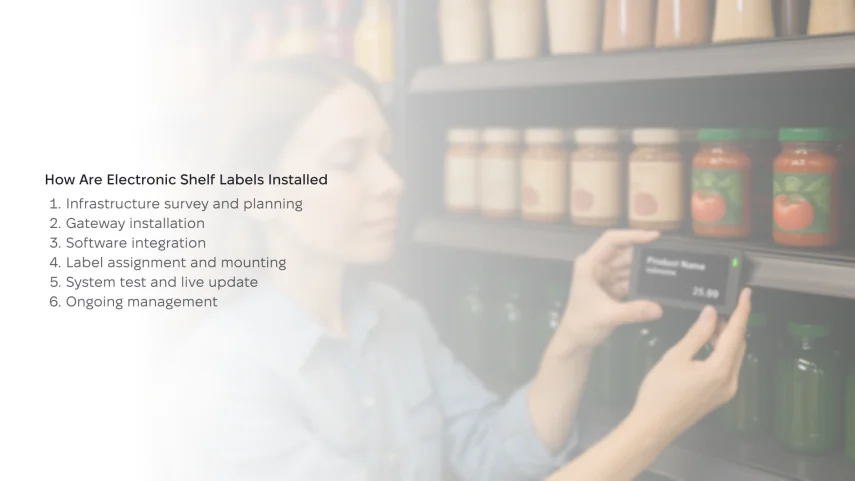
Installation divides between infrastructure setup and label deployment. Most commercial rollouts complete a mid-size store within one to three days. Neuroshop ships all hardware pre-configured, which removes the most time-consuming steps from a typical ESL setup.
- Infrastructure survey and planning. The store layout is mapped against wireless coverage requirements. Gateway placement is determined to ensure full coverage with no signal gaps, and any interference risks from existing wireless equipment are identified upfront.
- Gateway installation. Gateways are mounted throughout the selling floor, typically at ceiling height or on structural fixtures. Total count depends on store size and layout.
- Software integration. The Neuroshop control panel connects to the retailer’s ERP, POS, or pricing system. A price change entered once in the back-end pushes to every relevant label automatically, including scheduled promotions, flash sales, and AI-assisted dynamic pricing rules. Neuroshop supports bi-directional API integration, offline mode, and dedicated local network deployment. For a full overview of supported integrations, see the Neuroshop ESL integrations page.
- Label assignment and mounting. Each ESL is assigned to a product in the management system, then clipped or slid into standard shelf-edge mounting rails. Neuroshop ESLs fit existing rail profiles, so no shelving modifications are needed.
- System test and live update. A test update is pushed across the network to confirm every label receives and displays data correctly. Coverage gaps or assignment errors are resolved before go-live.
- Ongoing management. All updates run through the Neuroshop control panel or your ERP. Labels that stop communicating are flagged automatically in the dashboard. Replacing a label means assigning the new unit to the same product and position, with no surrounding reconfiguration needed.
Dynamic pricing rules, promotional templates, and AI-driven markdown schedules are configured once and execute automatically from that point forward. Once infrastructure is in place, launching a store-wide promotion is a software task. Learn more about how Neuroshop’s dynamic pricing with AI works across retail formats.
Conclusion
Electronic shelf labels replace a slow, error-prone manual process with a system that updates instantly and scales to any store size. E-ink display technology, reliable RF communication, and integrated management software make that possible in practice. Neuroshop’s ESL system combines all three: pre-configured hardware live from day one, a control panel covering everything from scheduled promotions to AI-powered dynamic pricing, and label variants for standard retail and subzero freezer environments. Contact the Neuroshop team to discuss deployment options.
FAQ
Are electronic shelf labels worth it? For retailers managing more than a few hundred SKUs, labor savings alone typically cover the investment within the first year. Reduced pricing errors, faster promotional execution, and dynamic pricing without manual relabeling add further value that paper systems cannot match.
How do electronic tags at grocery stores work? Grocery ESLs connect to the store’s central pricing system via a wireless gateway network. When a price changes in the back-end software, the update reaches the relevant shelf label within seconds, with no staff involvement at the shelf.
How long do electronic shelf labels last? Battery life depends on display technology and environment. Neuroshop’s standard e-ink ESLs last up to 7 years in ambient locations and up to 3 years in freezer environments. Batteries are field-replaceable and the hardware is built for long-term commercial use.
What are the pitfalls of electronic shelf labels? The main risks are poor wireless coverage causing labels to fall out of sync, integration gaps between the ESL platform and the pricing system, and incorrect label assignment at rollout. All three are avoidable with proper planning and a pre-configured system.
What is electronic shelf label technology and which type is best? ESL technology refers to the display method in each label: e-ink, LCD, or segmented display. E-ink delivers the best combination of battery life, readability, and low running costs for most retail environments. It is the only display type Neuroshop offers, and the right choice for deployments that include dynamic pricing and multi-year battery planning.

