Factories and warehouses run on tight schedules and shift rotations, leaving little room for workers to leave the floor in search of food, drinks, or supplies. Modern industrial vending machines manage PPE inventory, support multi-shift operations around the clock, and generate real-time data that helps operators cut waste and control costs. This guide covers everything you need to know about choosing, placing, and operating vending machines in manufacturing and warehouse environments.
Why Manufacturing Facilities Need Vending Machines
Most industrial environments have demands that standard office vending setups are simply not built for. Workers operate in shifts covering early mornings, overnight runs, and weekends, often without access to a canteen or a nearby store. Even a 10-minute trip off the floor adds up quickly across a large workforce.
The consequences of inadequate on-site access are practical and measurable:
- Lost productivity: Employees who leave the facility for food often extend breaks by 15 to 20 minutes
- Safety risks: Workers who skip meals on night shifts experience higher fatigue rates
- PPE shortages: Without automated dispensing, consumables like gloves and masks are frequently mismanaged or unavailable at the point of need
- Canteen gaps: Many facilities operate canteens for one or two meal windows only, leaving shift workers with no alternative outside those times
Two main solution types cover most industrial requirements. Food and beverage vending machines serve the nutritional needs of shift workers around the clock. Industrial vending machines (IVMs) are automated dispensing systems for tools, PPE, and MRO (maintenance, repair, and operations) consumables, with full tracking per user or department. Both are increasingly powered by AI, cloud connectivity, and cashless payment. Neuroshop builds all of these capabilities directly into its AI micromarket platform.
Types of Vending Machines for Industrial Settings
Choosing the right machine type depends on your workforce size, shift structure, and what workers need on site. The three formats below cover most manufacturing and warehouse use cases.
Food and Beverage Machines
A well-configured food and beverage setup for an industrial site typically includes:
- Snack and confectionery machines: protein bars, nuts, chocolate, chips
- Cold drink machines: water, energy drinks, juices, soft drinks
- Fresh food fridges: sandwiches, salads, ready meals, yoghurts
- Hot drink machines: bean-to-cup coffee, tea, hot chocolate
- Frozen food vending: frozen meals and meal prep items for longer shifts
Neuroshop’s AI fridge and freezer formats are built specifically for industrial environments. Products are stored at precise temperatures, 0°C to +8°C for fresh items and -24°C to -17°C for frozen, and tracked in real time using computer vision. Workers tap a card or scan the Neuroshop app, take what they want, and the system handles identification and payment automatically. No buttons, no scanning, no queues.
Industrial Vending Machines for PPE and MRO
The global industrial vending machine sector was valued at $1.6 billion in 2024 and is projected to reach $2.5 billion by 2029, driven by demand from manufacturing and logistics. Key items dispensed through these systems include:
- PPE: gloves, safety glasses, ear protection, hard hats, high-visibility vests
- MRO consumables: cutting tools, fasteners, lubricants, batteries
- Cleaning and hygiene supplies: sanitiser, wipes, cleaning agents
Each dispense is logged per employee via PIN, RFID badge, or biometric scan, providing inventory accountability that manual stores cannot match.
Micro Markets for Large Facilities
For sites with 200 or more employees, a micro market tends to outperform traditional vending in both revenue and employee satisfaction. Workers browse, pick up, and inspect products directly from open shelves or smart fridges, with self-checkout taking seconds. Micro markets in industrial settings typically generate 30 to 50% higher sales per location compared to standard enclosed machines, largely due to the expanded product range.
Key Benefits for Factory and Warehouse Operations
The right vending setup delivers measurable operational gains across productivity, cost control, and workforce wellbeing. Here is what facilities consistently report after installation.
24/7 Access Across All Shifts
A vending machine operates on every shift without additional staff or scheduling changes. Night crews, weekend workers, and overtime staff all get equal access to food, drinks, and safety supplies at any hour.
Reduced Downtime
On-site access keeps operations running smoothly:
- Workers rest during breaks instead of leaving to find food
- PPE is available at the point of need, without waiting on a centralised store
- Maintenance engineers access consumables without raising purchase orders
- Production stoppages caused by missing supplies are reduced
Inventory Control and Cost Savings
Industrial vending machines provide a digital audit trail for every item dispensed:
- Consumption data by employee, shift, and department: managers see usage patterns clearly
- Budget caps per user: daily or weekly limits on high-cost items
- Automatic reorder alerts: low stock is flagged before shortages occur
- Reduced over-ordering: actual consumption data replaces guesswork
Automated inventory management through vending typically reduces consumable spend by 20 to 30% compared to uncontrolled manual stores. Neuroshop’s telemetry platform delivers this visibility across all machines from a single dashboard, without requiring on-site visits.
Worker Welfare and Retention
Access to quality food and drink on every shift, especially overnight and in remote industrial locations, is a valued and practical workplace benefit. On-site food access consistently ranks in the top five workplace benefits for manual workers.
Ready to Equip Your Facility with Smart Vending? Neuroshop's AI micromarkets handle inventory tracking, temperature monitoring, and cashless payments automatically.
What to Stock
Getting the product mix right is what separates a performing setup from one that goes unused. Industrial workers have specific needs that differ from office employees, and stocking accordingly makes a significant difference to revenue.
- High-energy snacks: protein bars, nut mixes, beef jerky, energy drinks popular on night shifts, chocolate and confectionery
- Hot drinks: bean-to-cup coffee, tea, and soup cups, critical on early and overnight shifts
- Fresh meals: sandwiches, wraps, ready meals in sealed trays, salads, and breakfast items such as egg muffins and porridge pots. These are strong sellers before 8 AM in factories and logistics sites.
- PPE and safety: disposable gloves, safety glasses, ear defenders, FFP2/FFP3 respirators, high-visibility vests
- Hygiene: hand sanitiser, surface wipes, and basic first aid supplies where local regulations permit
For a deeper look at how Neuroshop’s smart fridges handle product recognition and restocking across different SKU types, see the computer vision technology overview.
Placement Strategy
Location determines how well any vending setup performs. A machine placed off the natural flow of worker movement will underperform regardless of the product selection inside it.
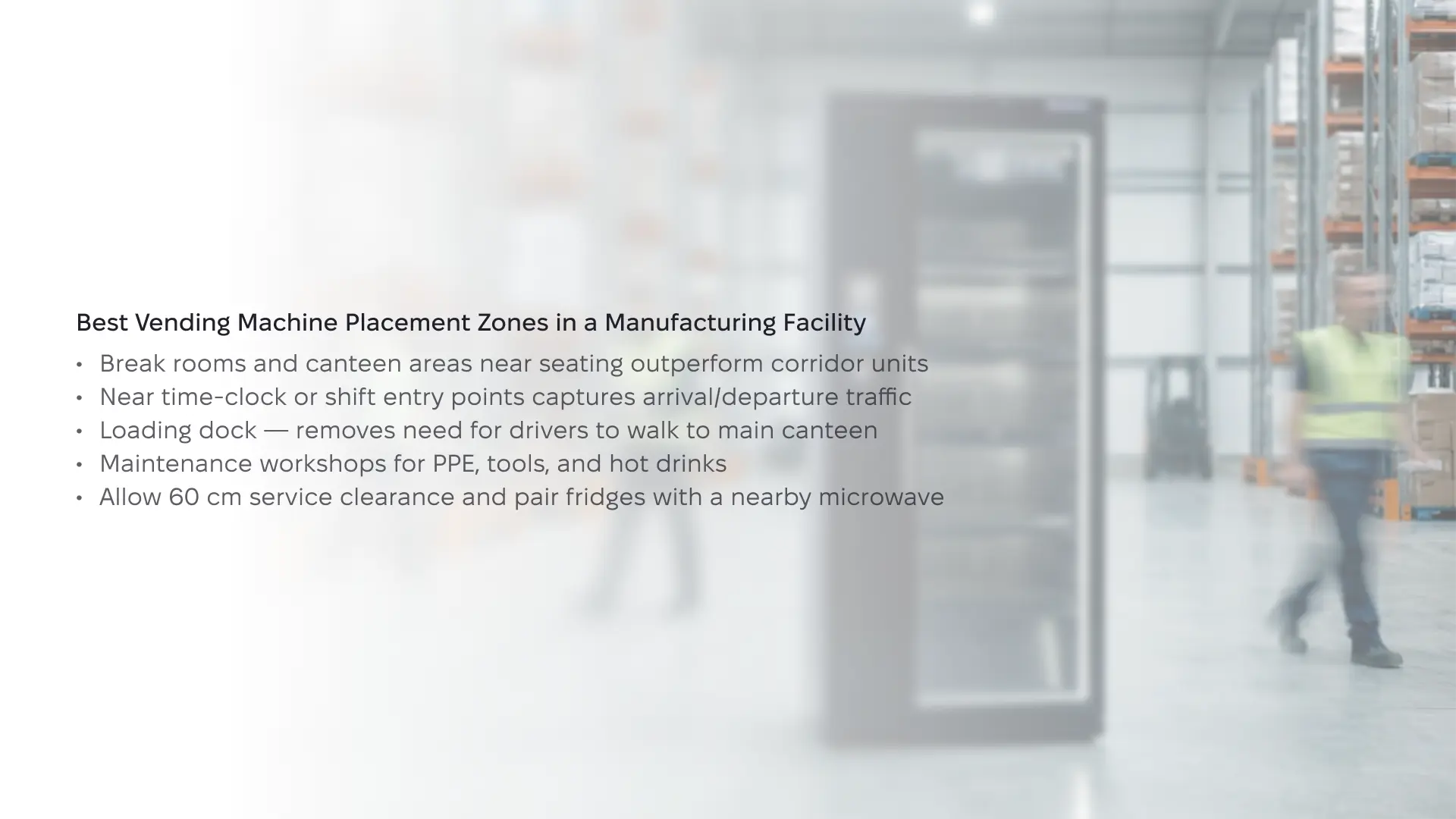
High-performing zones in manufacturing and warehouse facilities include:
- Break rooms and canteen areas: Machines near seating consistently outperform those placed in corridors
- Near time-clock or shift entry points: Workers arriving or leaving are prime buyers. Placement here captures traffic before and after breaks.
- Loading dock areas: Drivers and logistics staff have limited movement. A machine at the dock removes the need to walk to the main canteen.
- Maintenance and engineering workshops: A practical location for tool and PPE vending alongside hot drinks
General placement rules: position machines in natural foot traffic zones, ensure they are visible and well-lit, allow 60cm clearance on the service side, and pair fresh food fridges with a nearby microwave where there is no canteen.
Industrial Vending vs. Manual Stores
Many facilities manage PPE and consumables through a staffed stores room. Automated vending changes the economics of that model considerably.
| Factor | Manual Stores | Industrial Vending |
| Access hours | Limited to opening times | 24/7 |
| Transaction logging | Manual, often incomplete | Automatic, per-user, per-item |
| Stock visibility | Periodic manual count | Real-time cloud dashboard |
| Labour cost | Stores operative salary | Minimal |
| Shrinkage | High, difficult to audit | Low, every dispense is logged |
| Reorder process | Manual requisition | Automated alert |
| Payback period | N/A | Typically 6 to 18 months |
For facilities with consumable spend above £50,000 per year, automated vending typically pays back within 12 months through waste reduction, labour savings, and lower shrinkage.
Compliance Considerations
Compliance requirements vary by industry and product type, so it pays to understand what applies to your site before installation.
Fresh and refrigerated food sold through vending must comply with local food safety regulations covering temperature logging, expiry date management, and supplier traceability. Neuroshop’s platform logs temperature continuously and flags anomalies automatically, supporting compliance records without manual checks.
In regulated industries such as aerospace, chemicals, and pharmaceuticals, PPE dispensing must be traceable to named users. Industrial vending machines that log each transaction satisfy audit requirements and support ISO 45001 compliance. For machines placed in public-facing areas, confirm accessibility and reach standards with your supplier before installation.
Conclusion
For manufacturing and warehouse operations, a properly configured vending setup reduces unplanned downtime, supports workers on every shift, and brings consumables under proper inventory control. Neuroshop’s AI micromarket platform covers the full range of industrial use cases. Neural vision tracks every product taken from the cabinet in real time. The telemetry system monitors stock levels and machine health remotely. Cashless checkout via app, contactless card, or RFID badge keeps transactions fast and frictionless. Whether you need a single smart fridge for a night shift crew or a full micro market for a 500-person facility, Neuroshop has a format that fits.
Final Take
For any facility managing multiple shifts, consumable spend, and worker welfare, industrial vending delivers measurable ROI. Neuroshop’s neural vision, real-time telemetry, and app-based checkout perform as well on a loading dock as in a corporate break room.
FAQ
What types of vending machines are best for manufacturing facilities? Manufacturing facilities benefit most from food and beverage machines for worker nutrition combined with industrial vending machines for PPE and MRO consumables. Sites with 200 or more employees should consider a micro market setup, which offers a wider product range and higher revenue per location.
Can vending machines operate on overnight and weekend shifts in warehouses? Yes. Modern vending machines operate 24/7 without staff. Workers on night shifts, weekends, or overtime have full access to food, drinks, and safety supplies at any hour, making them particularly valuable in environments with rotating shift patterns.
How do industrial vending machines help control PPE and consumable costs? Industrial vending machines log every dispense to a specific user, department, or cost centre. This eliminates untracked withdrawals, reduces over-ordering, and gives management accurate consumption data. Most facilities report a 20 to 30% reduction in consumable spend within the first year of use.
What payment methods do warehouse vending machines support? Modern machines support contactless card, mobile wallet such as Apple Pay or Google Pay, QR code, and app-based payment. Many industrial deployments also integrate with existing RFID site access badges, so workers use the same card to enter the building and pay at the machine.
How do I choose the right vending machine supplier for a manufacturing site? Look for a supplier with experience in industrial environments. Key requirements include remote monitoring and real-time inventory alerts, temperature logging for fresh food, RFID or app-based payment, and a clear service agreement covering restocking and maintenance response times.

