Vending Machine Planogram: What It Is and How to Optimize It
Most vending machines don’t fail because of bad products. They fail because of bad placement. When a bestselling snack sits on the bottom shelf while a slow mover takes eye-level space, the machine quietly bleeds revenue on every visit. Restocking runs become guesswork, spoilage creeps up, and the operator rarely connects either problem to the layout.
A planogram solves this. It’s a documented, slot-by-slot layout that defines what goes where, how many facings each product gets, and how the overall arrangement guides purchasing behavior. This guide covers what vending machine planograms are, how to build one, and how to keep improving it over time.
What Is a Vending Machine Planogram?
A planogram is a visual diagram that maps how products are arranged inside a vending machine. It specifies which product sits in each slot, how many facings each item receives, and how categories are grouped across rows and columns. Facings refer to the number of visible product units a customer can see from the front of the machine.
The concept comes from traditional retail, where planograms guide supermarket shelf layouts. In vending, the constraints are tighter. A machine has a fixed number of slots, and each position is either earning revenue or wasting potential.
A well-designed vending machine planogram accounts for:
- Product dimensions and coil or column compatibility
- Sales velocity, meaning how quickly each item sells
- Customer demographics at that specific location
- Visual merchandising principles such as eye-level placement and color blocking
- Expiry dates and product rotation, following a first-in, first-out approach
Why Planograms Matter for Vending Operators
Strategic product placement can increase category sales by 12 to 20 percent. In unattended retail, customers decide within seconds. Layout has an outsized effect on that decision. Around 80 percent of vending purchases are impulsive, made based on what customers see first. That makes product placement a revenue decision, not an aesthetic one.
Beyond sales, planograms help in several practical ways. Knowing what sits in each slot makes restocking faster and more accurate. Proper rotation planning reduces spoilage and near-expiry waste. A documented planogram lets operators maintain consistent layouts across every machine in a network without relying on individual judgment or memory.
Performance tracking also depends on it. You can only measure the impact of a product’s position if you know what that position was. If you already analyse your vending machine sales data but haven’t connected it to layout decisions, you’re working with part of the picture.
How to Build a Vending Machine Planogram
Building a planogram doesn’t require specialist software, though it helps. Here’s a practical step-by-step process any operator can follow.
Step 1: Understand Your Location and Audience
Before placing a single product, establish who is buying and when. A machine in a hospital corridor serves different customers at different times than one in a university gym or a corporate office. Getting the right product assortment aligned to your location is the foundation of any effective planogram.
Step 2: Pull Your Sales Data
Identify your top 20 percent of products. These typically drive around 80 percent of revenue and should be treated as anchor SKUs. Slow movers either need repositioning to test whether visibility is the issue, or outright replacement.
Step 3: Apply Core Placement Rules
- Eye level rows (rows 2 and 3 in most machines) should hold your best-sellers and highest-margin items. Customers look here first and reach here most comfortably.
- Group products by category. Clustering drinks together and snacks separately reduces decision fatigue for customers making quick purchases.
- Alternate colours and sizes across the machine face to draw attention across the full display.
- Place low-consideration items, such as confectionery or small snacks, near the top where they are easy to spot and grab on impulse.
Step 4: Document and Distribute the Layout
Photograph the final arrangement. Record each product per slot in a spreadsheet or planogram tool. Share it with your restocking team. A planogram only works when it is followed consistently in the field.
Vending Machine Placement Guide by Zone
| Zone | Rows | Best Product Types |
|---|---|---|
| Eye level (premium) | 2–3 | Bestsellers, high-margin items |
| Top shelf | 1 | Lightweight snacks, impulse buys |
| Mid shelf | 4 | Secondary sellers, alternatives |
| Bottom shelf | 5–6 | Bulky items, lower-velocity products |
Operating food vending machines across Europe?
Neuroshop's AI vending machines produce the compliance records inspectors require.
Vending Machine Planogram Optimization: Ongoing Strategies
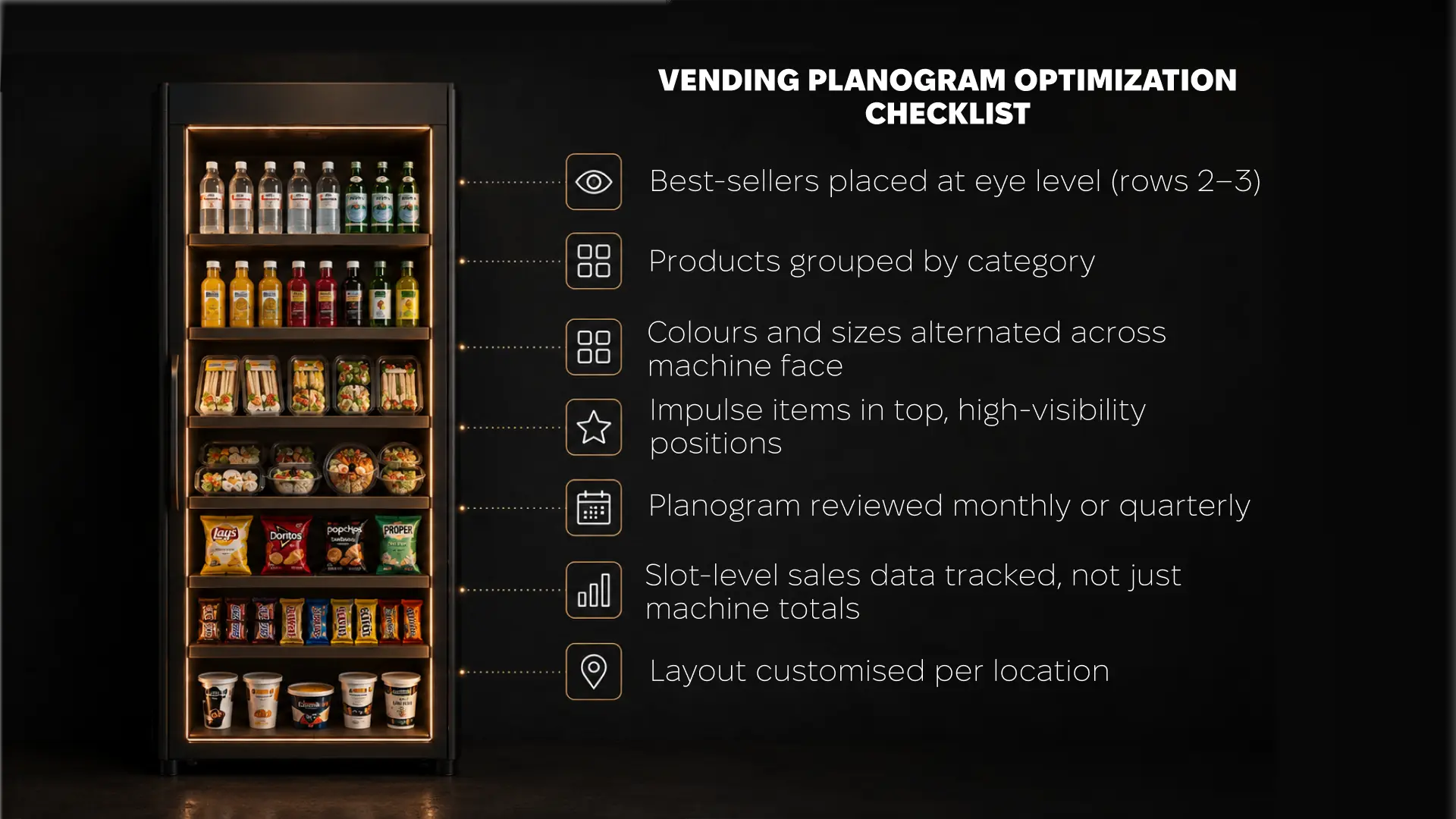
A planogram needs regular attention after it’s built. Monthly or quarterly reviews prevent stale layouts from dragging down performance. Seasonal shifts, new product launches, and changing customer habits all create valid reasons to adjust. Operators who only revisit the planogram when something goes wrong spend more time reacting than improving.
Testing layouts across similar machines gives reliable data. If you operate multiple machines at comparable locations, try different arrangements and compare results over a set period. This pairs naturally with a broader approach to vending machine sales techniques, and your own network data is more reliable than any industry average.
Slot-level tracking matters more than machine totals. Knowing a machine generates €500 per week is useful. Knowing that slot B3 sells out twice as fast as slot D5, and acting on that difference, is where meaningful optimization happens.
Watch out for these common planogram mistakes:
- Assigning eye-level slots to slow-moving products in an attempt to shift them — this rarely works and occupies your best real estate.
- Applying the same planogram across all locations regardless of audience differences.
- Updating the planogram document without updating the physical machine, or the reverse.
- Ignoring machine-specific constraints such as coil depth, product weight limits, or cooling zones in refrigerated units.
How Neuroshop Supports Smarter Planogram Decisions
Neuroshop AI vending machines and micromarket solutions are built for operators who make decisions from data. Real-time inventory tracking, sales analytics, and product recognition technology give slot-level visibility across your entire machine network, so planogram decisions come from evidence.
Neuroshop’s platform shows which products are selling, which slots are underperforming, and how placement changes affect revenue over time. This visibility applies whether you manage five machines or fifty. For operators focused on building a vending business, that level of insight gives planogram decisions genuine strategic weight.
Operating food vending machines across Europe?
Neuroshop's AI vending machines produce the compliance records inspectors require.
Conclusion
A vending machine planogram takes the guesswork out of product placement. Done well, it increases revenue, reduces waste, and ensures every slot earns its keep. The key is treating it as a document built on location data, sales performance, and consistent field review — one that gets revisited on a set schedule. Operators who combine deliberate planogramming with real-time analytics see consistent, measurable gains across their networks. If you want that level of control, Neuroshop gives you the tools to get there.
Frequently Asked Questions
What is a vending machine planogram? A vending machine planogram is a visual layout diagram that defines which product occupies each slot, how many facings it receives, and how products are grouped. It helps operators make placement decisions based on data, improving both sales and restocking accuracy.
How often should I update my vending machine planogram? Most operators benefit from reviewing planograms monthly or quarterly. High-traffic locations or machines with seasonal product ranges may need more frequent attention. Any time you introduce new products or notice a shift in sales patterns, a planogram review is worthwhile.
Does product placement really affect vending machine sales? Yes, significantly. Eye-level placement consistently outperforms upper or lower shelves. Impulse-buy products in high-visibility positions sell faster, and grouping products by category reduces decision fatigue for customers making quick, unplanned purchases.
What products should go at eye level in a vending machine? Rows two and three should feature your highest-margin products and fastest-selling SKUs. These generate the most revenue and customers are most likely to select them without scanning the full machine first.
Can I use the same planogram across all my machines? A shared template is a useful starting point, but machines serve different audiences. A gym location reflects different buying habits than an office building. Customising per location using local sales data consistently delivers better results than a fixed layout.

