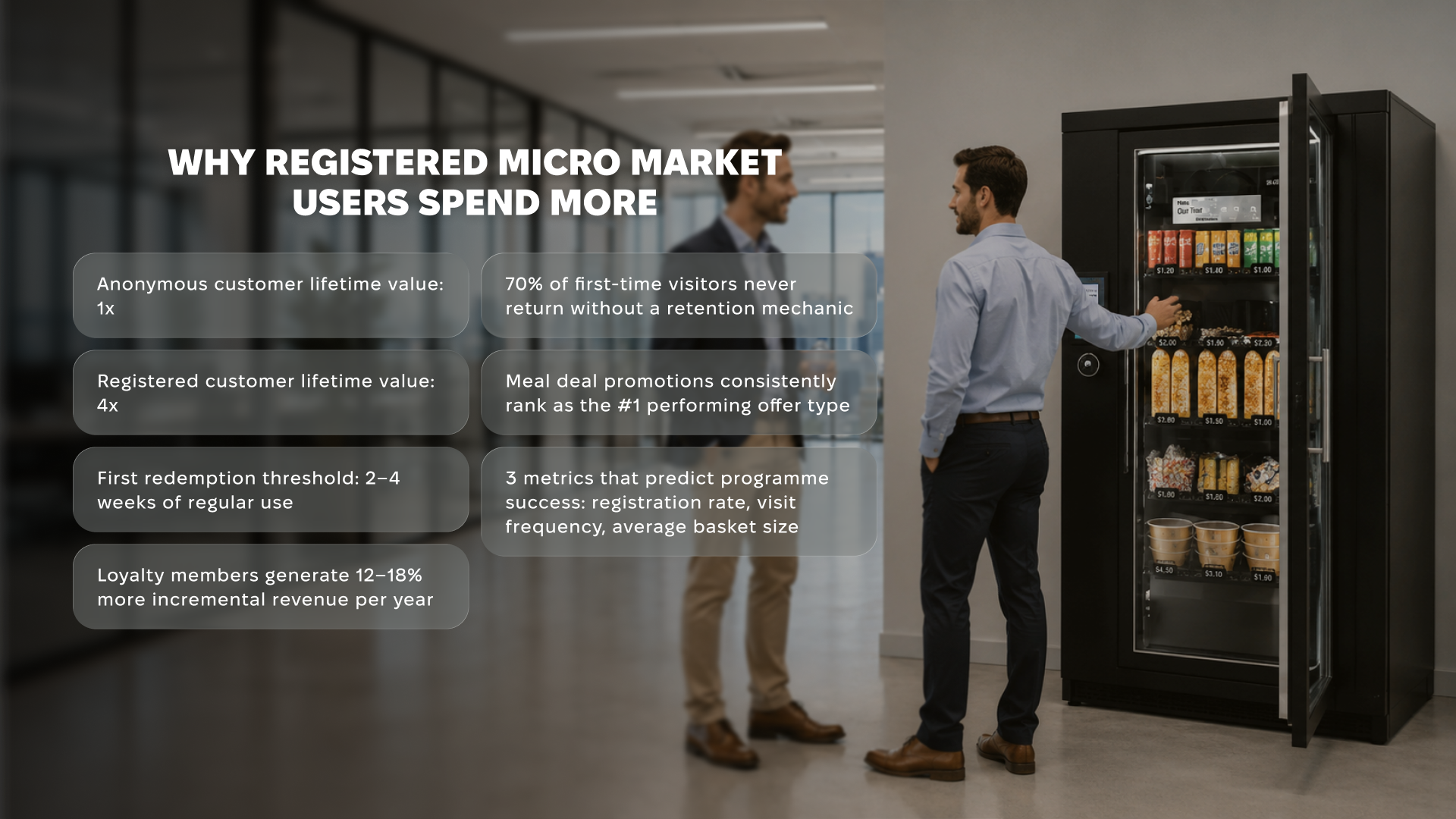
Around 70% of first-time micro market visitors never come back. In a closed environment like an office, factory, or university campus, the customer pool does not grow organically. When retention is low, revenue plateaus, and no amount of restocking optimisation fixes it. A loyalty program changes that equation by giving registered users a consistent reason to choose the micro market over the café on the corner or the lunch they brought from home. This guide covers what works, what to avoid, and how to set up a program that runs without adding manual overhead.
Why Loyalty Matters More in Micro Markets Than in Traditional Retail
Standard retail can compensate for poor retention by acquiring new customers. Micro markets cannot. The audience at any given location is essentially fixed, which means lifetime value per user is the metric that drives revenue growth.
Operators who treat micro market users as registered customers rather than anonymous transactions see meaningfully different results. One industry benchmark puts the lifetime value of a registered micro market customer at four times that of an anonymous one. The mechanism is straightforward: a registered user can be identified, rewarded, and re-engaged. An anonymous user disappears after each purchase.
Loyalty programs also produce a useful secondary benefit. Every registered transaction generates data: which products a user buys, at what time of day, and at what frequency. That data feeds better restocking decisions and more targeted promotions, which compounds the retention effect over time.
The Core Loyalty Structures and How They Compare
Not every loyalty model suits every micro market location. The right structure depends on the size of the user base, average transaction value, and how much the operator wants to manage actively.
| Reward Type | How It Works | Best For |
| Points per purchase | Users earn points for every euro or pound spent, redeemable for discounts or free items | High-frequency locations like offices and factories |
| Tier-based rewards | Spending thresholds unlock higher reward rates or exclusive products | Larger sites with 100+ daily users |
| Prepaid account bonuses | Users top up a digital wallet and receive a bonus credit on each load | Locations where payroll deduction is available |
| Combo or bundle deals | Discount applied automatically when two or more qualifying items are bought together | Locations with a strong lunch or meal-occasion purchase pattern |
| Punch card equivalent | Every Nth purchase earns a free item | Smaller locations where simplicity is a priority |
Points-based programs are the most widely adopted because the mechanic is familiar and the reward feels immediate. A default rate of 1 to 2 points per unit of currency spent gives users a tangible accumulation they can track, without the operator bearing an unsustainable redemption cost.
Operating food vending machines across Europe? Neuroshop's AI vending machines produce the compliance records inspectors require.
Setting Up a Loyalty Program: What Operators Need in Place
A loyalty program is only as useful as the data infrastructure underneath it. Before launching one, three things need to be in order.
- User registration. The program needs a way to identify individual customers. This is typically a loyalty card, an app, or a QR code linked to a registered account. Cashless payment through an existing app can handle both payment and identity in a single step, reducing friction at checkout.
- Transaction-level tracking. Each purchase needs to be recorded against a specific user ID. Without this, points cannot be awarded, redemption cannot be managed, and purchase history data is lost. Neuroshop’s telemetry platform captures this data at the SKU level across all machines in a location, giving operators the purchase history they need to run and optimise a loyalty program.
- A redemption mechanism. Users need a clear, accessible way to redeem points or rewards. The best implementations make redemption automatic at checkout once a threshold is met, removing the need for users to remember to claim anything manually.
How to Structure Rewards That Drive Behaviour
The goal of a loyalty program is not to reward purchases that would have happened anyway. It is to shift behaviour: to increase visit frequency, to lift basket size, and to win purchases that might otherwise go to a competitor.
A few structural choices make a measurable difference:
- Set the earn rate high enough that users reach the first redemption threshold within two to four weeks of regular use. Rewards that take months to reach do not change behaviour.
- Offer a first-purchase or registration bonus so users experience the reward mechanic immediately, before habit is established.
- Use bundle promotions to move the transaction from a single item to a meal occasion. Operators in the micro market sector consistently report that meal deals, a main item plus a drink or snack at a combined price, are among the highest-performing promotions.
- Create time-limited offers tied to specific products or times of day. A morning coffee discount for registered users at 7am to 9am captures purchases from people who might otherwise stop elsewhere on the way in.
For data-driven operators, purchase patterns from Neuroshop’s AI micromarkets surface exactly which users are at risk of lapsing and which products are most likely to trigger a return visit. That makes re-engagement campaigns practical rather than speculative.
Common Mistakes That Reduce Programme Effectiveness
Most loyalty programs that underperform share one of three problems.
The first is complexity. A program with multiple tiers, expiry windows, and product exclusions creates confusion. Users stop engaging when the rules are hard to follow. Simple programs with clear earn and redeem mechanics consistently outperform elaborate ones.
The second is poor visibility at the point of sale. If users cannot see their current point balance when they are standing at the kiosk, the program loses its in-the-moment motivational effect. The balance should be visible at checkout, not buried in a separate app screen.
The third is treating loyalty as a one-time setup. A program launched and left unchanged stops producing incremental results within a few months. Rotating offers, seasonal promotions, and product-specific bonus events keep the mechanic fresh and give users a reason to check what is currently on offer.
For a deeper look at how purchase data can guide these ongoing adjustments, see how to use vending machine sales data to make smarter business decisions.
What Results to Expect and When
Loyalty programs in micro market environments do not produce immediate results. The first month is typically dominated by registration friction: getting users to sign up and make their first tracked purchase. Month two and three is where behavioural change becomes measurable, as users with accumulated points make deliberate visit decisions.
A realistic timeline for measuring impact:
- Weeks 1 to 4: Registration rate and first redemption rate are the relevant metrics
- Weeks 5 to 12: Visit frequency per registered user compared to pre-programme baseline
- Months 3 to 6: Average basket size for loyalty users versus non-registered users
- Month 6 onward: Revenue per registered user and churn rate in the registered segment
Operators using Neuroshop’s computer vision and telemetry stack can segment these metrics by location, product category, and time of day, making it possible to adjust the program structure based on what the data shows rather than guessing.
Micro Market Loyalty: A Quick Setup Checklist
Before launching a programme at a new location:
- Confirm cashless payment is in place. Loyalty programs tied to cash transactions are difficult to operate reliably.
- Choose a single reward structure to start, usually points-based. Add tiers or promotions once the base mechanic is working.
- Set a registration incentive, such as a bonus credit on first sign-up, to accelerate initial adoption.
- Verify that point balances are visible at checkout, not just in an external app.
- Schedule a programme review at 60 and 90 days to assess registration rates and visit frequency.
Loyalty programs work best when the rest of the operation is solid. For operators who are still working through the fundamentals, the Neuroshop guide to common vending machine mistakes covers the baseline issues that undermine retention before a loyalty scheme even has a chance to help.
Conclusion
A micro market loyalty program is not a marketing add-on. In a closed-audience environment, it is one of the few reliable ways to grow revenue from a fixed user base. The operators who see the strongest results treat it as a data tool as much as a reward mechanism, using transaction history to refine product mix, adjust promotions, and identify which users are worth re-engaging before they stop visiting.
Operating food vending machines across Europe? Neuroshop's AI vending machines produce the compliance records inspectors require.
Frequently Asked Questions
What is a micro market loyalty program? A micro market loyalty program rewards registered users for repeat purchases, typically through a points system redeemable for discounts or free products. It identifies individual customers at the kiosk, records their transactions, and applies rewards automatically, without manual intervention from the operator.
How much do micro market loyalty programs cost to set up? Costs vary by platform and scale. Many micro market management systems include basic loyalty functionality within their standard subscription. Dedicated loyalty integrations with app-based registration and push notifications carry additional fees, typically charged per location or per active user monthly.
How do I get users to sign up for a loyalty program in my micro market? A registration bonus is the most effective first step. Offering a credit or free item on signup gives users an immediate reason to create an account. Signage at the kiosk and, where possible, employer communication through internal channels also improve initial adoption rates significantly.
Can loyalty programs work in small micro markets with fewer than 50 daily users? Yes, but the structure should be simpler. A punch card equivalent or a straightforward points-per-purchase system works well in smaller locations. Tiered or multi-promotional programs tend to underperform where the user base is small, because there is not enough transaction volume to make higher tiers feel attainable.
How do I measure whether my loyalty program is working? Track three metrics: registration rate among active users, visit frequency per registered user versus the pre-programme baseline, and average basket size for loyalty users compared to non-registered ones. A genuine behavioural lift should be visible in visit frequency by month two or three.

