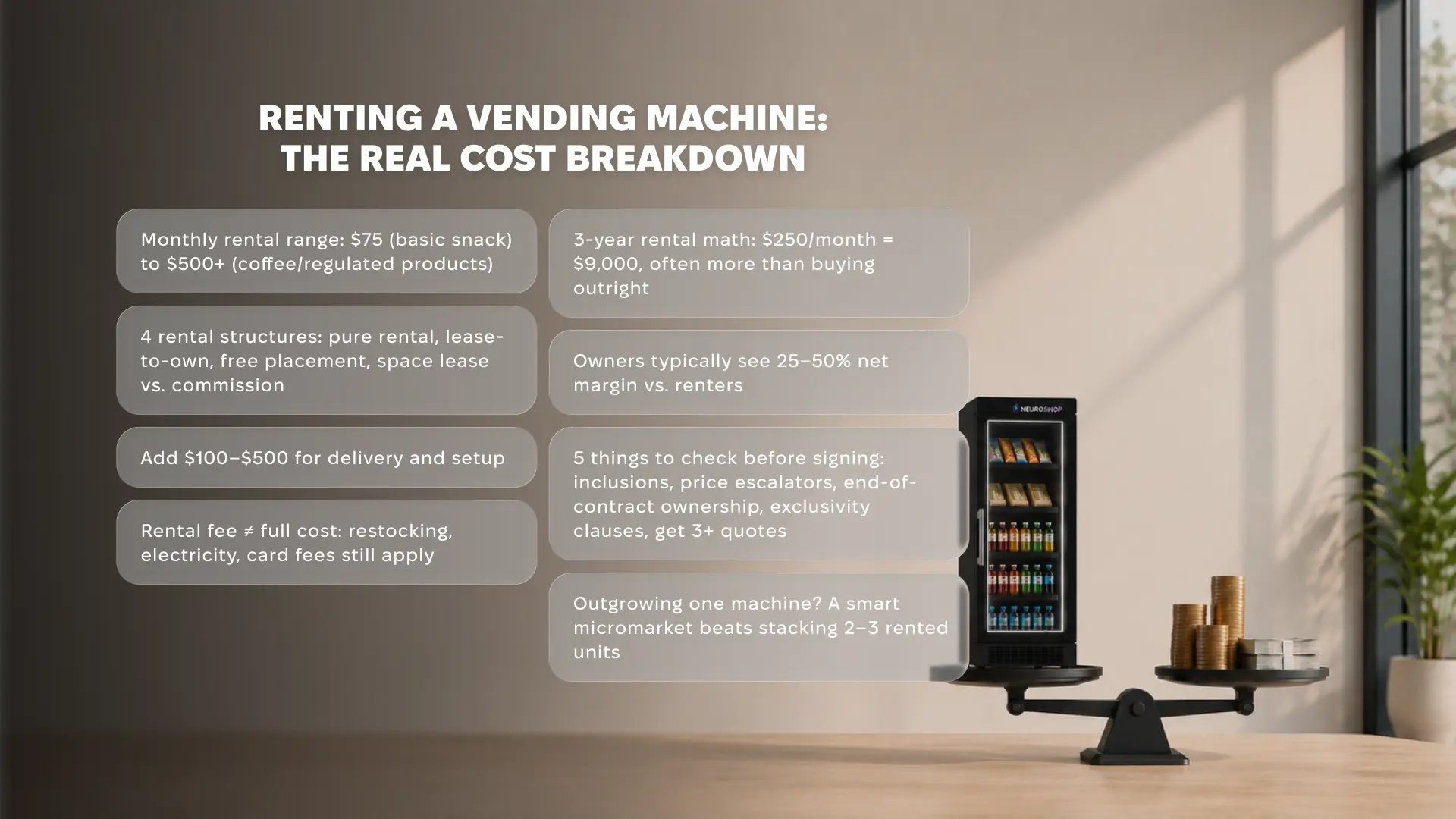
Renting a vending machine typically costs between $75 and $500 a month. It’s a common way to test a location without a large upfront purchase, but it isn’t always the cheapest path over time.
The stakes are real: global retail vending revenue reached an estimated $75 billion in 2025, and a well-placed machine can generate $100 to $300 a week in gross sales, with top locations pushing past $500, according to 365 Retail Markets. Whether renting or buying captures more of that for you depends on the numbers below.
How Vending Machine Rental Works
Renting a vending machine means paying a recurring fee, usually monthly, to use equipment you don’t own. The supplier retains ownership, and depending on the agreement, may also handle maintenance, repairs, and sometimes stocking.
Four structures come up most often:
- Pure rental. A fixed monthly fee with maintenance often included. Best suited to testing a new location or a short-term placement.
- Lease-to-own. Higher monthly payments than pure rental, but the machine becomes yours after a set term, typically 36 to 60 months.
- Free placement. The supplier installs the machine at no cost but takes a share of sales, or requires you to buy their consumables exclusively.
- Space lease vs. commission. Separate from the machine itself. The location owner may charge a flat monthly fee for the space or take a percentage of sales instead.
What Does It Cost to Rent a Vending Machine?
Rental pricing depends heavily on machine type, technology, and what’s included in the contract.
| Machine Type | Typical Monthly Rental | Notes |
|---|---|---|
| Basic snack machine | $75–$200 | Lower capacity, fewer features |
| Combo snack and drink | $125–$275 | Most common type rented |
| Coffee vending machine | $100–$500 | Wide range based on tech and service level |
| Hot food or ramen machine | $225–$450 | Heating modules add cost |
| Regulated products (vape, alcohol) | $250–$500+ | Compliance and ID verification add cost |
On top of the monthly fee, expect delivery and setup charges of $100 to $500, plus ongoing costs for restocking, electricity, and card processing fees that apply regardless of whether you rent or own the machine.
When Renting Makes Sense, and When It Doesn’t
Renting solves one specific problem well: it lowers the barrier to entry when capital is tight or a location hasn’t proven itself yet. That’s a fair trade for a short testing period.
The math shifts once an operator plans to stay put for years. A $250 monthly rental adds up to $9,000 over three years, well above what a comparable machine costs to buy outright. The rental fee also rarely includes upgrades: newer payment technology, remote monitoring, or a wider product range usually mean signing a new contract rather than modifying the one you have.
Ownership also affects margin directly. Operators who own their equipment typically see net margins in the 25% to 50% range, depending on commission rates and product mix, since there’s no recurring rental fee eating into gross sales before profit is even calculated.
Renting tends to make sense when:
- You’re testing an unproven location before committing long term
- Upfront capital is limited and a large purchase isn’t realistic yet
- You want predictable monthly costs without maintenance surprises
Buying tends to make more sense when:
- You plan to operate the same location for more than two years
- You want full control over technology, product range, and branding
- You want to avoid rental price increases partway through a contract
Five Things to Check Before Signing a Rental Agreement
A few contract details decide whether a rental actually saves money or costs more than expected.
- Confirm what’s included in the monthly fee. Machine only, or also installation, maintenance, and consumables? That changes the real cost significantly.
- Ask about price escalators. Some multi-year contracts raise the rate annually, turning a $250 rental into $350 by year three.
- Clarify who owns the machine at contract end. Pure rentals return the machine to the supplier; lease-to-own transfers ownership after the term.
- Check exclusivity clauses on consumables. Free placement deals sometimes lock operators into buying supplies at above-market prices.
- Compare at least three quotes. Identical machines can rent for meaningfully different prices depending on the supplier.
For a broader look at avoidable setup mistakes beyond rental terms, see the Neuroshop guide on common vending mistakes.
Operating food vending machines across Europe?
Neuroshop's AI vending machines produce the compliance records inspectors require.
Why Neuroshop Focuses on Ownership, Not Rental
Neuroshop doesn’t offer rental agreements. Neuroshop’s fridge vending machines and other equipment are available to purchase outright, with terms discussed directly based on your business, locations, and product plans.
Ownership changes what you’re actually building. The equipment, the sales data it generates, and the upside of a well-placed location all stay yours instead of reverting to a rental company at contract end. A basic rented machine also caps what you can sell in the first place, since most entry-level rental units skip the technology that makes a location genuinely profitable.
What comes standard with Neuroshop equipment, and typically doesn’t with a rental:
- Item-level stock tracking via weight sensors and RFID, not manual restocking guesswork
- Cashless payment built in, not bolted on as a premium upgrade
- Remote telemetry, so you check a dashboard instead of driving to the machine
- Full control over pricing, branding, and product mix from day one
- No rental price escalators or surprise contract renewals
Restocking is consistently the largest recurring cost for vending operators, and machines that report stock levels automatically cut down on both wasted trips and missed sales from empty slots nobody knew about. Neuroshop’s telemetry platform applies the same monitoring across an entire fleet, whether that’s two machines or twenty, so scaling up doesn’t mean scaling your driving route at the same rate.
Because every operator’s situation is different, from number of locations to expected foot traffic, Neuroshop discusses terms individually rather than publishing a flat price list. If you want a personalized offer, reaching out directly gets you numbers built around your actual sites, not a generic quote.
From a Single Machine to a Smart Micromarket
Operators who outgrow a single rented snack machine often assume the next step is renting a second one. For locations with strong foot traffic, that assumption costs money.
The problem with stacking rented machines:
Renting a snack machine, then a drink machine, then a coffee machine separately means three monthly bills, three service contracts, and three points of failure, for a fraction of the assortment a single connected unit could handle.
What a smart micromarket does instead:
Neuroshop’s AI micromarkets use computer vision to track what a customer picks up and bill it automatically at checkout, covering a full open-shelf assortment rather than one narrow product category. One installation replaces what would otherwise take several separate rented machines to achieve, and it reports into a single dashboard instead of several disconnected ones.
For locations that need refrigeration without the full micromarket footprint, Neuroshop’s fridge vending machines offer a middle step between a single snack unit and a full open-shelf store. Once equipment is generating consistent sales, the Neuroshop guide on using vending machine sales data to make business decisions covers how to turn that data into pricing and restocking decisions rather than letting it go unused.
Operating food vending machines across Europe?
Neuroshop's AI vending machines produce the compliance records inspectors require.
Conclusion
Renting a vending machine is a reasonable way to test a location without a large upfront cost, typically running $75 to $500 a month depending on the equipment. Once a location proves itself, the economics usually favor buying, especially with connected equipment that includes remote monitoring and cashless payment as standard rather than costly add-ons. If you’re weighing your options, Neuroshop is happy to discuss terms and put together a personalized offer based on your specific locations and goals.
Frequently Asked Questions
Is it cheaper to rent or buy a vending machine?
It depends on how long you plan to operate. Renting costs less upfront but adds up over time, often exceeding the purchase price within two to three years. Buying costs more initially but is typically cheaper over the equipment’s full lifespan.
What’s included in a typical vending machine rental?
This varies by supplier, but often includes the machine itself and sometimes maintenance. Installation, consumables, and advanced features like cashless payment or remote monitoring may cost extra or require a higher-tier rental plan.
Can I switch from a rented machine to owning one later?
Some lease-to-own agreements are built for this, transferring ownership after a set term, typically 36 to 60 months. With a pure rental, switching to ownership usually means ending that contract and purchasing separately.
Does Neuroshop offer vending machine rentals?
No, Neuroshop equipment is available for purchase rather than rental. We’re happy to discuss terms directly and put together a personalized offer based on your locations, product plans, and business goals.
When should I consider a micromarket instead of renting more machines?
Once a location has enough daily traffic to support a wider product range, a micromarket usually delivers better revenue per visit than adding a second or third single-purpose rented machine at the same site.

