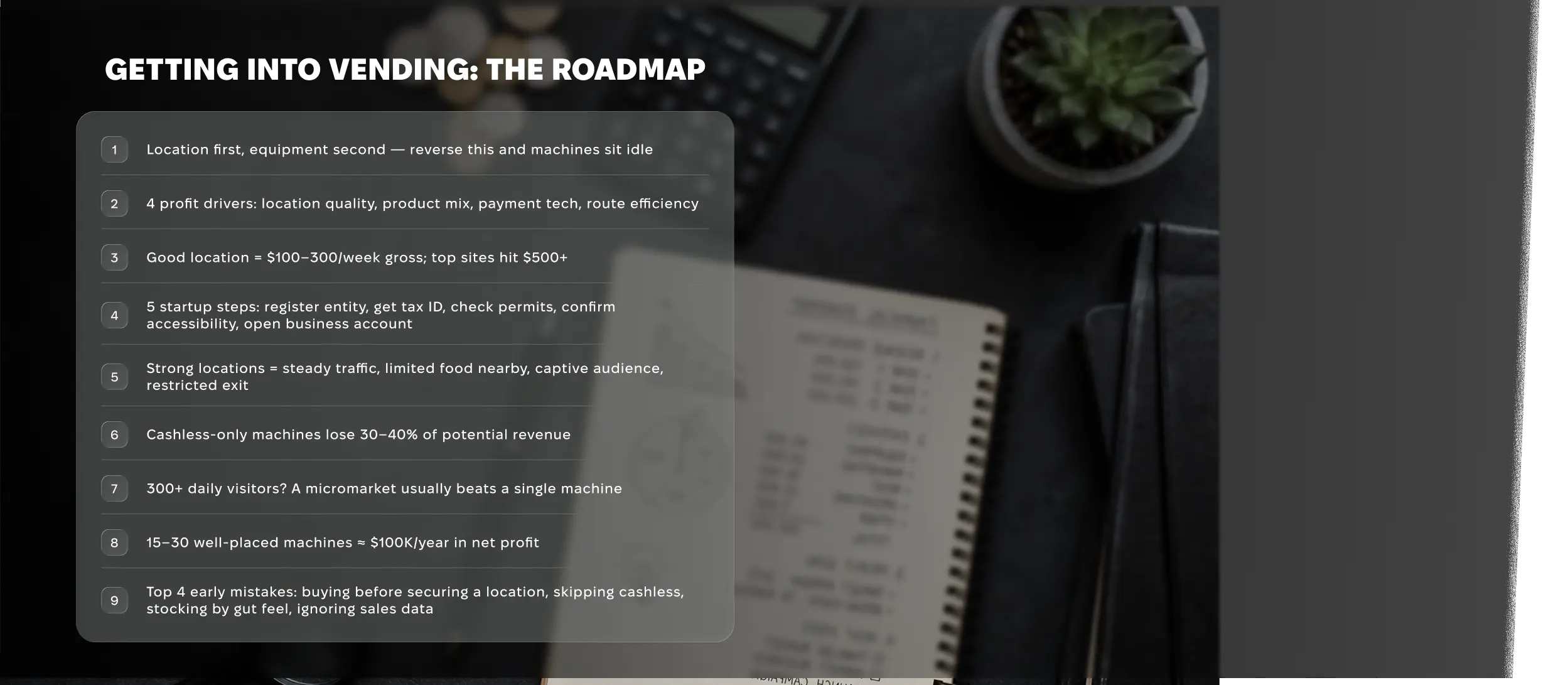
Getting into the vending machine business starts with location, not equipment. A machine bought before a placement is secured usually sits in storage while an operator scrambles to find somewhere to put it. Getting the order right from day one makes the difference between a business that grows and one that stalls.
This guide walks through the practical steps for entering vending, from choosing a business structure to picking equipment, and explains why many new entrants now start with a smart micromarket instead of a traditional machine.
Understand How the Vending Business Actually Makes Money
Vending profit comes from a simple loop: buy or lease equipment, place it somewhere with steady traffic, stock it well, and collect revenue. The mechanics are simple, but the results depend heavily on getting each step right.
Four factors drive profitability in this business:
- Location quality. A machine in the wrong spot underperforms no matter how well it’s stocked.
- Product mix. Matching products to the people who actually pass by matters more than personal preference.
- Payment technology. Cashless-capable equipment consistently outsells cash-only machines.
- Operational efficiency. Tight routes and good data cut wasted trips and missed sales.
A decent location can generate $100 to $300 a week in gross sales, according to industry data from 365 Retail Markets, with top-performing sites like hospitals or large residential complexes reaching $500 or more.
Choose a Business Structure Before Buying Equipment
Vending counts as a regulated retail business in most places, which means paperwork comes before the first machine, not after.
- Register a business entity. An LLC or similar structure separates personal assets from business liability.
- Secure a tax identification number. Most jurisdictions require this before you can legally collect payment.
- Check food and health permits. These apply if any machine dispenses consumables.
- Confirm accessibility requirements. Installed height and reach often fall under formal accessibility rules.
- Open a dedicated business account. Separating vending income from personal finances simplifies taxes later.
Operators expanding across multiple European countries should check requirements early. The Neuroshop guide to vending machine licensing breaks down registration and food rules by country.
Find Locations Before You Buy Machines
Location is the single factor most operators underestimate when getting into vending. A busy-looking lobby doesn’t always translate into vending usage.
Strong locations tend to share these traits:
- Consistent daily foot traffic rather than occasional crowds
- Limited nearby food options, so the machine is the convenient choice
- A captive audience with real dwell time, like shift workers or gym members
- Restricted exit access, where leaving the building costs meaningful time
Approach property managers or business owners directly with a simple proposal. Emphasize that installation, stocking, and maintenance are entirely your responsibility, with no cost or hassle on their end.
Operating food vending machines across Europe?
Neuroshop's AI vending machines produce the compliance records inspectors require.
Machine vs Micromarket: Choosing the Right Format
New operators default to a single vending machine because it feels like the lowest-risk entry point. That assumption doesn’t always hold once traffic and demand are factored in.
| Factor | Single Vending Machine | Smart Micromarket |
|---|---|---|
| Product variety | Limited to machine slots | Full open-shelf assortment |
| Best traffic level | Moderate, steady foot traffic | High daily visitor counts |
| Checkout | Automated dispensing | Self-checkout via computer vision |
| Fresh food capability | Limited | Well suited to fresh and chilled items |
| Revenue per location | Lower ceiling | Higher ceiling at the right site |
Neuroshop’s AI micromarkets use computer vision to track exactly what a customer picks up and bill it automatically, without barcodes or staffed registers. Sites with 300 or more daily visitors are often strong candidates for a full micromarket rather than a single machine, since the wider assortment converts that extra traffic into meaningfully higher revenue.
Selecting Equipment That Matches Demand
Equipment choice should follow location research, not the other way around. A combo snack and drink machine works as a flexible starting point, but it isn’t the only option worth considering.
- Snack and drink combo machines suit moderate-traffic offices and shared spaces.
- Fridge vending machines handle cold drinks, dairy, and fresh items in one connected unit. Neuroshop’s fridge vending machines fit this role well.
- Frozen vending machines cover ice cream and frozen snacks where demand supports it.
- Full micromarkets suit high-traffic sites wanting a wider, retail-style assortment.
Cashless payment is no longer optional. Machines without it typically lose 30 to 40% of potential revenue, since customers without exact change simply walk away.
Avoiding Common Early Mistakes
A few avoidable errors account for most of the setbacks new operators face in their first year.
- Buying a machine before securing a location, which leaves equipment sitting idle
- Skipping cashless payment to save on upfront cost
- Stocking based on personal preference rather than what the location’s audience actually buys
- Ignoring sales data once the machine is running, missing early signs of a weak location
The Neuroshop guide on common vending machine mistakes covers these in more depth, alongside the guide on using sales data to make business decisions, which explains how to turn early sales patterns into pricing and restocking decisions.
Operating food vending machines across Europe?
Neuroshop's AI vending machines produce the compliance records inspectors require.
Conclusion
Getting into the vending machine business rewards operators who plan before they spend. Location research, the right business structure, and cashless-capable equipment matter more than the number of machines purchased on day one. For sites with strong daily traffic, a smart micromarket from Neuroshop often delivers more revenue than a single vending machine, while running on the same connected foundation that makes modern vending manageable at scale.
Frequently Asked Questions
How much money do I need to get into the vending machine business?
Startup costs typically range from $2,000 to $10,000 for a first machine, covering equipment, initial inventory, licensing, and basic insurance. Costs vary by machine type, with micromarkets requiring a larger initial investment than a single snack machine.
Should I buy a machine before finding a location?
No. Securing a location first avoids the common mistake of equipment sitting unused while you search for somewhere to place it. Most experienced operators treat location research as the very first step, ahead of any equipment purchase.
How many vending machines do I need to make a full-time income?
Most operators need 15 to 30 well-placed machines averaging $300 to $600 net profit each per month to reach $100,000 in annual income. Premium locations or micromarkets can reach similar income with fewer individual units.
Is a micromarket a good choice for a first-time operator?
It can be, provided the location has enough daily traffic to support a wider assortment, generally 300 or more visitors per day. For lower-traffic sites, a single connected vending machine is usually the more practical starting point.
Do I need a business license to start vending?
Yes, in most jurisdictions. Requirements typically include business registration, a tax identification number, and food or health permits if you’re dispensing consumables, so confirm local rules before installing your first machine.

