Slot count decides how much variety a vending machine can offer, and how often you need to restock it. Too few slots, and customers do not find what they want. Too many, and you tie up capital in stock that expires before it sells.
There is no single answer, because slot count depends on machine size, product type, and the temperature zones a machine supports. This guide explains what a slot actually is, breaks down typical capacity by size and type, and shows why Neuroshop’s AI micromarkets remove the slot limit entirely for higher-traffic locations.
What Is a Vending Machine Slot?
A slot is a single coil, column, or shelf position inside the machine, and it is committed to one product until someone restocks or reconfigures it. Snack machines use spiral coils that rotate to push one item forward at a time. Beverage machines use vertical columns stacked with cans or bottles.
A few reference dimensions help put slot count in context:
- A standard snack coil is roughly 4 to 9 centimeters wide, depending on whether it holds slim items like biscuits or bulkier bags of chips
- A full-size cabinet is typically 150 to 190 centimeters tall and 80 to 100 centimeters wide, arranged into 5 to 7 horizontal trays
- Each tray holds several coils side by side, so total slot count is tray count multiplied by coils per tray
This is also where micromarkets work differently. Instead of fixed coils, Neuroshop’s AI micromarkets use open shelving of the same rough footprint, tracked item by item with computer vision instead of counted in rigid slots. That distinction matters throughout this guide, since it changes how you should think about capacity planning.
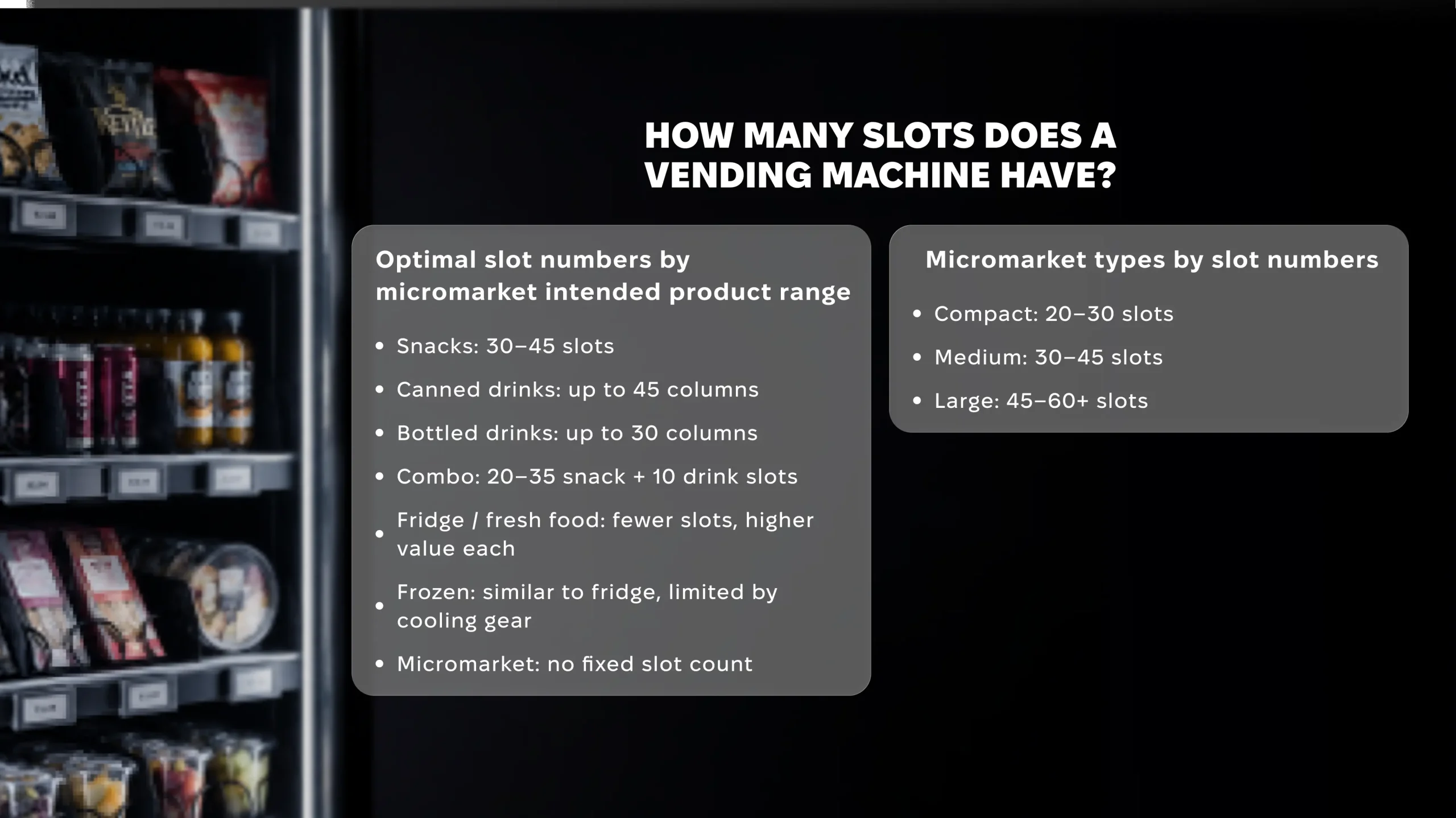
Vending Machine Slot Capacity by Size
Machine footprint is the first factor that determines how many product slots you get. Larger cabinets fit more coils, trays, and columns, but they also cost more and need more floor space.
| Machine Size | Typical Slot Count | Approx. Cabinet Height | Best Suited For |
|---|---|---|---|
| Compact / small | 20 to 30 slots | 150 to 165 cm | Small offices, break rooms, waiting areas |
| Medium | 30 to 45 slots | 165 to 180 cm | Standard offices, schools, gyms |
| Large | 45 to 60+ slots | 180 to 190 cm | Malls, transit hubs, factories, hospitals |
A compact machine with 20 slots works fine for a 15-person office. Place the same machine in a factory canteen with 300 workers, and you will run out of fast-moving items within a day. Once a location outgrows this table, a micromarket is usually a better fit than simply stepping up to a larger fixed-slot cabinet, since it scales product range without adding more coils.
Slot Capacity by Product Type
Slot count also depends heavily on what the machine dispenses. Snack coils, beverage columns, and refrigerated compartments each use space differently.
Typical ranges by product category:
- Snack machines: 30 to 45 slots, with each coil holding 6 to 15 units depending on package size
- Canned beverage machines: up to 45 columns, holding 250 to 500 cans at full capacity
- Bottled beverage machines: up to 30 columns, holding 200 to 400 bottles
- Combo snack and drink machines: 20 to 35 snack slots plus up to 10 beverage slots
- Fridge or fresh food machines: fewer total slots, but higher value per slot since items like sandwiches and salads carry premium pricing
- Frozen machines: slot count similar to fridge units, limited by the space temperature control equipment takes up inside the cabinet
- Micromarkets: no fixed slot count, since open shelving typically carries 150 to 200+ SKUs across snacks, fresh food, and beverages combined
Fresh food and frozen formats trade raw slot count for margin. A fridge vending machine with 30 slots stocked with sandwiches and salads can outperform a 50-slot snack machine on revenue per visit, even with fewer total product positions. A micromarket goes further still, since it is not capped by coil count in the first place.
How Much Space Does Each Item Actually Need
Product depth per slot matters just as much as the number of slots.
A slim biscuit packet might stack 12 deep in a single coil. A bulky bag of chips may only fit 6 before the coil runs out of reach. This means two machines with the same slot count can hold very different total item counts, depending on what fills each slot.
Factors that change usable capacity per slot:
- Package size and shape, since bulkier items reduce stacking depth
- Coil pitch, where wide-pitch coils suit bulky items and narrow-pitch coils maximize depth for slim products
- Tray count, since premium machines with an extra tray add 15 to 25% more capacity
- Temperature zones, which typically remove one or two trays from total snack capacity
Operating 38 SKUs on a 40-slot machine leaves a couple of flex slots for seasonal items, which is a practical setup many operators aim for. Over-specifying capacity, such as placing a 300-item machine in a 40-person office, ties up cash in stock that risks expiring before it sells. Open-shelf micromarkets avoid this trade-off, since adding a new SKU is a shelf decision, not a coil reconfiguration.
Matching Slot Count to Real Demand
The right slot count depends on foot traffic, product mix diversity, and how often you can realistically restock a given route.
Questions worth answering before choosing a machine:
- How many daily visitors does the location realistically generate?
- Does the audience want variety, or do they buy the same two or three items repeatedly?
- How far is this stop from the rest of your restocking route?
- What is the budget for stock, given that more slots mean more capital tied up in inventory?
- Does the location have the closed-loop trust environment, such as an office or campus, that a micromarket needs?
Underestimating demand leads to stockouts on fast-moving items before your next visit. Overestimating leads to slow movers sitting in slots too long, which increases the risk of spoilage. Neither problem is easy to see from a single site visit. Reviewing vending machine sales data at the SKU level is a more reliable way to size a machine, or a micromarket, correctly.
Not Sure How Many Slots Your Location Needs?
Neuroshop configures machine capacity and layout to match your foot traffic.
Beyond Fixed Slots: Why Micromarkets Outperform Coil Counts
Fixed coil-and-tray layouts work well for standardized products, but they force operators to commit to a product mix in advance. Every slot is locked to one SKU until someone physically reconfigures it.
Neuroshop’s AI micromarkets take a different approach. Instead of counting rigid slots, these open-shelf formats use computer vision to track inventory item by item, so the product mix can shift based on what actually sells. A location can carry more fresh food one week and more packaged snacks the next, without retrofitting the cabinet.
The revenue case is well documented across the industry. Micromarkets typically post 30 to 50% higher average transaction values than fixed-slot vending machines, and open-shelf formats commonly carry 150 to 200+ SKUs at once, well beyond what any coil-based cabinet supports. This matters most at higher-traffic sites, where a fixed 45-slot snack machine caps your product range no matter how much demand exists for variety. A micromarket removes that ceiling entirely, which is why offices, universities, and factory campuses with 150 or more daily visitors are the strongest fit for the format.
Practical checklist for choosing the right capacity:
- Estimate daily foot traffic before selecting a cabinet size or a micromarket format
- Choose slot count based on product category, not machine size alone
- Leave a few flex slots for seasonal or promotional items
- Track SKU-level sales data to catch under- and over-stocked slots early
- Consider an open-shelf micromarket once traffic outgrows a fixed-slot machine
Neuroshop’s telemetry platform tracks slot-level and shelf-level sales across every machine and micromarket in a route, which makes it easier to catch these patterns before they cost you revenue. The same data also helps new operators avoid common early-stage stocking mistakes that come from guessing instead of measuring.
Conclusion
A 20-slot compact machine and a 60-slot large unit both have their place. The right choice depends on foot traffic, product type, and how much variety your location’s customers expect. Track sales data at the SKU level once machines are live, and move to an open-shelf micromarket once demand outgrows a fixed layout. Getting capacity right from the start saves you from both empty slots and wasted stock.
Planning A Multi-Machine Vending Route Across Europe?
Neuroshop's telemetry tracks slot-level sales data across every machine in your network.
Frequently Asked Questions
How many slots does a standard vending machine have?
Most standard snack machines hold 30 to 45 slots, while beverage machines can have up to 45 can columns or 30 bottle columns. Compact machines may have as few as 20 slots, and large units in high-traffic locations can exceed 60.
Do bigger vending machines always hold more products?
Not always. Total item count depends on slot count and product depth per slot. A machine with fewer, deeper slots can hold as many items as a machine with more, shallower slots, depending on package size and coil pitch.
How do I know if I need more slots or fewer?
Track sales data at the SKU level for a few weeks. Frequent stockouts on popular items suggest you need more slots or deeper stacking. Slow movers sitting unsold suggest you have more slots than your location’s demand supports.
Why do micromarkets carry so many more products than a vending machine?
Micromarkets use open shelving instead of fixed coils, so there is no per-slot limit. Neuroshop’s AI micromarkets commonly stock 150 to 200 or more SKUs, tracked by computer vision instead of counted slot by slot.
Does refrigeration reduce how many slots a machine has?
Yes. Temperature control equipment typically takes up the space of one or two trays, which slightly lowers total slot count compared to a non-refrigerated snack machine of the same cabinet size. The trade-off is access to higher-margin fresh food items.

