Placement pitches are usually lost in the opening exchange, because the operator leads with the equipment instead of the site’s problem. Business owners are rarely interested in a vending machine as such. Their concern is staff leaving the building for coffee, a break room that fails at peak times, or an income stream requiring no administration.
This guide provides a full vending machine pitch script, a site research checklist, commission benchmarks by location type, and rebuttals for four common objections. Adapt the figures to your own route.
What Business Owners Want From a Placement
Your pitch answers three questions before anything else.
- What does this cost me? Usually nothing, and saying so in the first sentence keeps the conversation alive.
- What does my team gain? Breaks taken on site, fewer trips to the nearest shop, one fewer item on the facilities complaint list.
- What happens when it breaks? Owners remember the vendor who left a jammed machine for two weeks.
Research Before You Pitch
Ten minutes of preparation distinguishes a prepared supplier from an unannounced one.
What to Check on Site
- Headcount and shift pattern, which set a realistic transaction estimate
- Whether a machine is already installed, and what condition it is in
- Distance to the nearest shop or cafe, which defines the alternative
- Floor space near reception, the break room or the changing area
- A power socket within reach and mobile signal for card payments
Who Signs the Placement Agreement
In a small business the owner signs. In an office block it is the facilities manager, in a gym the club manager, in a factory the HR lead. Ask reception who handles supplier contracts, then request fifteen minutes with that person by name.
Vending Machine Pitch Script: A Full Example
Below is the sequence in the order you deliver it. Read it aloud once before the visit, then work from the structure instead of the wording.
Step 1: The Opener
“Hi, I run a vending route across [area]. We install and stock the machine at no cost to the site, and we handle restocking, card payments and repairs. A site with your headcount usually sees 30 to 60 purchases a week. Could I take five minutes to show you what that would look like here?”
Step 2: Discovery Questions
Ask these before describing any equipment, since the answers supply the argument used at the close.
- How many people are on site on a normal day? The answer sets a realistic transaction estimate.
- Where do staff buy snacks and drinks now? This defines the alternative your machine replaces.
- Have you had a machine here before? Previous problems indicate which objection will follow.
- What have staff asked for that you cannot offer? This supports the product mix argument.
- Who else approves something like this? This identifies the second decision maker early.
Step 3: The Value Statement
Restate their own answers with figures attached to them.
“You said around 80 people are on site and the nearest shop is a ten minute walk. A combo machine at that footfall typically runs 40 to 70 transactions a week. Your team keeps twenty minutes of every break, and you get a monthly sales report.”
Step 4: The Close
“If the numbers work, we could install within two weeks. Would you want to see the placement agreement first, or should I put together a proposal with a product list for your team?”
Both options represent agreement, which is the purpose of a two-option close.
Cold Call and Email Version
Facilities managers read on a phone between tasks, so keep the written pitch to five lines.
“Subject: Vending for the [Company] break room
Hi [Name], I run a vending route covering [area]. We supply and service the machine at no cost to the site, including restocking, card payments and repairs. For a site with around [X] staff we would expect [Y] transactions a week. Would fifteen minutes this week work to check whether the space fits? Best, [Name]”
Vending Machine Commission Rates by Site Type
Operators tend to prepare commission arguments more thoroughly than owners require. Match the structure to the traffic profile instead of quoting a single rate across your route.
| Location type | Traffic profile | Common structure |
|---|---|---|
| Small office, 20 to 50 staff | Steady, weekdays | No commission, framed as a staff amenity |
| Large office or coworking | Steady, high headcount | 5 to 10 percent of gross sales |
| Gym or leisure club | Evenings and weekends | 5 to 15 percent, or a flat monthly fee |
| Factory or warehouse | Shift-based, round the clock | 10 to 15 percent of gross sales |
| Transit hub or shopping centre | Very high, public | 15 percent and above, often by tender |
Product credit serves as a middle option. A monthly stock allowance for meetings costs you only your product cost, while presenting as a larger concession than the same percentage in cash. Record the payment date in the agreement before installation.
How to Handle Vending Machine Placement Objections
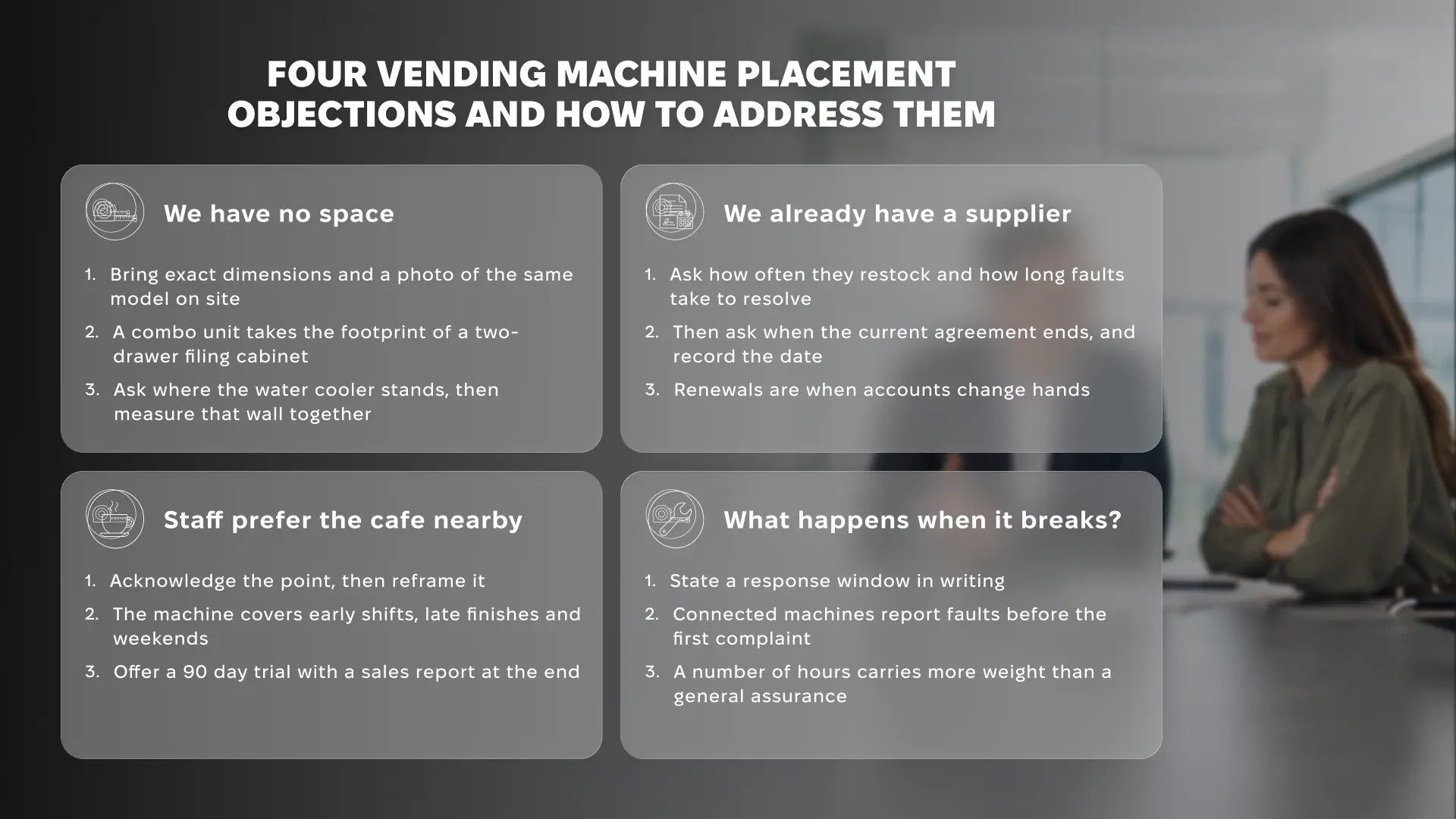
Each objection below has a factual answer. Rehearse them, since hesitation signals inexperience to the person deciding.
“We have no space”
Bring exact dimensions and a photo of the same model in a comparable site. A standard combo unit takes roughly the footprint of a two-drawer filing cabinet plus clearance. Ask where the water cooler sits, then measure that wall together.
“We already have a vendor”
Ask how often it is restocked and how long faults take to resolve. Poor service is the usual reason a site changes supplier. Then ask when the current agreement ends and log the date. Renewal windows are where accounts change hands, and most operators never follow up.
“Staff prefer the cafe nearby”
Acknowledge the point before reframing it. The machine covers early shifts, late finishes and weekends when the cafe is closed. Offer a 90 day trial with a sales report at the end, which removes the risk from their side of the decision.
“What happens when it breaks?”
Give a response window in writing. Machines with remote monitoring report faults before anyone complains, and many issues clear with a remote restart. A stated number of hours carries more weight than a general assurance about service quality.
Pitching locations without hard numbers to show?
Neuroshop telemetry gives operators real sales data for every placement conversation.
What Goes in the One-Page Proposal
Leave a document behind after every visit, kept to a single page instead of a brochure.
- Machine model, dimensions and power requirement
- Product range, including three items the site asked for by name
- Service schedule and the guaranteed response time for faults
- Commission or product credit terms, with the payment date
- Two reference sites of similar size, with contact permission
- Proposed installation date and the length of the agreement
Recorded figures carry more weight than estimates. Comparable numbers from your sales data let you present a site of similar size, and a documented comparison closes faster than a projection.
Follow-Up That Wins the Placement
Most placements close on the second or third contact, so set the next step before you leave the building.
Send the proposal within 24 hours while the visit is fresh. Follow up after four working days with one short message referencing something specific they said. If the answer is negative, ask what would need to change, then schedule a revisit in six months. The operator with a record of that conversation gets the call when the vendor changes.
Confirm the regulatory requirements before signing. Food hygiene registration and equipment rules differ by market, and our overview of vending licensing in Europe sets out what applies where. Skipping it is one of the common mistakes that costs new operators their first account.
Equipment also shapes the pitch. An AI micromarket opens sites that decline a traditional machine, since it presents as a small retail space without the staffing cost.
Ready to place your first AI micromarket?
Neuroshop supplies the equipment, installation and support behind every placement you win.
Final Thoughts
A vending machine placement pitch is a short structured conversation with a clear ask at the end. Research the site, open with the owner’s problem, quantify the benefit, answer objections with facts, and leave a one-page proposal. Commission terms should follow the traffic profile. Operators who follow up on schedule and record every rejection convert a substantial share of those sites later.
Frequently Asked Questions
How do you pitch a vending machine to a business owner?
Ask reception who handles supplier contracts, then request fifteen minutes with that person. Open with what the site gains, confirm there is no cost to them, and close with two options instead of one.
What commission should I offer for a vending machine placement?
It depends on traffic. Small offices often accept no commission when the machine is framed as a staff amenity. High-traffic industrial and public sites commonly expect 10 to 20 percent of gross sales.
Do I need a vending machine placement agreement?
Yes. A short agreement should cover the term, service frequency, fault response time, commission and payment schedule, insurance, and the notice period for removal. Verbal arrangements cause disputes when management changes.
How long does it take to secure a vending machine location?
Most placements close on the second or third contact, usually inside two to four weeks. Larger organisations with procurement processes take longer, since supplier approval and site surveys add several weeks.
What is the best type of business for a vending machine placement?
Sites with steady captive footfall perform best: factories on shift patterns, gyms, coworking spaces, clinics and student accommodation. Distance to the nearest shop matters more than headcount alone.

