A laundromat customer stays on site for 45 minutes to two hours and cannot leave without abandoning a load. Few retail settings hold an audience that reliably. Vending machines for laundromats exist to serve that waiting time, which most self-service laundries currently leave unserved.
This guide covers what sells in a laundry setting, where to position the machine, how to choose equipment, and whether to own or host. The figures are ranges from common practice, so test them against your own site.
Why Laundromats Suit Vending
Coin-operated laundries are a growing category in Europe, driven by urban rental housing and small apartments without in-unit machines. Germany alone accounted for 17 percent of European coin-operated laundry revenue in 2024, according to Grand View Research. More than half the German population rents its housing. That customer base arrives without supplies more often than most operators assume.
Three conditions make a site work for vending, and a laundromat meets all three.
- Dwell time. Customers are present for a full cycle with little to occupy them.
- Forgotten purchases. Detergent, softener and dryer sheets are the items people leave at home.
- Unattended hours. Many self-service laundries run without staff, and a machine sells through those hours.
The second point matters most. A customer who leaves for detergent sometimes does not return for the load, which costs the site a cycle and a visit.
Vending itself is well established across the region. The European Vending and Coffee Service Association counts roughly 4.4 million machines in Europe, or one per 200 people. Its annual market report tracks placement by sector. Laundry sites remain under-represented in that field base, which is the opening.
What to Stock in a Laundromat Vending Machine
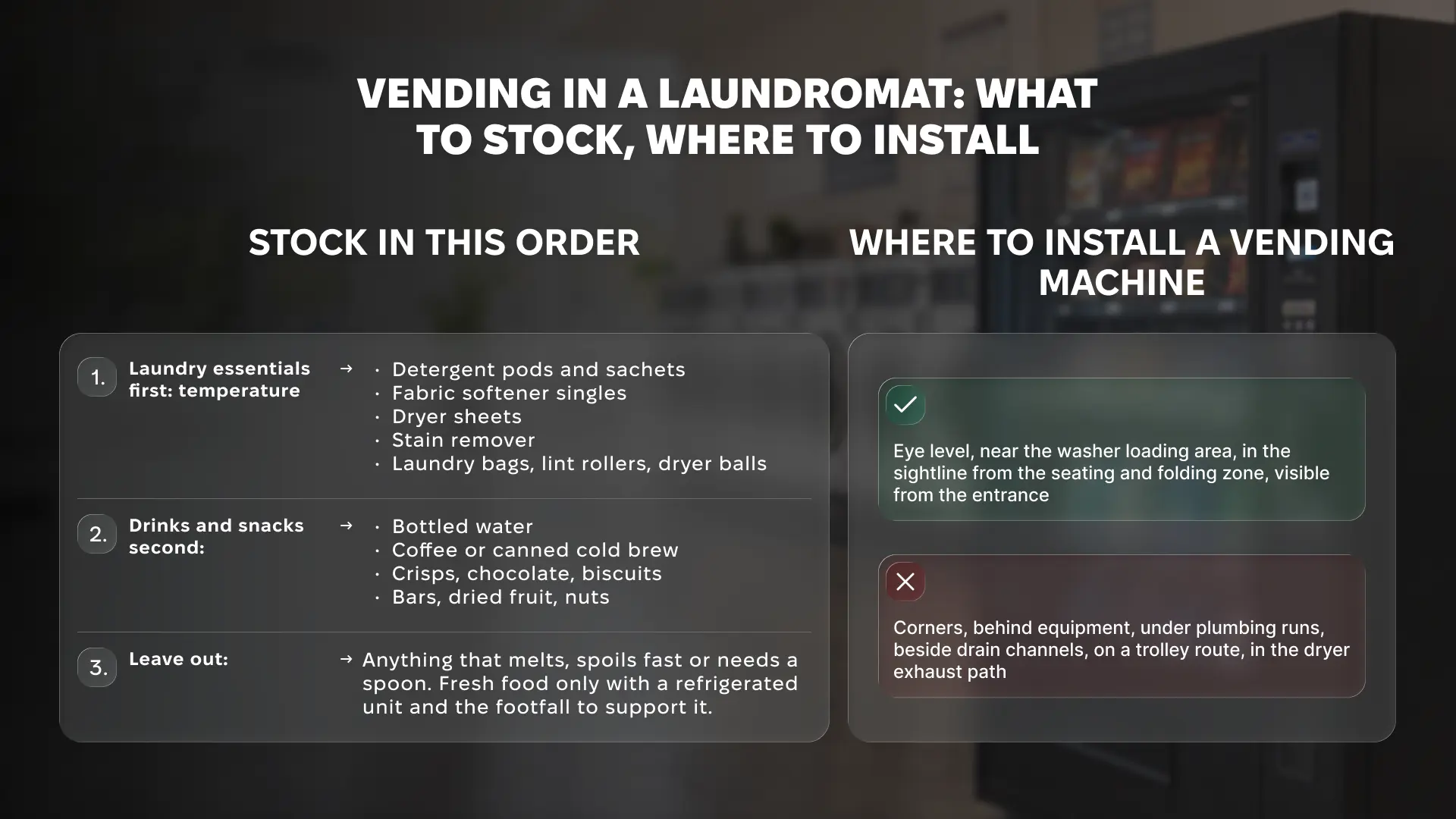
Getting the range wrong is the usual reason these machines underperform.
Laundry Essentials
These carry the highest margin and the clearest reason to buy on site.
- Single-serve detergent pods and sachets
- Fabric softener singles
- Dryer sheets in small packs
- Stain remover pens and packets
- Laundry bags, lint rollers and dryer balls
Price them for convenience instead of matching the supermarket. A customer mid-cycle is comparing your price to a twenty minute round trip.
Drinks and Snacks
Bottled water outsells carbonated drinks in most vending settings, so give it prominent facings. Beyond that, keep the range narrow:
- Bottled water and cold drinks, particularly in summer
- Coffee, from a hot drinks unit or as canned cold brew
- Crisps, chocolate and biscuits for the impulse purchase
- Granola bars, dried fruit and nuts for the health-conscious segment
What to Leave Out
Anything that melts, spoils quickly or needs a spoon performs badly here. Skip fresh food unless the machine is refrigerated and throughput supports it. A refrigerated unit opens sandwiches and chilled drinks, though only where daily footfall covers the running cost.
Where to Position the Machine
Position costs nothing to change and moves revenue more than the product range does.
Machines in a sightline from the seating and folding area outperform those pushed into corners or behind equipment. Place at eye level near the washer loading zone, visible from the entrance. Customers decide while loading and while waiting, so the unit has to be in view during both.
Four constraints specific to a laundromat floor plan:
- Keep clear of water. Avoid positions beneath plumbing runs or beside drain channels.
- Check the power supply. A refrigerated unit draws more than a snack machine, and older sites have limited spare circuits.
- Preserve trolley routes. Machines blocking a cart path get moved within a month.
- Mind the humidity. Dryer exhaust affects packaging and label adhesion over time.
Choosing a Machine for the Space
Floor space is limited in most self-service laundries, so match the format to the room available.
| Machine type | Approximate footprint | Best fit |
|---|---|---|
| Compact combo unit | Around 0.6 m wide | Small sites needing snacks and drinks in one unit |
| Full-size snack machine | Around 0.9 m wide | Sites with 60 or more daily users |
| Refrigerated drinks unit | Around 0.8 m wide | High footfall, summer trade, chilled products |
| Laundry supply dispenser | Around 0.5 m wide | Paired with a snack unit, dedicated to essentials |
| AI micromarket | Modular, from 1 m | Larger sites wanting an open shelf format |
Two smaller units in separate positions usually outsell one large machine, because they capture the loading moment and the waiting moment.
Payment and Physical Security
The machine sits unattended in a room the public enters freely, so payment configuration and cabinet security matter more than in a staffed lobby.
On payment, three technical points decide the setup:
- The reader must present as an MDB cashless device to the vending controller. Level 3 supports multi-vend sessions, so a customer buys detergent and a drink in one authorization instead of two.
- A shared laundry credential needs a protocol match and a shared balance. Laundry payment systems also run on MDB. Some providers hold laundry credit and vending credit in separate wallets, which removes the convenience the integration was meant to deliver.
- Keep the coin mechanism, restrict the note validator. Customers already carry change for the washers. Accept notes only with daily collection, since a full cassette left overnight raises the value of a break-in.
On the cabinet: anchor the unit to wall or floor to defeat tilting, specify a T-handle lock instead of a cam lock, position it within the entrance camera’s field of view, and vary collection times. Confirm whether your insurance treats the machine as fixed equipment or as stock, since limits differ.
Running vending across multiple laundromat sites?
Neuroshop machines report stock levels and faults without a site visit.
Own the Machine or Host an Operator
The right answer depends on footfall.
- Hosting an operator costs nothing upfront. The operator supplies, stocks and services the machine, and typically retains 20 to 40 percent of revenue. This suits sites with low or unproven traffic, and owners with no interest in restocking.
- Owning the machine keeps the full margin and gives you control of pricing and range. It requires capital, a stock relationship and a service routine. Above roughly 40 daily users, ownership usually returns more over a two-year horizon.
A hybrid works at many sites. Own the laundry supply dispenser, since those products are cheap to source and sell at high margin. Host an operator for snacks and drinks, where stock management is heavier.
The Service Visit, Step by Step
Restocking frequency follows footfall: two or three visits a week at 30 to 50 daily customers, three or four above that. Run each visit as a fixed sequence.
- Pull the DEX read or telemetry report before loading the van. Levels by selection tell you what to carry, instead of taking full cases to every site.
- Reconcile the counters before opening the cash box. Compare the non-resettable audit total against the resettable one and the cash present. A discrepancy points to a validator fault, a free vend or a miscount.
- Collect cash first, then restock. Separating the two keeps door-open time short and keeps the cash record clean.
- Refill only the flagged selections, rotating older stock forward. Change prices in the same service menu session, then verify one selection at the new price.
- Test vend one item per device and log the visit. One spiral and one cashless transaction confirm the dispensing mechanism and the reader. Wipe the delivery bin and keypad, since lint and detergent dust reach sensors faster here than in an office.
Reviewing your sales data each month shows which lines to drop and which to give more facings. Compliance is lighter than in food service, though chilled and fresh items bring temperature records and hygiene registration into play. Our overview of vending licensing in Europe sets out what varies by market.
Where AI Micromarkets Fit
Larger laundromats with a seating area can support an open format instead of a closed machine. An AI micromarket presents products on open shelves, with cameras and sensors handling identification and payment at exit.
Basket size rises, because customers pick up several items instead of selecting one through a keypad. The format also removes the spiral jam, the most common complaint in unattended retail. Stock levels and faults arrive through remote monitoring, so an owner without vending experience is not left diagnosing hardware.
Considering a micromarket instead of a machine?
Neuroshop supplies the hardware, installation and remote support for laundromat sites.
Final Thoughts
Vending works in laundromats because the audience is waiting and short of something. Stock laundry essentials first, add a narrow drinks and snack range, and position the machine in view of the seating area. Own the equipment once daily footfall passes about 40 users, and host an operator below that. Review the sales report monthly and adjust the range accordingly.
Frequently Asked Questions
Are vending machines profitable in a laundromat?
Usually yes, provided the product mix matches the setting. Laundry essentials carry high margin and sell on necessity, while snacks and drinks depend on footfall. Placement in view of the seating area affects returns significantly.
What should a laundromat vending machine stock?
Single-serve detergent, fabric softener, dryer sheets, stain remover and laundry bags form the core. Add bottled water, coffee and a narrow snack range. Keep the selection small and adjust it monthly using sales data.
How much space does a laundromat vending machine need?
A compact combo unit occupies roughly 0.6 metres of wall width, plus clearance for the door. Laundry supply dispensers are narrower. Check power access and keep the unit away from plumbing.
Should I buy the machine or let an operator place one?
Hosting an operator costs nothing upfront but gives away 20 to 40 percent of revenue. Buying keeps the full margin and adds a service routine. Above roughly 40 daily customers, ownership generally returns more.
How often does a laundromat vending machine need restocking?
Two or three visits a week suit a site with 30 to 50 daily customers. Busier locations need three or four. Machines with remote stock reporting let you schedule visits by actual demand.

