A coin falls through a vending machine coin mechanism in under a second. In that time the machine measures its diameter, thickness, and metal content, then credits the sale. Banknotes face longer checks using light, magnetism, and a stored currency profile.
Operators care for a simple reason. A validator that rejects real money loses sales quietly, and one that accepts slugs loses cash. The European Vending Association puts cashless systems on 85% of Europe’s pay vend fieldbase, yet cash handling runs alongside cards in most markets.
How Does a Vending Machine Read Money?
Every cash payment moves through four stages, coin or note:
- Validation: the coin acceptor or bill validator measures the physical properties of the money at the sensors.
- Comparison: the readings are checked against stored reference values for each accepted denomination.
- Credit transfer: the validator reports the value to the vending machine controller (VMC) over the MDB protocol.
- Storage or return: accepted money goes to the coin tubes or bill stacker, rejected money to the coin return.
The VMC never sees the money. It trusts the value message the validator sends, so validator quality drives both counterfeit losses and false rejections.
How Do Vending Machines Read Coins?
A coin mechanism runs four checks in sequence, each filtering out a different category of fake. Euro coins were designed around this process, and the European Commission publishes exact figures for all eight denominations that validators hold as reference values.
1. Coin Size, Diameter and Thickness
The first check is mechanical. A calibrated slot in the coin track passes only coins within a narrow size range. Buttons, washers, and oversized foreign coins are diverted before reaching the electronics.
| Coin | Diameter | Thickness | Weight |
|---|---|---|---|
| 1 cent | 16.25 mm | 1.67 mm | 2.30 g |
| 2 cent | 18.75 mm | 1.67 mm | 3.06 g |
| 10 cent | 19.75 mm | 1.93 mm | 4.10 g |
| 5 cent | 21.25 mm | 1.67 mm | 3.92 g |
| 20 cent | 22.25 mm | 2.14 mm | 5.74 g |
| €1 | 23.25 mm | 2.33 mm | 7.50 g |
| 50 cent | 24.25 mm | 2.38 mm | 7.80 g |
| €2 | 25.75 mm | 2.20 mm | 8.50 g |
Three details shape how the gate is cut. Adjacent denominations sit as little as 1.00 mm apart, so size alone cannot separate 5 cents from 20 cents. The 1, 2 and 5 cent coins share an identical 1.67 mm thickness, which rules that measurement out at the low end. And the 5 cent coin is physically larger than the 10 cent coin, so the gate cannot simply widen with value.
2. Weight and Metal Composition
Euro coins use three alloy families, and each behaves differently in a magnetic field:
- Copper-plated steel (1, 2, 5 cent): the steel core makes these strongly magnetic.
- Nordic gold (10, 20, 50 cent): 89% copper with aluminium, zinc and tin, and not magnetic.
- Bimetallic (€1, €2): a nickel-bearing core inside a contrasting ring, only weakly magnetic.
Weight spans 2.30 g to 8.50 g across the set, but the gaps that matter are small. A 5 cent coin and a 10 cent coin differ by 0.18 g, so mass alone would not separate them. The alloy does, since one is steel and the other is Nordic gold.
3. Electromagnetic and Optical Sensors
Coils along the track generate a field, and the coin’s conductivity and permeability change it as it passes. That signature resolves the 1 mm ambiguities the size gate cannot. It is also why a slug cast in the wrong metal fails even with perfect dimensions. Optical sensors then time the coin’s fall between two points. Speed confirms diameter and mass together, and it catches coins lowered on a string.
4. What Happens After a Coin Is Accepted?
Accepted coins are sorted by value. Common denominations feed the coin tubes or hopper behind the change dispenser, and the overflow drops into the cash box. Credit reaches the controller within milliseconds.
Losing sales to rejected coins and worn banknotes?
Neuroshop's AI vending machines take contactless payments and skip cash validation entirely.
How Do Vending Machines Read Bills?
A bill validator has the harder job. Notes bend, fade, and pick up dirt, so the machine authenticates a surface, not a solid object.
Optical Scanning
The validator pulls the note past image sensors that scan its print pattern, size, and layout. A note fed in skewed or torn fails the match and reverses back out.
Magnetic, UV and Infrared Detection
Optical scanning alone would accept a good colour photocopy, so validators add three further checks:
- Ultraviolet: genuine notes carry fluorescent fibres and inks that react under UV. Plain paper does not.
- Magnetic ink: magnetic heads read the iron particles in the printing and verify their placement.
- Infrared: IR sensors read paper density and ink thickness through differences in absorption.
How a Bill Validator Identifies the Denomination
Each unit stores a currency profile for every denomination it accepts, and the closest match sets the credited value. New banknote series need a firmware update first.
What Happens to an Accepted Bill?
A validated note waits in escrow until the vend completes. If the product drops, the note moves into the stacker and cash box. If the vend fails, the note comes back.
Can Vending Machines Detect Fake Money?
Yes. The checks are cheap, layered, and hard to defeat at once, so counterfeiters rarely target vending.
| Check | What it measures | What it rejects |
|---|---|---|
| Size gate | Diameter and thickness | Buttons, washers, foreign coins |
| Electromagnetic coil | Conductivity and permeability | Slugs in the wrong alloy |
| Optical scan | Print pattern and denomination | Photocopies, wrong-format notes |
| UV and magnetic | Fluorescent fibres, magnetic ink | Inkjet and laser-printed notes |
How Fake Coins Are Detected
The Bundesbank pulled 68,400 counterfeit coins from German payments in the first half of 2025, €2 pieces making up 91%. Vending mechanisms catch these on the alloy test, since genuine €1 and €2 coins are only weakly magnetic.
How Counterfeit Bills Are Detected
The ECB recorded 444,000 counterfeit banknotes withdrawn across the euro area in 2025, down 20% year on year. Most were crude copies with no security features, which a UV and magnetic check rejects immediately.
Why Genuine Money Is Sometimes Rejected
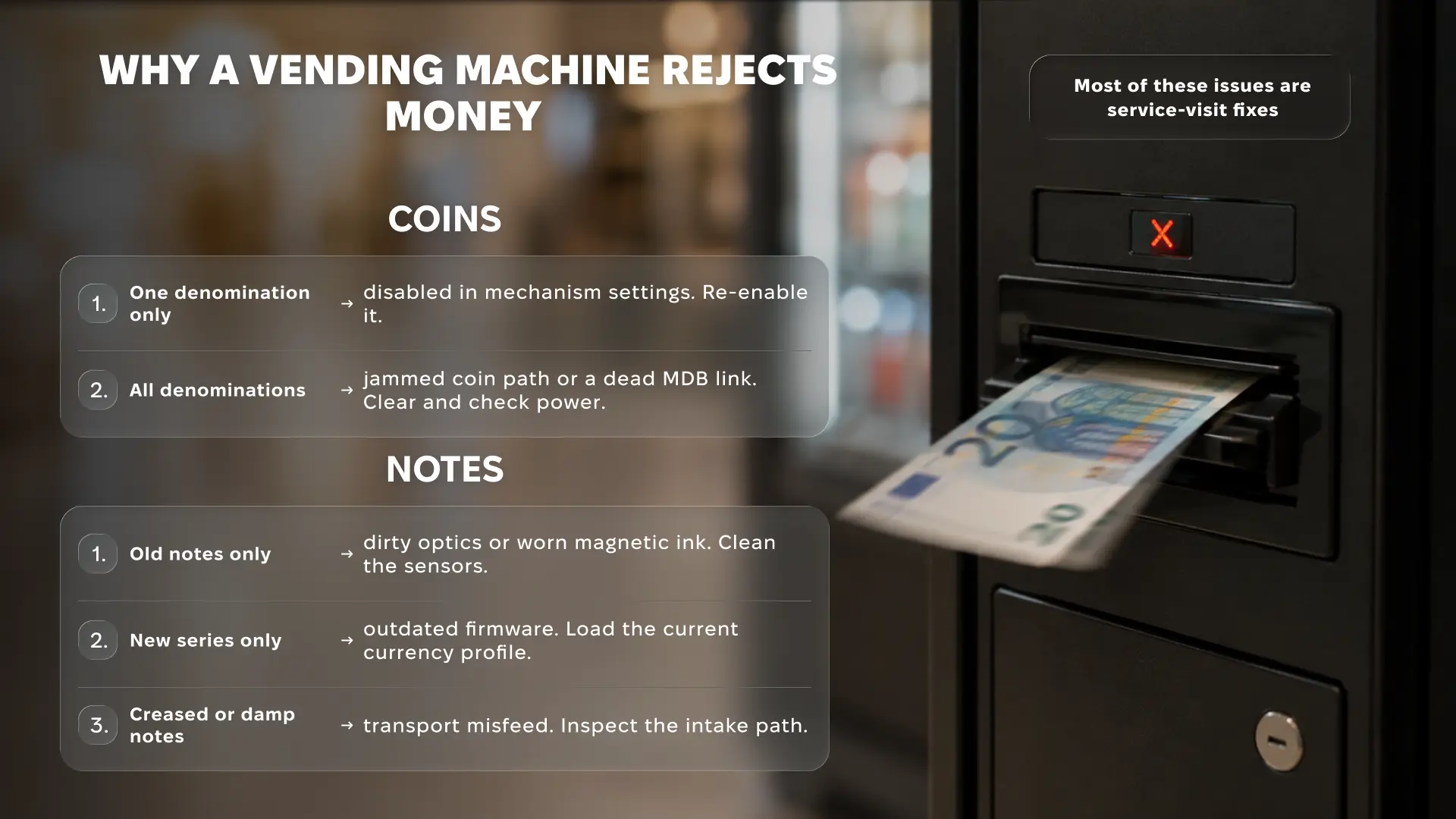
Counterfeit rejection and false rejection look identical to the customer. A machine returning real money is usually reporting on its own condition:
- Dirty optical sensors: dust and residue distort the scan and push valid notes below the threshold.
- Worn magnetic ink: magnetic properties degrade with circulation, so an old note fails a check it once passed.
- Creased or damp notes: the transport misfeeds them and the validator reads a partial image.
- Outdated firmware: a new banknote series needs an updated profile.
Two of those four are maintenance problems. A telemetry platform that flags rising rejection rates turns sensor cleaning into a scheduled task.
Tired of driving out to fix jammed coin mechanisms?
Neuroshop machines report payment faults remotely before your customers start complaining about them.
How Do Vending Machines Give Change?
Change comes from the coin changer, which holds common denominations in coin tubes or a hopper. Once a vend is approved, the controller works out the difference and tells the changer which coins to release.
The “exact change only” message appears when a tube drops below its set level. Refilling tubes on a service visit takes a minute and prevents a week of lost sales.
Cash vs Cashless Payments in Modern Vending Machines
Cash validation is the most maintenance-heavy part of a traditional machine. The choice between coin-operated and cashless vending machines comes down to service cost per site.
Neuroshop machines take card, NFC, QR codes, and mobile wallets, including Apple Pay on vending machines. Every sale is logged, so operators read transaction data instead of counting a cash box. The same connection carries stock and temperature reporting from AI vending machines and the wider set of top vending machine technologies.
Final Take
Reading money is a set of physical measurements checked against stored references, then a value message to the controller. Coins are judged on size, alloy, and speed, with gaps as tight as 1 mm and 0.18 g between denominations. Notes are judged on print, fluorescence, magnetic ink, and infrared response. Both catch fakes well, and both fail more often through dirt and wear than through forgery.
FAQ
How does a vending machine recognize money? It measures physical properties as the money passes a validator, then compares the readings against stored reference values for each denomination. A match sends credit to the controller.
What is the #1 way to detect counterfeit money? No single check carries the load. Infrared is hardest to defeat, but validators combine it with ultraviolet, magnetic ink reading, and optical scanning. A fake has to pass all four.
How do vending machines know the value of the coins inserted? Each denomination has its own combination of diameter, thickness, and alloy signature. A €2 coin measures 25.75 mm against 23.25 mm for a €1, and the alloys differ too.
What happens if you put fake money in a vending machine? The validator drops it into the coin return, or reverses the note out of the slot. No credit is added, and modern machines log the rejection in their transaction data.
Do vending machines take pennies? Most do not. Low-value coins are usually disabled in the coin mechanism settings, because they fill the tubes quickly and add very little to average sale value.

