Retail in 2026 is being reshaped by several overlapping shifts: consumers spending more carefully, expecting more personalisation, and increasingly using AI to decide what to buy. Nearly seven in ten retail executives now agree that value-seeking behaviors such as trading down and swapping convenience for savings represent a structural shift, not a temporary response to inflation, according to Deloitte’s 2026 retail outlook.
Understanding these shifts matters for any operator placing equipment in consumer-facing locations, from workplace snack machines to full smart micromarkets. This article maps the key behavioral trends of 2026 and explains where automated retail fits in the picture.
Online vs. Offline: Still a Balancing Act
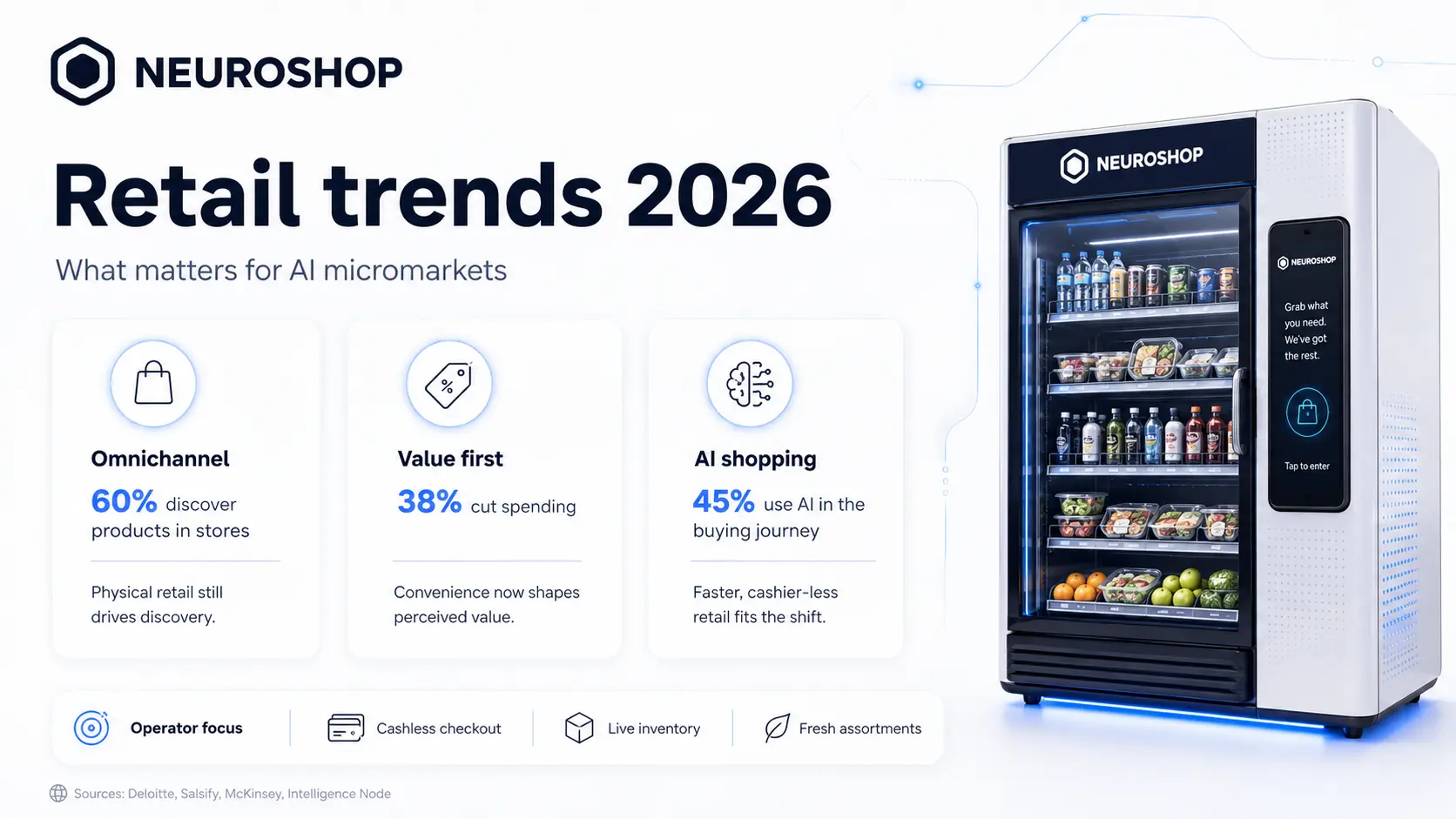
The simple narrative that online is replacing physical retail has given way to something more nuanced. Key findings from Salsify’s 2026 Consumer Research:
- Physical stores (60%) narrowly lead online marketplaces (57%) as the top method for discovering new products
- 67% of shoppers engage in webrooming: researching online, then buying in-store
- 53% showroom: researching in-store and completing the purchase online
- E-commerce still accounts for just 16.2% of total retail sales by dollar value, even as online trips grow, per Colliers’ 2026 Outlook
What this tells operators is that the channel matters less than the quality of the experience at each touchpoint. Spending still happens in person, even when discovery happens digitally.
For unattended retail, this creates a clear opening. Automated formats like Neuroshop’s AI micromarkets sit precisely at this intersection: physically present, always available, and driven by digital inventory tracking, cashless payment, and live data reporting.
The Value Shift: Spending Smarter, Not Less
Budget pressure is the dominant consumer mood of 2026. Shoppers are not abandoning spending — they are scrutinising it more. Data from Salsify and Forbes/Euromonitor:
- 38% of shoppers have cut back on spending in certain product categories
- 39% are comparing prices more carefully before purchasing
- 48.8% of Gen Z list affordability, value, and product availability as their top priorities
- Overall card spend is softening, but categories tied to everyday joy and wellbeing are still growing
Crucially, Deloitte found that as much as 40% of consumer perception of value stems from factors beyond price, including ease of checkout, product quality, and loyalty programs.
What this means for vending and micromarket operators
- Products need a clear value proposition, whether a better price point, a convenience premium, or both
- Fresh and healthier options are outperforming pure snack assortments in many locations
- Cashless and frictionless checkout reduces abandoned purchases at the point of sale
- Operators with connected equipment can track what sells and adjust pricing without a site visit
Convenience and Speed Remain Non-Negotiable
Time efficiency has been a priority for years, but 2026 consumers are less patient than before. From European retail research by IntoTheMinds:
- Proximity stores are projected to grow 5.3% in 2026
- Drive-throughs are projected to grow 5.7%
- Hypermarkets continue to decline at -0.5%, losing share to smaller, faster formats
Shoppers want fewer steps between decision and purchase. Automation fits this pattern directly. A global IBM and National Retail Federation study found that nearly half of shoppers (45%) now turn to AI during their buying journeys to make purchase decisions, per Intelligence Node.
Operating food vending machines across Europe?
Neuroshop's AI vending machines produce the compliance records inspectors require.
Mobile and Social Commerce: Where Discovery Happens Now
Mobile is no longer just a browsing channel. It’s the primary purchase environment for a growing share of transactions.
Key 2026 figures:
- Social commerce sales in the US are projected to reach nearly $70 billion by 2026, as consumers buy directly on TikTok, Instagram, and Facebook
- 70% of Gen Z have used AI tools in the last year for budgeting, planning, and shopping, per Barclays
- Baby Boomers and Gen X still control nearly two-thirds of US retail dollars, per UPS Consumer Trends 2026
For unattended retail operators, the implication is not to compete with social platforms but to recognise that customers arriving at a micromarket may have already compared prices elsewhere. A stale assortment or an out-of-stock slot registers immediately against the instant availability they expect online.
Personalisation and Loyalty: The Data Advantage
Over 80% of American shoppers now expect personalised shopping experiences, according to Intelligence Node. In traditional retail this comes from apps and loyalty cards. In unattended retail it comes from the data layer built into connected equipment.
A micromarket that tracks what sells at what time, flags slow-moving products, and adjusts its assortment based on actual behavior is delivering personalisation at scale without a single member of staff. The Neuroshop guide on using vending machine sales data to make business decisions covers exactly how operators turn that data stream into better stocking and pricing.
Loyalty mechanics that work in unattended retail:
- App-based payment that builds a purchase history per customer
- Personalised promotions triggered by repeat purchase patterns
- Operator-side data showing which products drive return visits vs. one-off buys
Automation in Retail: Where Smart Micromarkets Fit
Automation has moved from novelty to baseline expectation. McKinsey’s research found that self-checkout and cashier-less formats reduce shopping times by 30 to 40%, and that figure has become a standard reference point in retail planning.
Neuroshop’s AI micromarkets are the unattended retail implementation of this shift: an open-shelf, cashier-free format using computer vision to log what each customer takes and bill it automatically at checkout. No barcodes. No queues. No staffed registers.
What comes standard with a Neuroshop micromarket
- Computer vision checkout with no barcodes required
- Live stock tracking updated with every transaction
- Remote dashboard for sales, stock levels, and fault alerts
- Cashless payment including cards, mobile wallets, and QR codes
- Compliance reporting built in for food safety inspections
Where smart micromarkets perform best in 2026
- Office buildings and business parks where employees want quick, quality food without leaving the building
- Gyms and health clubs where fresh and protein-focused assortments outperform standard snack selections
- Residential complexes and co-living spaces wanting a retail amenity without staffing cost
- Multi-site operators who need consistent data reporting across a fleet of locations
For locations that don’t yet have the traffic to justify a full micromarket, Neuroshop’s fridge vending machines offer the same telemetry and cashless infrastructure in a smaller footprint. New operators should also check local compliance requirements first. The Neuroshop guide to vending machine licensing in Europe covers registration and food permit rules by country.
Ethics, Sustainability, and Brand Trust in 2026
Consumer values continue to shape purchase decisions beyond price and convenience.
What the data shows:
- Nearly 1 in 5 consumers changed their shopping habits to actively avoid certain retailers in 2025, per Numerator
- Two-thirds of UK consumers say they would buy more locally produced goods, per Barclays
- Provenance and transparent supply chains are becoming as important as promotional pricing, per Forbes/Euromonitor
For unattended retail operators, this plays out in product selection more than brand positioning. Fresh food, locally sourced options, and low-waste packaging all resonate with 2026 consumer preferences. An assortment that reflects those preferences converts better than one built purely around margin.
Operating food vending machines across Europe?
Neuroshop's AI vending machines produce the compliance records inspectors require.
Conclusion
Consumer behavior in 2026 is defined by value-consciousness, convenience expectations, and growing comfort with automation across every retail touchpoint. For operators of unattended retail formats, these trends create a clear mandate: connected equipment, cashless payment, fresh and relevant assortments, and data-driven decisions. Smart micromarkets from Neuroshop are built around exactly that combination, bringing modern retail logic to locations that would otherwise have no retail at all.
Frequently Asked Questions
What are the biggest consumer trends affecting retail in 2026?
Value-seeking behavior, omnichannel habits, AI-assisted product discovery, and demand for frictionless checkout top most 2026 research reports. Shoppers are spending more carefully but protecting everyday convenience purchases, which benefits well-placed automated retail.
How is automation changing the shopping experience?
Self-checkout and cashier-less formats reduce shopping times by 30 to 40% according to McKinsey, and nearly half of consumers now use AI tools during their buying journey. Smart micromarkets apply the same logic to unattended locations without requiring any staffing.
Does physical retail still matter in 2026?
Yes. Physical stores have narrowly retaken the lead over online marketplaces for product discovery, and the majority of retail spending still happens in person. Unattended retail formats serve this preference by providing physical access 24 hours a day.
How do smart micromarkets fit the 2026 consumer landscape?
Micromarkets combine the convenience and speed consumers demand with fresh assortment and cashless payment. They operate without staff, generate sales data automatically, and adapt their product mix based on what actually sells at each specific location.
What should vending and micromarket operators focus on in 2026?
Fresh and relevant product assortments, cashless and frictionless checkout, and real sales data that drives restocking decisions. Operators who treat their equipment as a managed retail asset consistently outperform those who stock it once and leave it alone.

