Most vending operators set prices once and rarely revisit them. That same price covers the morning rush and the quiet mid-afternoon, high-traffic days and slow ones. Dynamic pricing changes that by adjusting prices automatically based on real-time data: time of day, foot traffic, remaining stock, and location. This guide covers how it works and what the revenue difference looks like in practice.
What Dynamic Pricing in Vending Machines Actually Means
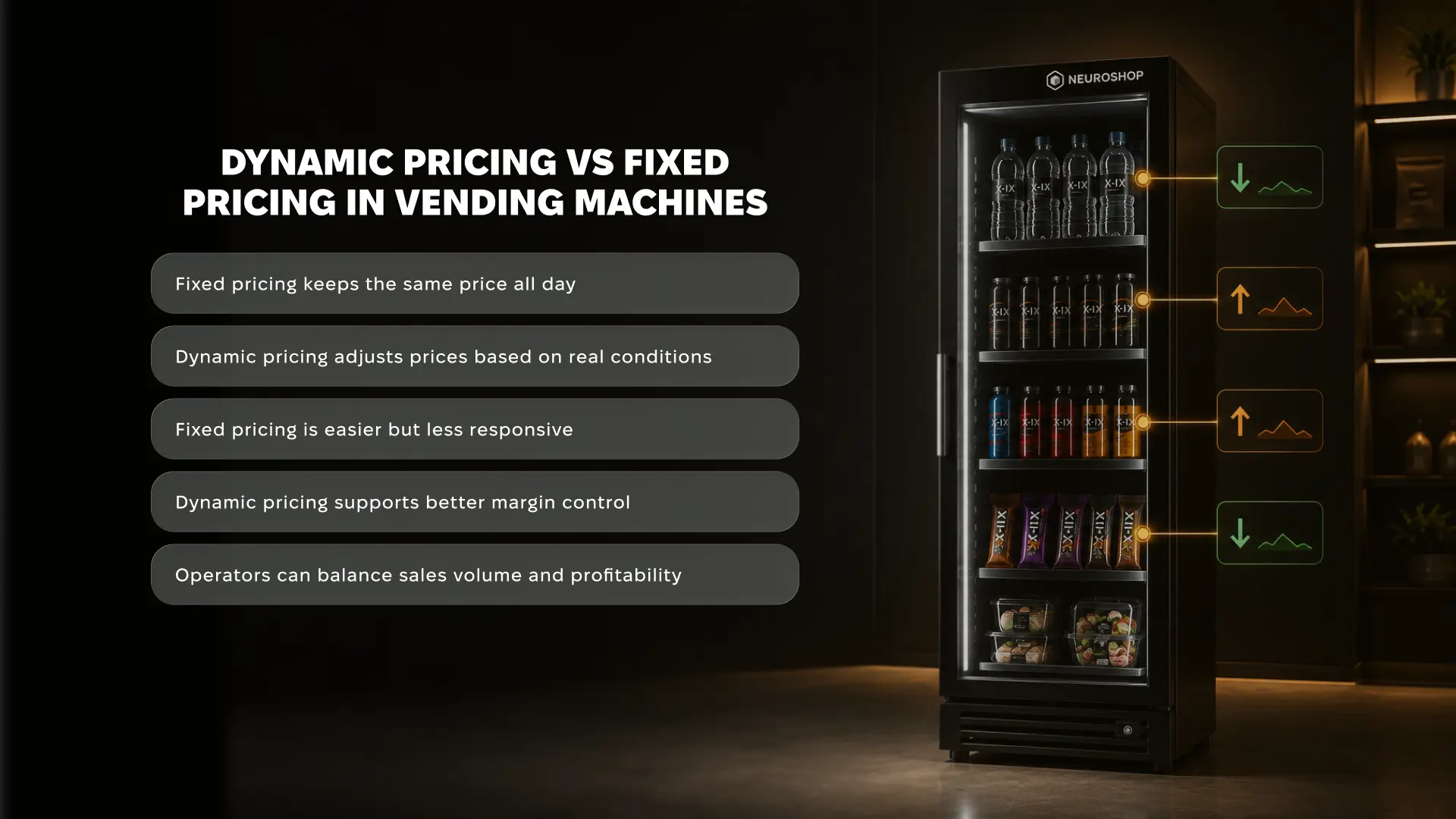
Dynamic pricing is a pricing model where product prices adjust automatically in response to real-time variables. Those variables include time of day, current demand levels, remaining stock per SKU, ambient temperature, and day of the week.
The concept is well established in other industries. Airlines price seats differently depending on how far in advance a ticket is purchased and how full a flight is. Hotels adjust room rates based on occupancy and local demand. Vending machines apply the same principle, with prices updating remotely through a network connection as conditions change throughout the day.
What makes this practical for vending operators now is the connectivity layer already present in modern smart machines. Sales timestamps, transaction volume by product, and hourly demand data are all generated automatically. Pricing decisions built on that data reflect what actually happens at each specific location, not assumptions about what buyers might want.
Operating food vending machines across Europe? Neuroshop's AI vending machines give operators the live data pricing decisions actually require.
How Dynamic Pricing Works in a Connected Vending Machine
The mechanics vary by platform, but the core workflow follows a consistent pattern across all connected vending deployments.
- Data collection. The machine logs every transaction with a timestamp, product ID, and price paid. Over time, this builds a demand profile covering which products sell at which hours and at what velocity.
- Rule or algorithm-based pricing. Operators configure rules, such as raising cold drink prices between 11 a.m. and 2 p.m., or connect to an AI-driven system that calculates optimal prices automatically based on live demand signals.
- Remote price update. New prices are pushed to the machine over the network. Digital displays reflect the change immediately, with no physical visit required.
- Monitoring and iteration. Operators review which price points maximised revenue and which reduced transaction volume, then refine the rules accordingly.
Neuroshop’s telemetry platform provides the data layer that makes this workflow practical. Sales velocity, transaction timestamps, and SKU-level reporting give operators the inputs needed to run demand-based pricing with confidence.
The Variables That Drive Vending Price Changes
Not every pricing trigger produces the same result. The table below covers the most commonly used dynamic pricing variables in smart vending deployments, along with what each responds to and where it applies.
| Pricing Variable | What It Responds To | Typical Use Case |
| Time of day | Peak and off-peak demand cycles | Higher coffee prices at morning rush; discounts mid-afternoon |
| Day of week | Weekday vs. weekend traffic patterns | Lower prices on weekends in office-only locations |
| Stock level | Remaining inventory per SKU | Discounts on near-expiry stock; slight premium when popular items run low |
| Weather | Temperature or precipitation | Higher prices on cold drinks during hot weather |
| Location demand | Historical velocity at that specific machine | Captive locations priced at a sustained premium |
| Promotional period | Operator-configured campaigns | Bundle pricing or limited-time discounts on slow movers |
Understanding which variables are most relevant to a specific location determines which pricing strategy delivers the best return. A hospital vending machine and a gym vending machine face different demand curves and should not be priced from the same logic.
What Revenue Lift Dynamic Pricing Realistically Delivers
The revenue impact depends on how the strategy is implemented and how demand-elastic the location is. Captive environments with limited nearby alternatives, such as airports, hospitals, factories, and large office buildings, tend to see the largest gains because buyers have fewer options at the moment of purchase.
Across connected vending networks, operators typically report:
- 5 to 15% increase in average transaction value when time-of-day pricing is applied to confirmed high-demand windows
- Reduced stock waste through near-expiry discounting, recovering margin that would otherwise be written off entirely
- Higher revenue per machine without adding units or increasing restocking frequency
- Better slow-period performance from targeted off-peak discounting that converts browsers into buyers who might otherwise walk away
The key distinction is between raising prices uniformly across all products and using data to identify the specific moments where demand is inelastic enough to support a higher price point. The former risks reducing transaction volume. The latter captures revenue that was available all along.
Operators who already use vending machine sales data to guide business decisions will find that the same analytics infrastructure supports both pricing optimisation and stock management at once, two revenue levers running off a single data pipeline.
Running AI vending machines across Europe? Neuroshop's telemetry platform gives operators live pricing control and detailed sales analytics.
Setting Up Dynamic Pricing on Your Vending Machines
The practical starting point is connected hardware. A machine without remote management capability cannot receive price updates over the network, which means any pricing change requires a physical visit and a manual adjustment. That eliminates the core efficiency of the model.
For operators already running Neuroshop AI fridge vending machines or AI micromarkets, the telemetry connection is already in place. What remains is building the pricing logic from actual transaction data.
A practical implementation sequence:
- Run your current pricing for four to six weeks and collect baseline transaction data by hour and day of week.
- Identify two or three peak demand windows per location where volume is consistently high and buyer alternatives are limited.
- Apply a modest price increase, around 5 to 10%, for those windows only, and hold all other variables constant.
- After two to three weeks, check whether transaction volume held, fell, or was unchanged. If it held, demand at that location during that window is price-inelastic. That is where the pricing opportunity sits.
- Extend the model to additional products and time windows incrementally, using data to validate each step before moving to the next.
Starting conservatively is important. Customers at a captive location may accept modest price variation without resistance. Unpredictable or sharp changes can produce pushback that damages long-term revenue more than the short-term gain justifies.
Machine selection plays a role here too. Avoiding the common mistakes operators make when choosing and placing vending equipment from the outset means working with hardware that supports these pricing strategies from day one.
Pricing Mistakes That Reduce Revenue
Dynamic pricing applied without underlying data tends to produce worse outcomes than static pricing held at the right level. The most common errors include:
- Raising prices across all products and time slots without identifying specific windows where demand is demonstrably inelastic
- Ignoring transaction volume as a balancing metric, since a higher unit price paired with fewer total purchases reduces overall revenue
- Setting pricing rules once and leaving them untouched, because demand patterns shift seasonally and logic built in January may be wrong by July
- Applying the same pricing model across all locations without accounting for demographic and competitive differences between each site
- Treating dynamic pricing as a standalone tactic, separate from the broader operating data the machines already produce
The goal is to find the price points that maximise total revenue at each specific location. At some locations, during certain hours, that means charging less than current prices.
Conclusion
Dynamic pricing is a logical extension of the transaction data vending operators already generate. The machines that produce the strongest returns are the ones where pricing reflects actual demand at that location and at that moment in the day. For operators prepared to act on their sales data, the margin improvement is accessible without adding a single machine or scheduling an extra restocking visit.
Frequently Asked Questions
What is dynamic pricing in vending machines? Dynamic pricing adjusts product prices automatically based on real-time variables such as time of day, demand levels, remaining stock, or weather. Prices update remotely through the machine’s network connection, with no physical visit from the operator required.
Does dynamic pricing reduce the number of sales? Not when applied correctly. The goal is to raise prices during windows where demand is demonstrably inelastic, meaning buyers purchase regardless of a modest price increase. Data from your own machines identifies those windows before any change is made.
Do I need specific hardware to run dynamic pricing? Yes. Machines need a live network connection, remote management capability, and digital price displays. Standard non-connected machines require a manual visit for every price adjustment, which removes the efficiency benefit of the model entirely.
How much extra revenue can dynamic pricing add? Most operators running connected machines with time-of-day pricing report a 5 to 15% increase in average transaction value during targeted windows. The actual figure depends on location type, foot traffic volume, and how many demand-inelastic windows exist at each specific site.
Can small operators use dynamic pricing? Any operator running connected machines can use demand-based pricing, even across two or three units. The approach scales down cleanly: start with one location, validate the pricing logic with data over a few weeks, and expand once results confirm it works at your specific sites.

