Hot food vending machines have moved well past reheated sandwiches and mediocre soup. Today’s units serve freshly cooked meals, rotating seasonal menus, and specialty items that meet the real expectations of office workers, hospital staff, and university students. If you’re evaluating hot food vending for your location, this guide covers all of it: how the technology works, which menu options perform best, where returns are strongest, and what to check before committing to equipment.
How Hot Food Vending Machines Work
Understanding the mechanics behind a hot food vending machine helps you choose the right unit and avoid equipment that limits your menu from day one. What separates a well-designed system from a basic reheating box is how each step in the process is handled: from safe cold storage through to payment and real-time inventory update. Neuroshop’s AI micromarkets are built around this full cycle, not just the dispensing moment.
Here is how a Neuroshop AI micromarket handles a hot food transaction, step by step:
- Customer unlocks the cabinet. The customer taps a card on the POS terminal or scans a QR code in the Neuroshop app. This pre-authorises payment and opens the secure cabinet door.
- Neural vision activates. A three-camera rig (two cameras mounted at the top of the door frame, one at the bottom) begins tracking hand movements and product positions in real time. The system identifies items by their packaging geometry, shape, and visual cues, even when customers tilt or rotate products.
- Customer takes what they want. There is no scanning, no selecting items on a screen in advance. Customers open the door and pick up whatever they want. The system handles multi-item grabs, put-backs, and item swaps without errors. If a customer changes their mind and replaces an item, the session reconciles correctly: no false charges.
- Cabinet closes and payment processes automatically. Once the door closes, the AI matches recorded movements to specific SKUs and charges the customer. A receipt is sent to the app instantly.
- Products are stored at controlled temperatures until taken. The AI Fridge format maintains 0°C to +8°C for fresh meals, sandwiches, and dairy. The AI Freezer holds -24°C to -17°C for frozen meals and desserts. The AI Ambient Case handles snacks, hot drinks, and non-chilled items without temperature control.
- Inventory updates in real time. Every transaction triggers an immediate adjustment in the cloud dashboard. Low-stock alerts fire automatically. Operators see exactly what is left on each shelf without visiting the location.
- New products are added overnight. To introduce a new SKU, the operator records a short 360° video of the item. Neuroshop’s system generates a synthetic training dataset automatically. Detection is live by the following morning: no labelling work, no third-party photo studio required.
Heating: how Neuroshop’s format handles it
Neuroshop AI micromarkets store products at controlled temperatures: the heating step happens separately, either by the customer using a nearby appliance or at point of sale in a paired unit. Here is how each format is used in practice:
| Format | Temperature range | Best for |
| AI Fridge | 0°C to +8°C | Fresh meals, sandwiches, dairy, ready-to-eat items |
| AI Freezer | -24°C to -17°C | Frozen meals, TV dinners, ice cream |
| AI Ambient Case | Room temperature | Snacks, pastries, coffee beans, dry goods |
In corporate break rooms and hospital floors, operators typically pair the AI Fridge with a nearby microwave or convection oven. Customers pick their meal from the fridge, then heat it themselves. This approach works well and keeps the machine footprint small. For locations that need fully self-contained heating, traditional hot food dispensing machines handle the cook cycle internally. Convection units take 2.5 to 4 minutes per item. Infrared units run 90 seconds to 2 minutes, with better moisture retention.
The format you choose shapes your menu range, your location footprint, and how much of the process the machine handles versus the customer.
Smart Technology and Inventory Management
A hot food machine without remote monitoring creates operational problems that compound quickly. Expired items, empty slots during peak hours, and heating faults discovered only when a customer complains all cost you more than the technology to prevent them.
Neuroshop’s AI micromarkets use computer vision to track inventory in real time. The system flags low stock before items run out and alerts operators when specific products need reordering. This matters more with hot food than with packaged snacks, because fresh items carry shorter shelf lives and higher unit costs. Running out of the lunch menu at 11:45 AM is a fundamentally different problem from running out of crisps.
Key capabilities to look for in smart hot food vending systems:
- Real-time inventory tracking with low-stock alerts sent to operators via a cloud dashboard
- Temperature monitoring logs that document safe holding conditions for compliance records
- Sales data by item and time of day, so menu decisions are based on what people actually buy
- Remote diagnostics that identify heating faults before a full machine failure
- Cashless payment support including contactless card, mobile wallet, and QR code
- Automated product recognition, which in Neuroshop’s platform is updated overnight via a short video recording of the shelf: no manual re-entry required
Cloud-based management means reviewing performance across multiple locations from a single dashboard, without visiting each site. For operators running several machines, that visibility is what makes a hot food program genuinely scalable. Read more about how Neuroshop’s monitoring technology works in the telemetry overview.
Menu Options That Actually Sell
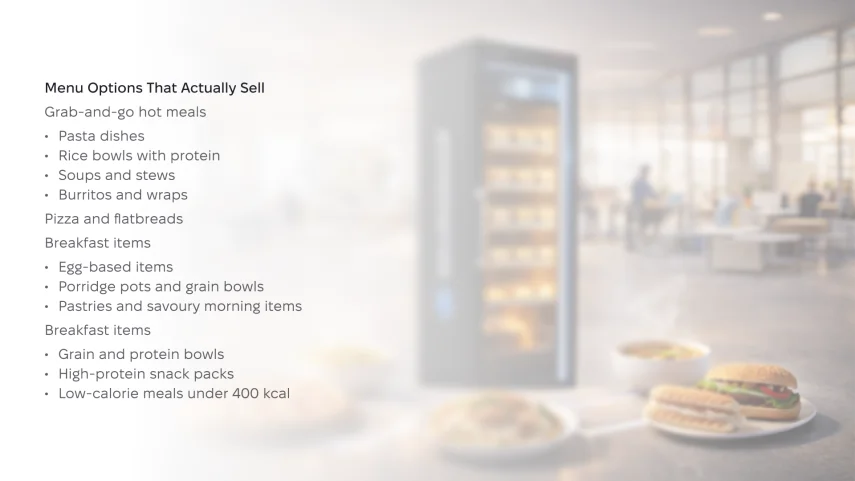
The menu is where most operators either build a profitable hot food program or watch one slowly stall. The right product mix depends on your location type and the time windows when people are most likely to buy. Starting with proven sellers and adjusting based on sales data gives you a much faster path to a performing menu than trying to predict demand in advance.
High-Performing Menu Categories
Grab-and-go hot meals: the anchor category for any hot food program
- Pasta dishes such as mac and cheese, penne arrabbiata, and carbonara in sealed trays. Store at 0°C to +4°C. Shelf life: 3 to 5 days from production. Reheat time: 90 seconds microwave, 3 minutes convection.
- Rice bowls with protein such as chicken teriyaki, beef and broccoli, or tofu and vegetables. Store at 0°C to +4°C. Shelf life: 3 to 4 days. These hold texture better than pasta after reheating, which makes them strong performers in locations without quality convection units.
- Soups and stews in portion-sealed containers: lentil, tomato, chicken broth. Store at 0°C to +4°C. Shelf life: 4 to 5 days. Perform particularly well in autumn and winter rotations and in healthcare locations serving night staff.
- Burritos and wraps with protein fillings. Store at 0°C to +4°C. Shelf life: 2 to 3 days. Best reheated in convection. Microwaving makes tortillas chewy. A consistent lunchtime seller across corporate and campus locations.
Pizza and flatbreads: high conversion, short heat time
- Single-serve pizza slices: store at 0°C to +4°C. Shelf life: 2 to 3 days. Convection reheat: 2.5 to 3.5 minutes at 180°C for a crisp base. Microwave makes bases soggy. This product only works with convection or infrared heating.
- Flatbreads and paninis: store at 0°C to +4°C. Shelf life: 2 to 3 days. Infrared reheat: 90 to 120 seconds. Paninis with hard cheese fillings hold up significantly better after reheating than soft cheese variants.
Breakfast items: the most under-served window in hot food vending
- Egg-based items: breakfast burritos, omelette bites, egg muffins. Store at 0°C to +4°C. Shelf life: 2 to 3 days. Best before 10 AM. Sales drop sharply after that window.
- Porridge pots and grain bowls: store at 0°C to +4°C. Shelf life: 3 to 5 days. Reheat time: 2 minutes microwave. These sell well at 6 AM to 8 AM in hospitals, factories, and logistics sites where shift workers arrive early with no canteen option.
- Pastries and savoury morning items: croissants, sausage rolls, breakfast sandwiches. Store at ambient temperature in the Neuroshop AI Ambient Case. Shelf life: 1 to 2 days. No heating required. Ideal for operators without convection infrastructure.
Health-focused options: growing demand, higher transaction values
- Grain and protein bowls: quinoa, farro, or brown rice bases with roasted vegetables and legumes. Store at 0°C to +4°C. Shelf life: 3 to 4 days. Popular in corporate offices and gyms. Average sale price 15 to 25% higher than a standard pasta dish.
- High-protein snack packs: boiled eggs, edamame, hummus and crudités, cheese and crackers. Store at 0°C to +4°C. Shelf life: 2 to 5 days depending on format. No heating required. These drive add-on purchases alongside a main hot item.
- Low-calorie meals under 400 kcal: labelled portions with macros visible on packaging. Store at 0°C to +4°C. Shelf life: 3 to 4 days. In locations running corporate wellness programmes, clear nutritional labelling measurably increases purchase rate for this category.
Seasonal Menu Rotation
A fixed menu loses relevance quickly among regular users. Rotating four to six items each season keeps purchase frequency higher and gives you a reason to re-promote the machine to employees or residents.
A practical rotation framework by season:
- Autumn / Winter: lentil soup, pulled pork rice bowls, warming pasta dishes, hot porridge pots
- Spring / Summer: grain bowls, noodle dishes, lighter wraps, fresh fruit packs and protein snacks
With Neuroshop’s platform, adding new products requires only a short overnight video recording of the updated shelf. The system recognises new items automatically, without any manual product configuration. It’s one of the practical reasons operators choose Neuroshop when managing a rotating fresh food menu across multiple sites. For product selection guidance, see Neuroshop’s healthy vending snack guide and the vending machine tips and optimisation post.
Locations That Generate the Best Returns
Location is the single factor that most consistently determines whether a hot food vending machine generates strong returns or underperforms. The locations that work best share one consistent characteristic: people there have limited access to other hot food options and a regular schedule that drives repeat purchases. Foot traffic alone is not enough. Captive demand and limited food alternatives are what convert footfall into consistent daily sales.
1. Corporate Offices
Employees on lunch breaks need fast options, especially in buildings without on-site canteens. A hot food machine in the break room of a 100-person office can generate 30 to 50 transactions during peak lunch hours. Demand is highly predictable, restocking is straightforward, and the same users return every working day. Offices above 300 daily visitors are strong candidates for a full Neuroshop AI micromarket combining hot food, fresh items, and packaged snacks.
2. Hospitals and Healthcare Facilities
Healthcare locations generate strong demand across three distinct daily windows: early morning before shifts begin, a midday lunch rush, and a late-night period for night shift staff. That 24-hour demand profile makes hot food vending considerably more valuable here than in a standard office. Staff on 12-hour shifts often have no practical alternative to an on-floor vending machine, which makes purchase frequency high and consistent.
3. Manufacturing and Logistics Sites
Shift workers at factories and distribution centres frequently have 20-minute breaks, no canteen, and no time to leave the building. A hot meal ready in two to three minutes fits those constraints directly. These locations often have three shift cycles running around the clock, which means demand is spread across the full day rather than concentrated in a single lunch window.
4. University Campuses
Universities generate high volume during term time, particularly in buildings where students study into the evening. Late-night demand for hot food is a consistent gap that on-campus food service rarely covers past 9 PM. Buildings with postgraduate students or 24-hour study spaces are especially productive placements.
5. Hotels and Serviced Apartments
Guests who arrive late, check out early, or want food outside restaurant hours represent a reliable and underserved demand segment. A hot food machine in a hotel lobby or floor corridor generates sales that the kitchen cannot capture. Average transaction values tend to be higher here than in office or campus environments.
Choosing the right location is the most important decision you make before installing any hot food machine. Our guide on the best locations for micro market vending machines covers placement criteria and revenue benchmarks in more detail.
Ready to Add Hot Food Vending to Your Location? Neuroshop's smart vending systems handle temperature monitoring, inventory tracking, and remote management automatically, so you can focus on growing your operation.
Compliance and Food Safety Requirements
Hot food vending operates under food safety regulations that go beyond what applies to standard snack machines. Operators who overlook compliance during setup face fines, forced shutdowns, and the kind of reputational damage that is difficult to recover from in institutional placements like hospitals or schools. Getting the regulatory groundwork right before installation is considerably easier than fixing it after the fact.
Common requirements across most jurisdictions include:
- A food handler’s permit or equivalent certification for anyone responsible for restocking perishable or hot food products
- Health department approval for machines serving heated or refrigerated food items, which typically involves an inspection before the machine goes live
- Temperature monitoring records showing that items have been stored within safe holding ranges throughout their shelf life. The FDA Food Safety Modernization Act (FSMA) sets the regulatory framework in the US. EU operators follow Regulation (EC) No 852/2004 on food hygiene.
- Supplier documentation confirming that packaged meals meet local food labelling and allergen disclosure standards
- Regular cleaning and servicing records, available for inspection by environmental health officers
Smart machines simplify compliance by logging temperature data automatically and storing it in the cloud. Manual machines require operators to record this data themselves. That creates risk when documentation lapses during busy periods or staff changes. Before selecting equipment, confirm what your local health authority requires. Then verify that the machine’s built-in monitoring meets those standards.
Neuroshop’s systems log temperature continuously and surface any deviations in the operator dashboard immediately, giving you a defensible compliance record without additional manual effort.
What to Look for When Choosing a Hot Food Vending Machine
Before selecting a unit, match the machine’s capabilities to your location’s specific demands and your own operational capacity. The right machine for a 50-person office looks very different from the right machine for a hospital floor serving 400 staff across three shifts.
Heating technology
- Convection or infrared supports a wider menu and better food quality; microwave-only limits your product range
- Confirm maximum cook time: anything over four minutes loses customers during short breaks
Storage and capacity
- Check total SKU slots and unit count, not just one figure
- Higher-volume sites need either larger capacity or more frequent restocking
- Refrigerated compartments should maintain 2°C to 5°C with continuous monitoring
Payment systems
- Contactless card and mobile wallet are the minimum baseline
- Employee badge or payroll deduction integration increases transaction frequency in corporate settings
- QR code support enables promotions and loyalty schemes
Remote monitoring and inventory management
- Real-time inventory tracking is essential for fresh food: stockouts cost more than the technology to prevent them
- Look for cloud dashboards that show sales by item and time slot, not just total transaction counts
- Neuroshop’s computer vision platform tracks product levels automatically and updates overnight when new items are added
Energy and running costs
- Refrigerated hot food units consume more power than standard snack machines: confirm the rated draw and factor it into your cost model
- LED-lit display panels and programmable low-power modes reduce overnight consumption
- For a full breakdown of running costs across machine types, see Neuroshop’s vending machine cost guide
Service and support terms
- Heating components require more maintenance than mechanical dispensing systems
- Confirm who handles repairs, what the response time guarantee is, and whether parts are stocked locally
- Neuroshop covers device installation, software updates, remote diagnostics, and hardware support directly. You handle restocking, location agreements, and business reporting.
Conclusion
Hot food vending generates strong returns in the right locations, with the right menu and the right operational setup. The heating technology you choose shapes your menu range. The management platform you use determines how efficiently you can run and scale. Compliance handled correctly at the start protects every location you build into your network. Neuroshop’s smart vending systems bring together real-time inventory tracking, automated temperature monitoring, and cloud-based management in one platform. That lets operators focus on growing the business rather than firefighting operational problems. Talk to the Neuroshop team about setting up hot food vending at your location.
FAQ
How does a hot food vending machine keep food safe before purchase? Items are stored in a refrigerated compartment at 2°C to 5°C until a customer orders. The heating cycle only begins after payment is confirmed, ensuring food stays at a safe temperature throughout its shelf life and meets food safety requirements.
What is the best type of hot food vending machine for an office? For offices under 75 people, a convection or infrared unit serving 30 to 40 products works well. Offices above 100 employees get significantly better returns from a full micro market combining hot food, fresh items, and snacks in a single open-shelf setup.
How often does a hot food vending machine need restocking? Frequency depends on sales volume and capacity. A machine serving 30 to 50 meals daily typically needs restocking every two to three days. Smart machines with real-time inventory alerts let operators schedule routes around actual stock levels rather than fixed calendars, which cuts unnecessary trips and reduces waste.
Do hot food vending machines require a permit? Yes, in most regions. Operators generally need a food handler’s permit, health department approval, and temperature monitoring records. Requirements vary by jurisdiction, so check with your local authority before installation to avoid compliance issues after the machine is already live.
Are hot food vending machines profitable? Yes, in the right locations. A well-placed hot food machine in a corporate office or healthcare facility can generate £800 to £2,500 per month depending on footfall and product mix. Smart machines with data-driven menus and lower waste rates typically reach break-even faster than standard units.

