Quotes for a luxury vending machine run from roughly $4,500 to well past $50,000. That spread is why most supplier pages answer the cost question with “it depends” and move on. Published pricing does exist across the full range, from branded stock units to bespoke builds with engineered dispense systems. This guide sets out the price bands for 2026 and explains what pushes a quote from one tier into the next. It also covers the setup and running costs that arrive after the invoice.
What Makes a Vending Machine Luxury
Suppliers apply the term loosely, so it helps to define what buyers are paying for before looking at numbers. A premium cabinet works as a system: finish, screen, dispense path, payment flow, and venue all operate at the same level. Weaken one of them and the price becomes hard to justify.
The Five Layers Buyers Pay For
- Cabinet and finish. Larger footprint, architectural lines, and materials that hold up in a hotel lobby or flagship corner.
- Screen-led merchandising. A 32-inch to 55-inch touchscreen with product photography, descriptions, and multi-item carts.
- Protective dispense. An elevator or lift mechanism that carries items down to the collection point, which matters for glass, boxed goods, and fragrance.
- Payment and connectivity. Contactless cards, mobile wallets, and telemetry reporting sales and faults to a dashboard.
- Venue fit. A location whose customers already accept higher price points, since the machine cannot create that permission on its own.
How Long the Category Has Existed
Premium automated retail predates the current wave of smart equipment by more than a decade. Selfridges in London installed a chilled Moët and Chandon dispenser back in 2013. The Emirates Palace hotel in Abu Dhabi ran a gold-plated Gold to Go unit selling coins and small bars. Sephora put beauty machines into US airports as early as 2010. The hardware has changed considerably since then, though the placement logic still applies.
Luxury Vending Machine Price Bands in 2026
Published vendor pricing gives a clearer picture than a project-based answer. The four tiers below cover most real quotes, and figures are in USD as listed by the suppliers.
| Tier | What the build includes | Typical price |
|---|---|---|
| Branded standard cabinet | Stock machine, vinyl wrap, cashless reader, small display | $4,500 to $6,000 |
| Smart premium cabinet | Large touchscreen, cashless, telemetry, cloud dashboard | $9,000 to $15,000 |
| Protective-dispense build | Elevator delivery, refrigeration, 43-inch screen, full wrap | $15,000 to $25,000 |
| Bespoke luxury build | Custom chassis, engineered dispense, integrations, flagship finish | $25,000 to $70,000 |
For reference points, DMVI publishes floor-standing smart machines from $12,995 with volume pricing at $9,495 per unit, and wall-mounted units from $4,995. The same manufacturer puts custom project pricing between $2,000 at high manufacturing volume and $70,000 for engineering-heavy builds, with most landing at $5,000 to $12,000.
What Moves the Quote
Two machines that look identical in photos can differ by five figures in price. The variables below account for that gap, ordered by how much they typically add.
- Engineering scope. A chassis designed from scratch carries the largest cost. Adapting a proven platform to new branding costs a fraction of that, and most briefs are solved with configuration work on an existing platform.
- Dispense mechanism. Elevator delivery protects fragile and boxed products, and most luxury programs specify it as standard.
- Refrigeration and climate zones. Chilled or dual-zone builds add compressor cost, insulation, and energy draw for the life of the machine.
- Screen size and count. Moving from a 22-inch to a 49-inch commercial display changes both hardware cost and cabinet structure.
- Finish and wrap. A professional wrap is the cheapest visible upgrade available, while brushed metal, backlit panels, and custom lighting sit far higher.
- Software and integrations. Loyalty systems, ERP hooks, and age verification each add development time to the quote.
- Order volume. Unit pricing drops sharply past the first few machines, which is why single-unit quotes look expensive.
Cost by Concept and Venue
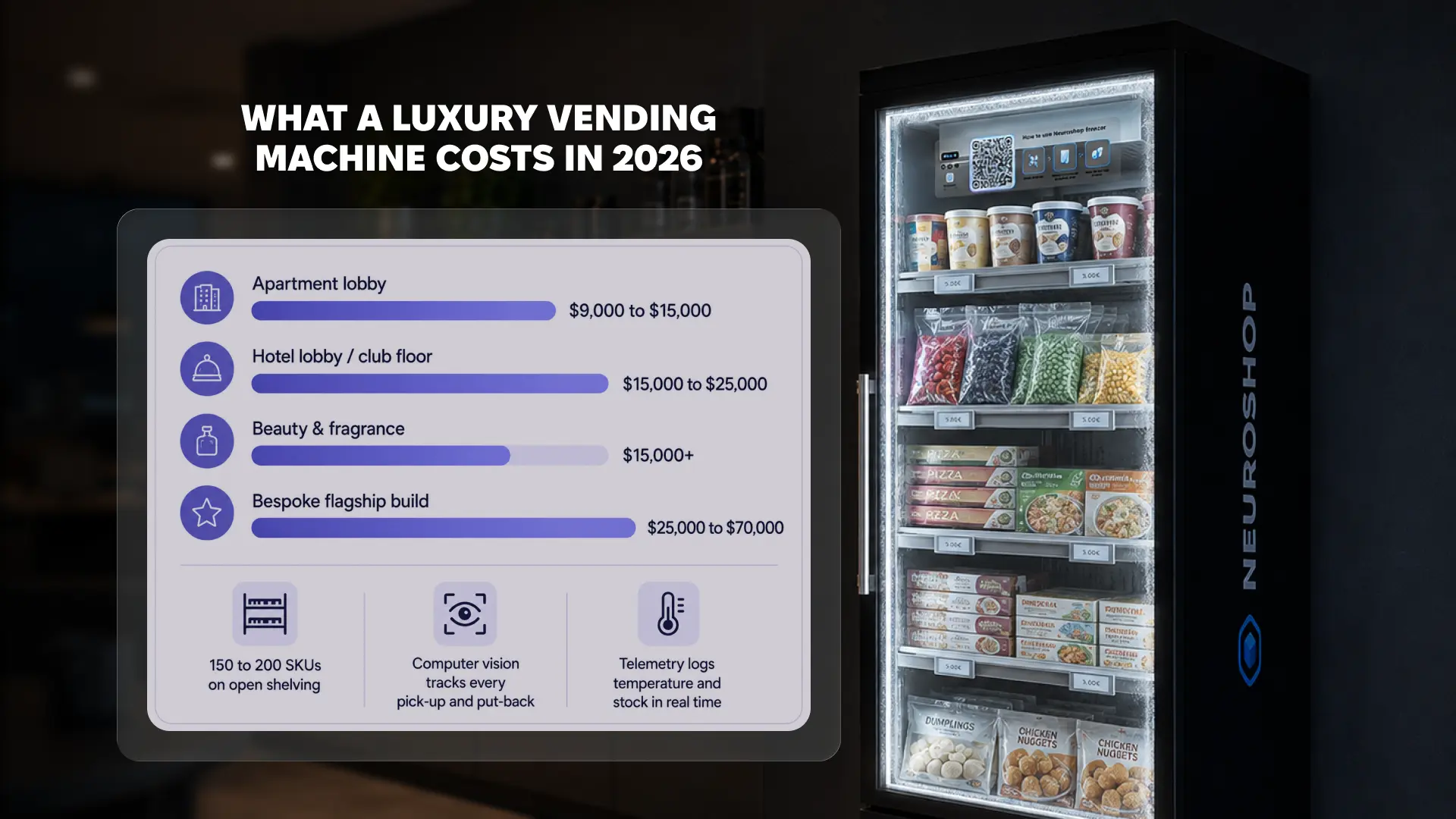
Budget follows the placement more than the product category. The five formats below cover most requests, and each carries its own price implication.
Luxury Hotel Vending Machine
Lobby and club-floor units usually need refrigeration, a large screen, and a finish that matches the surrounding interior. Expect the $15,000 to $25,000 band, since hotels rarely accept a wrapped stock cabinet in a public space.
Luxury Apartment Lobby and Gym Machines
A luxury apartment vending machine serves a fixed group of residents, so presentation and uptime carry more weight than capacity. Lobby installations typically sit at $9,000 to $15,000. A luxury apartment gym vending machine adds chilled drinks and recovery products, which pushes toward the upper end of that range.
Luxury Beauty and Fragrance
Beauty is the strongest fit in the category. Products are sealed, carry high margin, and sell well on visual presentation. Boxed cosmetics and fragrance need elevator dispense to survive delivery intact, which places most beauty builds above $15,000.
Luxury Coffee Vending Machine
Bean-to-cup equipment prices separately from retail cabinets. Premium units with grinders, milk systems, and touchscreens run $10,000 to $25,000, and servicing costs more than any dry-goods machine.
Luxury Alcohol Vending Machine
Champagne and spirits work only in licensed venues, and the build needs refrigeration, bottle protection, and age verification. Licensing requirements usually decide whether the concept is viable, well before hardware specification begins.
Planning a premium automated retail concept for a hospitality venue?
Neuroshop builds AI micromarkets that fit lobbies, gyms and members-only spaces.
Costs That Arrive After Purchase
The cabinet covers only part of the first-year spend on a premium installation. Planning the remaining items early keeps a luxury vending machine setup on schedule.
- Delivery and installation. Large cabinets need freight, sometimes a lift, and a scheduled install window agreed with the venue.
- Opening stock. Premium SKUs tie up more capital per shelf than snacks, often several thousand per machine.
- Payment processing. Card fees apply to each transaction and scale with the higher ticket values luxury products carry.
- Venue commission. Hotels and premium residential buildings usually negotiate a revenue share for the floor space.
- Service and monitoring. Connected machines cost more to run than basic units. Our guide to vending machine ownership costs breaks the figures down by machine type.
Revenue targets deserve the same scrutiny. Our guide to realistic vending machine profits gives the per-machine monthly figures a premium placement needs to beat.
How AI Micromarkets Compare on Cost
A second route to a premium concept skips the coil-and-glass format. Neuroshop AI micromarkets use open shelving, so customers pick products up and handle them the way they would in a boutique. That removes the dispense engineering behind much of the cost in a luxury cabinet build.
Tracking runs through computer vision. Cameras identify each item as it leaves the shelf, log put-backs, and charge the customer on exit. Open shelving also carries 150 to 200 SKUs against roughly 40 in a comparable cabinet. Average transaction values run higher too, since customers buy several items in one visit.
For chilled premium ranges, fridge vending machines cover the same ground with temperature logging built in. Either format reports through the Neuroshop telemetry platform, so venue managers see stock levels and faults without a site visit.
Neuroshop prices each project individually, because a single lobby installation and a ten-site rollout carry very different economics.
Running premium food and drink formats across European venues?
Neuroshop equipment logs temperature and produces the records inspectors ask for.
Final Take
A realistic luxury vending machine budget starts near $9,000 for a smart premium cabinet and reaches $25,000 or more once elevator dispense, refrigeration, and a flagship finish enter the specification. Bespoke engineering can double that again. The tier you need follows the venue and the product, so scope both before requesting quotes. If the concept depends on presentation and product handling, price an AI micromarket alongside the cabinet options before committing.
FAQ
How much does a luxury vending machine cost? Most premium builds fall between $9,000 and $25,000 depending on screen size, dispense mechanism, refrigeration, and finish. Bespoke engineering projects reach $70,000. Branded standard cabinets with a wrap start closer to $4,500.
What is the difference between a smart vending machine and a luxury one? A smart luxury vending machine adds premium materials, larger screens, and protective dispense on top of the telemetry and cashless payment that define smart equipment. The technology overlaps heavily, while the finish and venue expectations differ.
Which products suit a luxury vending machine concept? Beauty, fragrance, packaged jewelry, premium accessories, and chilled drinks perform best. The common requirement is sealed packaging that survives delivery, strong margin, and a venue where customers accept the price point.
Do luxury vending machines need refrigeration? Only for chilled categories such as champagne, fresh food, and some cosmetics. Refrigeration adds compressor cost and ongoing energy draw, so specify it only when the product range requires temperature control.
Is an AI micromarket cheaper than a luxury vending machine? Pricing depends on scale and configuration in both cases. Micromarkets remove the dispense mechanism, hold four to five times more SKUs, and let customers handle products directly, which suits premium ranges well.

