Fresh food vending sells sandwiches, salads and prepared meals from an unattended machine. The commercial case is strong, and so is the compliance load. Every chilled item carries a use by date with legal force across the EU, and each hour outside the correct temperature band shortens the safe window.
Operators who treat expiry management as a manual chore usually hit two problems at once. Stock ages out unnoticed and becomes a write-off, while inspections arrive without records to answer them. So this guide covers the rules, the routines that keep chilled stock safe, and the documentation inspectors ask for.
What Separates Fresh Food Vending from Snack Vending
A snack machine carries months of shelf life in every slot. A chilled machine stocked with sandwiches carries two to five days, and that single difference reshapes the whole operating model.
Where the operational demands diverge:
- Restocking frequency moves from weekly to daily or every second day at busy sites
- Refrigeration performance becomes a food safety control with legal weight behind it
- Stock rotation has to be verifiable, since a missed item can be sold past its date
- Product loss is measured per visit rather than per quarter
Fresh food also raises average transaction value at a location, since shift workers and late-running teams need meals when kitchens are closed. Therefore the revenue upside is real, provided the safety routine underneath it is solid.
The EU Rules That Apply to Fresh Food Vending
European food law treats a vending machine as food business premises. Three instruments define most of what an operator has to do, and each carries direct consequences for how machines are stocked.
Hygiene obligations
Regulation 852/2004 names vending machines explicitly in Annex II, Chapter III. Machines must be sited, designed and maintained so contamination risk stays controlled, with food contact surfaces kept sound and easy to clean. Operators also have to run HACCP-based procedures covering the hazards specific to their products.
Date marking
Under Article 24 of Regulation (EU) No 1169/2011, highly perishable foods carry a use by date in place of a best before date. Once that date passes, the food is legally deemed unsafe, and no argument about its actual condition changes that classification.
| Date marking | What it signals | What it means in a machine |
|---|---|---|
| Use by | Microbiological safety limit on highly perishable food | Item must leave the machine before the date passes; later sale is a breach |
| Best before | Quality limit on food that stays safe afterwards | Sale remains legal in most markets, though operators usually remove stock anyway |
Traceability and withdrawal
Regulation (EC) No 178/2002 requires food businesses to identify suppliers and recipients one step in each direction. For vending, that means knowing which batch went into which machine on which date. Because of that, batch-level records decide the scale of a recall: you empty three machines instead of thirty.
Building an Expiry Management Routine
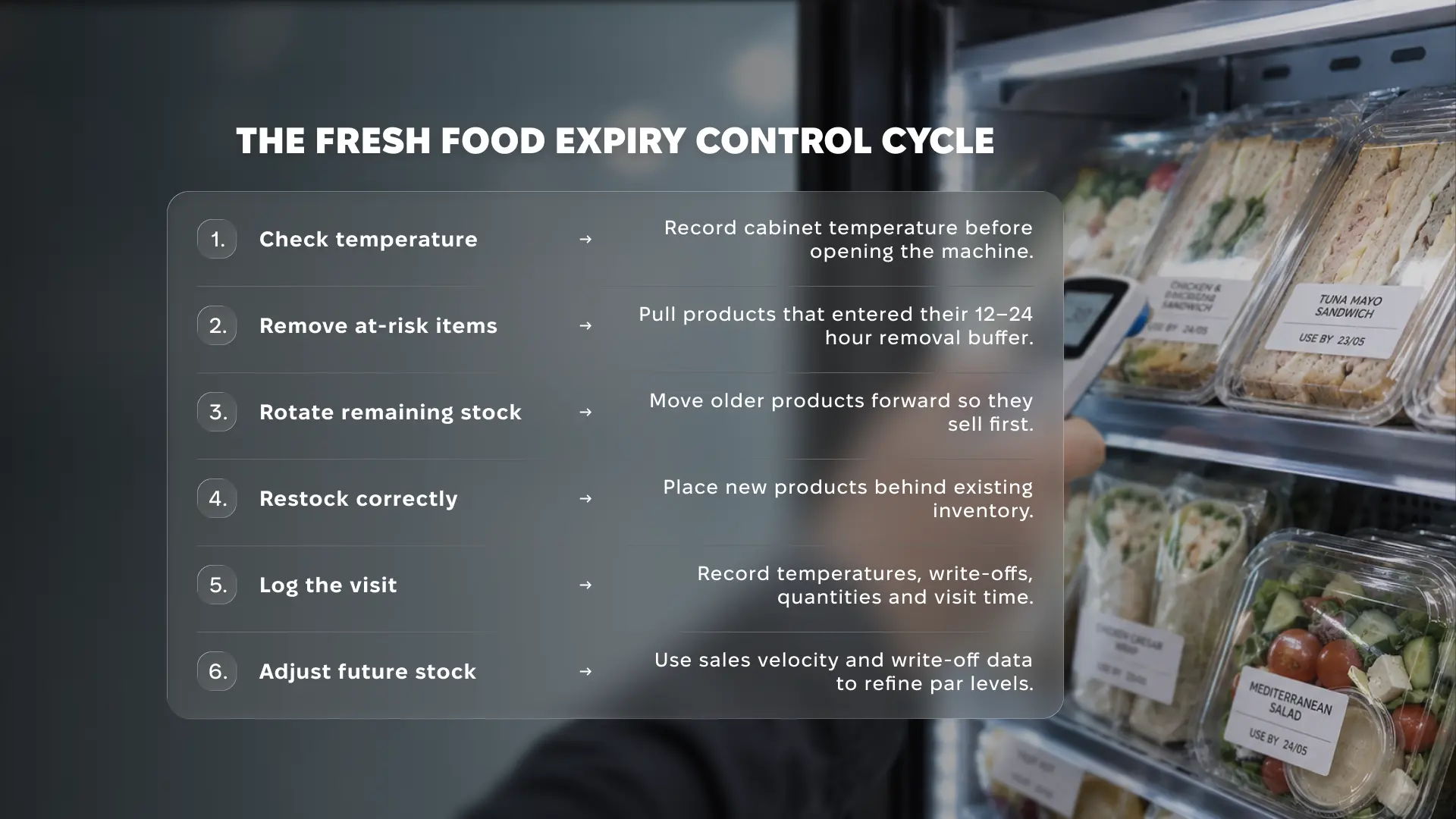
Most expiry failures trace back to a process that depends on someone remembering to check. A documented routine removes that dependency and produces evidence at the same time.
Set a removal buffer ahead of the date
Pulling stock on the morning of its use by date leaves no margin for a delayed route or a sick driver. A buffer of 12 to 24 hours gives the schedule room to absorb disruption. Products with very short shelf life may need that buffer set in hours.
Rotate on every visit
A workable restocking sequence looks like this:
- Record the machine temperature reading before opening the door
- Remove any item inside the removal buffer and log it as a write-off
- Move remaining stock forward so oldest items sit in the front position
- Load new stock behind existing stock, never in front of it
- Log the visit with time, temperatures, write-offs and quantities loaded
The final step matters more than most operators expect. A logged visit is the difference between telling an inspector that you rotate stock and showing them that you do.
Match par levels to real demand
Overstocking a chilled machine guarantees waste, since unsold items expire on the shelf. Sales data at SKU level shows how many units a location clears within the shelf life of each product. Neuroshop’s telemetry platform reports velocity per product per machine, so par levels follow demand rather than estimates.
Retail and food distribution generated around 10 kg of food waste per inhabitant in 2023, according to Eurostat food waste data. Fresh vending sits inside that category, and disciplined par levels remain the cheapest way to cut your share.
Operating food vending machines across Europe?
Neuroshop's AI vending machines produce the compliance records inspectors require.
Cold Chain Control and Temperature Records
Refrigeration is where fresh food vending succeeds or fails. Chilled foods must be held at low, stable temperatures, and the specific band comes from member state legislation and from the storage instructions on each product.
Controls that keep the cold chain intact:
- Continuous temperature logging inside the cabinet rather than spot checks during visits
- Automatic alerts when readings drift above the threshold for a defined period
- A written response procedure covering what happens to stock after an excursion
- Scheduled condenser cleaning and door seal checks as preventive maintenance
An alert only helps when someone acts on it. So define in advance how long an excursion can last before stock is written off, and record the decision each time. Neuroshop’s fridge vending machines log cabinet temperature continuously and push alerts to the operator dashboard, which builds the evidence trail automatically.
What Inspectors Actually Ask For
Food safety officers rarely arrive looking for a single failure. They assess the system as a whole, and they test it by asking for records.
Documentation worth having ready:
- Temperature logs covering the previous months, retrievable per machine
- HACCP documentation with hazards, critical limits and corrective actions
- Supplier records and delivery notes carrying batch identification
- Restocking and rotation logs showing dates, times and write-offs
- Cleaning schedules and staff hygiene training records
Country requirements sit on top of this baseline, covering registration and food business notification. The Neuroshop guide to vending licensing sets those out market by market.
Where Automation Reduces Risk and Waste
Manual expiry tracking scales badly. At twenty machines with daily rotation, individual date checks run into the thousands every week, so accuracy drops long before the route does.
Computer vision changes the input side of that equation. Machines identify items at SKU level as customers take them, which produces a live inventory without manual counting. Combined with batch data captured at loading, the system flags which items approach their removal buffer.
How Neuroshop smart micromarkets handle expiry management
Neuroshop’s AI micromarkets hold chilled and ambient ranges in one installation. The management software behind them is where expiry control becomes practical at scale. Operators work from planograms that define what sits in every zone, so each shelf position maps to a known product and shelf life.
What the platform covers day to day:
- Planogram setup and micromarket configuration for each individual location
- A full product view with stock levels, batch data and expiry dates per item
- Delivery planning built on measured sales velocity instead of fixed schedules
- Expiry alerts that group items by removal date across the whole network
- Write-off logging that feeds straight into your compliance records
Pricing belongs to the same picture. Electronic shelf labels let operators apply a markdown to items nearing their removal buffer without printing anything or visiting the site. It all boils down to selling perishable stock before it ages out, and a final-day discount usually beats a write-off.
Producers and caterers selling their own prepared meals can review the B2B food and catering solutions built around this setup.
Cutting waste on chilled stock?
See how live inventory data keeps fresh products moving before expiry.
Final Thoughts
Fresh food vending rewards operators who run it as a food business with equipment attached. Define removal buffers, rotate on every visit, log temperatures continuously, and keep records that answer questions before anyone asks. Waste falls when par levels follow real demand, and inspections become procedural once the evidence exists. Neuroshop machines and management software produce that evidence during normal operation.
Frequently Asked Questions
Can I sell food after its use by date has passed?
No. Under Article 24 of Regulation (EU) No 1169/2011, food is deemed unsafe once the use by date passes. The classification applies automatically, regardless of the product’s apparent condition or storage history.
How often should fresh food vending machines be restocked?
Frequency follows shelf life and sales velocity. Sandwiches and salads usually need daily or alternate-day visits, while yoghurt and packaged dairy allow longer intervals. Telemetry data lets you set visit frequency per machine rather than applying one schedule everywhere.
What temperature should a fresh food vending machine hold?
Chilled foods require low, stable storage temperatures, with the exact band set by national legislation and by the storage instructions printed on each product. Continuous logging matters more than the specific figure, because inspectors ask for stability evidence.
Do I need HACCP documentation for a vending machine?
Yes. Regulation (EC) No 852/2004 requires food business operators to implement HACCP-based procedures. For vending, documentation typically covers temperature control, stock rotation, cleaning schedules and supplier verification, scaled to the products you sell.
How does AI vending reduce food waste on chilled products?
Live inventory tracking shows what sells at each location and how fast. Par levels can then match real demand, which limits the number of items sitting in a machine long enough to reach their expiry date.

