Key Takeaways
- Contactless is the default: most vending customers now tap or scan instead of inserting a coin or a card.
- Integrated beats retrofit: readers built into the machine controller cause fewer failures than bolt-on units wired in later.
- Fees are predictable, if you know where to look: processing costs combine a capped interchange fee with a scheme fee and an acquirer markup.
- Compliance is not optional: any reader that touches card data needs PCI PTS certification and secure data handling.
- Connectivity decides uptime: a reader with no cellular or Wi-Fi backup goes offline the moment a location’s network does.
Card and mobile payments now cover most transactions at unattended payment terminals across Europe. In the first half of 2025, 83% of in-person card payments in the euro area were contactless, according to European Central Bank data. That is up from 81% a year earlier. This shift makes the card reader, sometimes called a vending machine credit card reader, one of the most important parts of a vending machine. It is not an accessory added later. A reader that drops its connection or fails a compliance check costs more in lost sales than it ever saves.
This guide covers how a vending machine card reader works, what it costs, and what to check before installing one.
How Do Vending Machine Card Readers Work?
A vending machine card reader is the hardware and software that lets a customer pay with a card or mobile wallet instead of coins. First, it reads the payment credential from a tap, a chip card insertion, or an NFC-enabled phone. From there, that credential goes to a payment processor for authorization, and the machine releases the item once the transaction clears. In practice, most of this happens in two to three seconds.
Why MDB Compatibility Matters
Most readers connect through MDB (Multi-Drop Bus), the standard protocol for vending hardware. In practice, it lets a card reader, coin mechanism, and bill validator share one wiring line back to the controller. Because of that, MDB compatibility works across most control boards on the market, while a proprietary protocol locks you into one manufacturer’s support queue instead.
Connectivity decides whether that reader keeps working in the field:
- Cellular connectivity with a built-in SIM: keeps the reader online at warehouses, transit stops, or other sites with no reliable Wi-Fi.
- Wi-Fi fallback: useful indoors, where a stable network is usually already available.
- Offline transaction queuing: completes a sale during a brief outage and settles it once the connection returns.
Analyst firm Berg Insight counted 8.1 million connected vending machines worldwide in 2025. Cashless payment support was the main driver of that connectivity growth, according to IoT Business News.
Running vending machines without reliable cashless payment?
Neuroshop's integrated card readers process contactless payments without third-party hardware or extra wiring.
Types of Vending Machine Card Readers
Picking a card reader for vending machine fleets comes down to one decision: retrofit or integrated. A retrofit card reader is a standalone unit wired into the MDB bus of an existing machine. An integrated reader, by contrast, ships built into the machine’s controller, so payment and vending logic run as one system from day one. That split tracks a broader trend. Cashless systems are already fitted to almost 78% of the vending fieldbase across Europe, according to the European Vending Association. So the reader is now standard equipment on most new machines.
| Factor | Retrofit Reader | Integrated Reader |
|---|---|---|
| Installation | Added after purchase, wired separately | Built in at manufacture, no extra wiring |
| Reliability | Extra connector adds a failure point | Fewer moving parts between reader and controller |
| Data | Payment log separate from sales data | Transaction and inventory data in one dashboard |
| Software updates | Managed independently of the machine | Bundled with the machine’s software updates |
| Best fit | Upgrading an older coin-only machine | New machine purchases and multi-site rollouts |
Machines like Neuroshop’s AI micromarkets ship with the reader already integrated. That removes the connector as a point of failure. It also feeds every transaction into the same inventory management and sales analytics dashboard operators already use.
Vending Machine Payment Systems: What They Need to Handle
A modern vending machine payment system usually needs to support three payment types at minimum:
- Chip and PIN or chip insertion for standard credit and debit cards.
- Contactless tap for NFC-enabled cards.
- Mobile wallets such as Apple Pay and Google Pay, which use the same NFC antenna as a contactless card.
For a full walkthrough of a tap-to-pay transaction, see our guide on use Apple Pay on a vending machine. It covers the authorization steps in detail.
Whether to keep a coin mechanism alongside the card reader depends on the location. A machine in a factory canteen with an older workforce may still see meaningful coin volume, while an office lobby rarely does. Our comparison of coin vs cashless vending machines walks through when each setup pays off.
Vending Machine Card Reader Cost and Credit Card Processing Fees
What Drives the Price of the Reader
Reader pricing depends mainly on whether it is a standalone retrofit unit or built into the machine. A retrofit unit is a separate line item added on top of the machine price. An integrated reader, on the other hand, is part of the purchase price, with no separate hardware to source or mount.
Vending Machine Credit Card Processing: Fees You Will Actually Pay
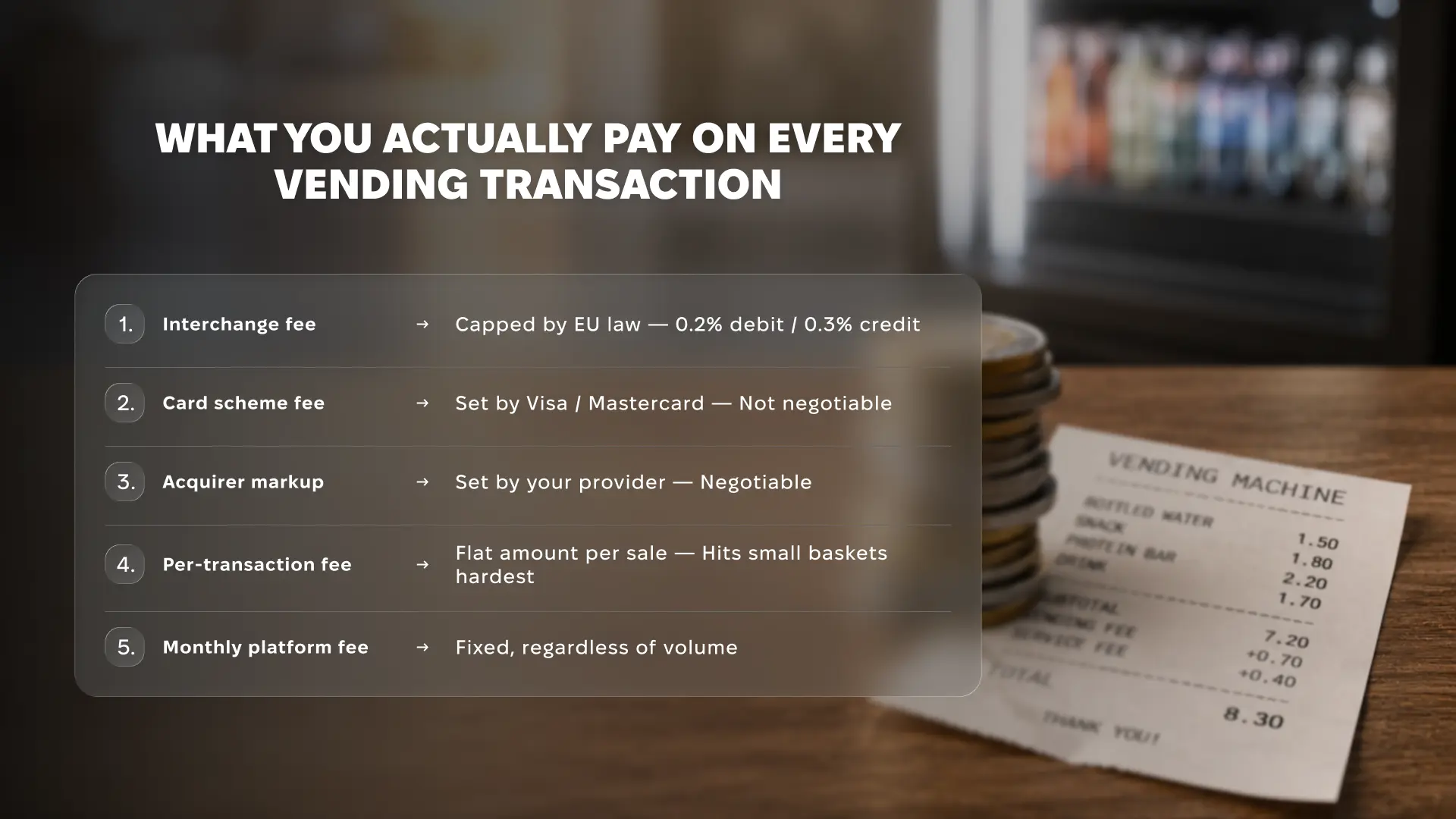
Payment processing on a credit card reader for vending machine operations is not free, even under the EU’s capped interchange rate. Regulation (EU) 2015/751 caps the interchange fee on consumer card payments at 0.2% of the transaction for debit cards and 0.3% for credit cards. That cap is only one piece of the total cost. Processors add a card scheme fee and an acquirer markup on top, and many also add a per-transaction fee or a monthly fee. Budget for the effective rate to run higher than the interchange cap alone once those extra layers are added in.
Compliance adds a separate cost line, and PCI compliance is not optional. Any reader that captures card data needs PCI PTS certification, and its software must meet PCI DSS rules for handling that data. Neuroshop’s fridge vending machines ship with a PCI-compliant reader as standard, so operators are not chasing a separate certification before the machine can accept cards.
Tired of chasing payment fees across every machine?
Neuroshop's control panel shows transaction totals and processing costs by location.
How to Choose the Best Card Reader for Vending Machine Operations
Before signing off on a reader for a new or existing machine, check these six items:
- MDB compatibility: confirms the reader works with your existing or planned machine controllers without a custom adapter.
- Payment security: PCI PTS certification and end-to-end encryption protect card data from the reader to the processor.
- Backup connectivity: built-in SIM plus Wi-Fi keeps the machine taking payments if one network drops.
- Transparent processing fees: a flat, published rate is easier to budget than a tiered scheme with hidden minimums.
- Refund handling: the ability to reverse a failed vend without a manual override at the machine.
- One vending management system: transaction and inventory data land in the same dashboard as the rest of your route instead of a separate app.
Machines already connected to Neuroshop’s telemetry platform get remote monitoring that flags equipment issues in real time. A payment system without that visibility means you hear about a broken reader from a customer complaint before it ever shows up on a dashboard.
The cheapest reader upfront is not always the cheapest one over its total cost of ownership. With that in mind, weigh processing fees, compliance costs, and service calls against the sticker price before comparing options.
Frequently Asked Questions
How do vending machine card readers work? A card reader captures payment details from a tap, chip, or mobile wallet. It sends them to a processor for authorization over the machine’s cellular or Wi-Fi link, and releases the item once the transaction is approved.
How much is a card reader for a vending machine? Pricing depends on whether you buy a standalone retrofit unit or a machine with the reader already built in. Integrated readers are usually included in the machine’s purchase price, with no separate hardware to source or install.
Can you put a card reader on any vending machine? Most machines built in the last decade support MDB, so a retrofit card reader can usually be added. Very old coin-only machines may need a controller upgrade first, which can cost more than replacing the machine.
What fees do vending machine card readers charge? Processing fees combine a capped interchange fee, 0.2% for debit and 0.3% for credit under EU rules, with a scheme fee and an acquirer markup. Many providers also add a flat per-transaction fee or a monthly platform fee.
Can vending machine card readers accept Apple Pay and Google Pay? Yes, as long as the reader has an active NFC antenna and a processor agreement that supports mobile wallets. Most integrated readers sold today include this by default; older retrofit units may need a firmware update.
Final Thoughts
A vending machine card reader is not a separate purchase decision from the machine itself. MDB compatibility, backup connectivity, and PCI certification decide whether a machine keeps selling when a network blips or an inspector asks for records. For that reason, machines that ship with the payment system already built in remove one more point of failure from the route. Neuroshop’s fridge vending machines and AI micromarkets, for instance, come with certified, contactless-ready readers installed. That makes the payment layer one less thing to configure before a machine goes live.

