The global intelligent vending machines market is projected to reach $53.95 billion by 2033, growing at a CAGR of 11.45%. This expansion reflects a fundamental shift from mechanical button-press systems to AI-powered retail automation that recognizes products instantly, processes multiple items simultaneously, and completes transactions in under 30 seconds. For a closer look at how AI improves vending machine performance in real deployments, see our dedicated breakdown.
In this guide, you’ll discover how AI vending machines work through their core technologies, understand the step-by-step transaction process, and learn what separates these smart systems from traditional models. Whether you’re exploring an AI vending machine business or evaluating AI vending machines for sale, this breakdown reveals the complete technology stack behind modern autonomous retail.
What Are AI Vending Machines?
An AI vending machine is an autonomous retail system using artificial intelligence, computer vision, and sensor networks to identify products, process transactions, and manage inventory without human intervention. Unlike traditional machines dispensing single items mechanically, AI powered vending machines create open-access shopping. Customers browse freely and purchase multiple items through automatic recognition.
Key differences:
- Traditional machines: Physical slots with buttons tied to mechanical dispensers
- AI vending machines: Open shopping with visual recognition identifying products anywhere
Core capabilities:
- Automated product recognition: Computer vision and RFID identify items without barcodes
- Cashierless checkout: Transactions complete automatically when customers leave
- Real-time inventory management: Stock levels update instantly without manual counting
- Customer behavior analytics: Systems track browsing patterns and purchase histories
- Multi-item transactions: Customers select multiple products like convenience store shopping
- Grab-and-go convenience: No buttons, mechanical dispensers, or checkout queues
Vending machine AI technology handles complex scenarios. Customers pick up five products, examine them, return two, and walk away with three—the system tracks everything and bills only for items taken.
Advanced implementations extend into AI micromarkets. These are unmanned retail spaces (10-30 square meters) with multiple refrigerators and shelves offering 300-500+ SKUs. These operate 24/7 without staff, creating autonomous convenience stores.
The transformation is immediate: no lines, no scanning, no exact change needed. It mirrors taking items from your home refrigerator, with invisible payment processing.
Looking to get started with AI vending
Let Neuroshop be your vendor.
Technologies Powering AI Vending Machines
Modern AI vending machines integrate multiple technologies working simultaneously for seamless retail experiences. Understanding how these function reveals why AI smart vending machines achieve 99%+ accuracy while processing transactions in under 30 seconds.
Computer Vision and Product Recognition
Computer vision forms the visual intelligence layer of AI vending machines. High-resolution cameras positioned strategically throughout the machine capture detailed images from multiple angles, feeding data continuously to machine learning algorithms trained to recognize hundreds of products by their visual characteristics.
How the recognition process works:
- High-resolution camera placement: Multiple cameras at different angles capture complete product views
- Shape, color, and label analysis: Algorithms identify products through geometry, packaging design, and text recognition
- Real-time vs batch processing: Systems track continuously or analyze when doors close
- Accuracy rates and continuous learning: Each transaction improves recognition through machine learning
When a customer picks up a can of soda, the system identifies the specific brand, flavor, and size based on visual markers. Accuracy improves continuously as each transaction adds training data that helps algorithms distinguish between similar products more effectively.
RFID Scanner Technology
Radio-frequency identification (RFID) provides wireless communication that complements visual recognition. Small RFID tags attached to products emit unique identification signals that specialized readers detect instantly without line-of-sight requirements.
Key RFID capabilities in AI vending machines:
- RFID tag application to products: Each item receives a unique wireless identifier during stocking
- Instant transaction registration: Readers detect tag movements when customers remove items
- Inventory updates without manual input: Stock levels adjust automatically
- Anti-theft capabilities: Missing tags trigger alerts without corresponding payment transactions
When customers remove products, RFID readers detect specific tag movements and register which items left the machine. The technology maintains accurate counts without manual intervention. Each product entering gets logged during restocking. Each product leaving triggers automatic inventory deduction.
Smart Weight Sensors (Scales Scanner Kit)
Precision scales at shelf level detect slight weight changes when customers pick up or return products, registering fluctuations as small as a few grams. This enables accurate tracking of variable-weight items that challenge purely visual systems.
Weight sensor advantages:
- Detection of smallest weight fluctuations: Sensors register changes of just a few grams
- Adaptive algorithms for product identification: Systems learn to recognize products by weight profiles
- ±30% tolerance for variable weights: Accommodates natural variations in fresh food and packaged goods
- Self-learning capabilities: Accuracy improves as systems process more transactions
Modern scale systems account for acceptable weight variations. If a product’s registered weight is 200 grams, the system recognizes 140-260 grams as the same item, accounting for packaging variations. This flexibility ensures AI powered vending machines handle real-world product variations without false errors.
Triple Verification System
The integration of vision, RFID, and weight systems creates redundancy that maximizes accuracy while minimizing errors. When customers remove products, all three systems activate simultaneously to cross-reference data points.
How triple verification ensures accuracy:
- Vision + RFID + Weight collaboration: Three independent systems confirm each transaction
- Maximum accuracy through redundancy: If one system faces challenges, two others provide validation
- Customer trust and billing confidence: Multiple verification sources eliminate billing disputes
- Reduced errors and chargebacks: Error rates drop below 1% compared to 5-10% in traditional machines
This layered approach ensures transactions process correctly even when individual components face challenging conditions. Customer trust improves dramatically because multiple independent systems validate purchases. Chargebacks drop significantly with three distinct sources confirming each transaction.
Contactless Payment Systems
Modern AI vending machines eliminate cash handling through integrated contactless payment. NFC readers accept mobile wallets like Apple Pay and Google Pay, processing tap-to-pay transactions in under two seconds.
Payment technology features:
- Apple Pay, Google Pay, contactless cards: All major mobile wallets and tap-to-pay cards supported
- QR code payment options: Customers scan codes through mobile apps for instant authentication
- PCI compliance and encryption: All payment data is protected under the PCI DSS standard, the industry’s baseline for cardholder data security.
- Split payment capabilities: Some systems support multiple payment methods per transaction
QR code payments offer alternatives for customers without NFC-enabled devices. Users scan displayed codes through banking apps, authenticate, and gain immediate access. This flexibility ensures virtually any customer can complete purchases regardless of payment preferences.
Cloud-Based Management Platform
Behind every AI smart vending machine operates a cloud platform enabling remote monitoring, data analytics, and multi-location management from any internet-connected device.
Cloud platform capabilities:
- Real-time inventory tracking: See exact stock levels across all machines without site visits
- Sales analytics dashboard: Analyze performance by product, location, time, and demographics
- Multi-location management: Control multiple machines from a single interface
- Predictive restocking alerts: AI algorithms forecast when products will run out
The analytics transform raw data into actionable insights. Operators identify top-selling products, determine optimal pricing, and discover purchasing patterns. Predictive restocking analyzes sales velocity and forecasts replenishment needs days in advance, allowing optimized delivery routes that ensure popular products never run out.
Learn more about top vending machine technologies powering modern retail automation.
How AI Vending Machines Work: Step-by-Step Process
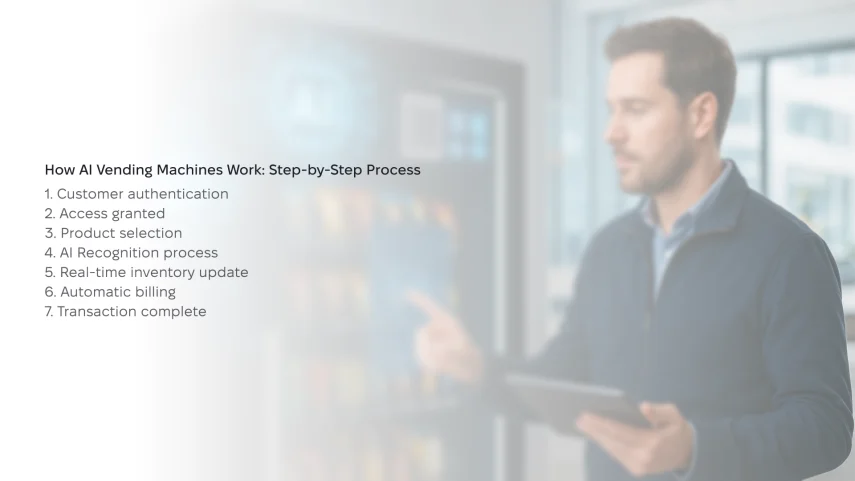
Understanding how AI vending machines work requires walking through the complete customer journey. The entire process takes 15-30 seconds for multiple items, compared to 45-90 seconds per single item in traditional machines. For practical ways to apply AI in vending, see real-world implementation examples.
- Customer authentication. Customers tap a contactless card on the NFC reader, scan a QR code, or use facial recognition. Authentication takes 1-2 seconds and verifies the payment method is valid.
- Access granted. The door unlocks automatically and all sensors activate simultaneously. Computer vision cameras begin tracking, RFID readers monitor tag movements, and weight sensors calibrate for change detection.
- Product selection. Customers browse freely, picking up items to examine them, reading labels, comparing options, and returning unwanted products. Multiple cameras track hand movements, RFID sensors detect tag movements, and weight sensors register items removed.
- AI Recognition process. Computer vision identifies products by visual features. RFID confirms product identity through unique tags. Weight sensors validate expected mass. The system cross-references all three data points for final purchase determination.
- Real-time inventory update. The system deducts identified products from the inventory database. The cloud platform updates stock levels instantly. If inventory drops below thresholds, restocking alerts notify operators.
- Automatic billing. The final total is calculated automatically. Payment processes through the pre-authorized method without checkout scanning or manual confirmation.
- Transaction complete. A digital receipt sends to an email or mobile app. The door closes automatically, and analytics data records for business insights.
The entire process from door opening to billing takes 15-30 seconds for 3-5 items. Even purchases with 10+ items complete in 40-45 seconds, dramatically faster than traditional machines where buying 3 items requires three separate transactions taking 2-3 minutes.
Interested in maximizing vending performance? Explore best locations for micromarket vending machines to find ideal placement opportunities.
How to Use an AI Vending Machine by Neuroshop
Using a Neuroshop AI vending machine is intuitive even for first-time customers, with multiple payment options and streamlined processes.
For First-Time Customers
Download the Neuroshop App (Optional) – While not required, the mobile app (iOS/Android) provides the best experience with one-time payment setup, loyalty program enrollment, purchase history, and personalized product recommendations.
Approach the Machine – The touchscreen displays a welcome message with clear instructions in multiple languages. Audio guidance provides accessibility for visually impaired users.
Choose Your Payment Method – Tap a contactless card, scan a QR code, use Apple Pay/Google Pay, or scan the Neuroshop app. Authentication takes 1-2 seconds.
Shop Freely – The door unlocks automatically. Pick up items, examine labels, compare options, and take your time. Return any unwanted items—the system only bills for products actually taken.
Walk Away – Close the door and leave. Automatic billing happens in the background. A digital receipt arrives via email or app within seconds.
Customer Support Features
Neuroshop machines include built-in support systems:
- Built-in help screen: Access common questions about payments and product selection
- Audio assistance: Voice-guided instructions for visually impaired users
- Remote support button: Connect to live help for troubleshooting
- Quick issue resolution: Most problems resolve within 1-2 minutes remotely
AI vs Traditional Vending Machines: What’s the Difference?
The differences between AI vending machines and traditional models extend far beyond technology. These systems represent fundamentally different approaches to retail automation, with implications for customers, operators, and business profitability. Here’s a comprehensive comparison:
| Feature | Traditional Vending Machine | AI Vending Machine |
| Payment | Cash, coins, basic card reader | Contactless, mobile wallets, QR codes |
| Product Selection | Buttons with alphanumeric codes | Open access, grab-and-go browsing |
| Checkout Process | Press button → mechanical dispenser → collect item | Open door → take items → automatic recognition → walk away |
| Inventory Tracking | Manual counting, end-of-day reports | Real-time automated tracking, instant updates |
| Transaction Time | 45-90 seconds per item | 15-30 seconds for multiple items |
| Product Variety | 30-50 SKUs, mostly packaged goods | 300-500+ SKUs, fresh food, beverages, meals |
| Customer Experience | One item per transaction, mechanical | Multiple items, browse freely, natural shopping |
| Error Rate | 5-10% (jams, failed dispensing) | <1% (triple verification) |
| Theft Prevention | Physical barriers only | Multi-sensor verification, instant alerts |
| Restocking | Visual inspection required | App-based alerts with exact quantities needed |
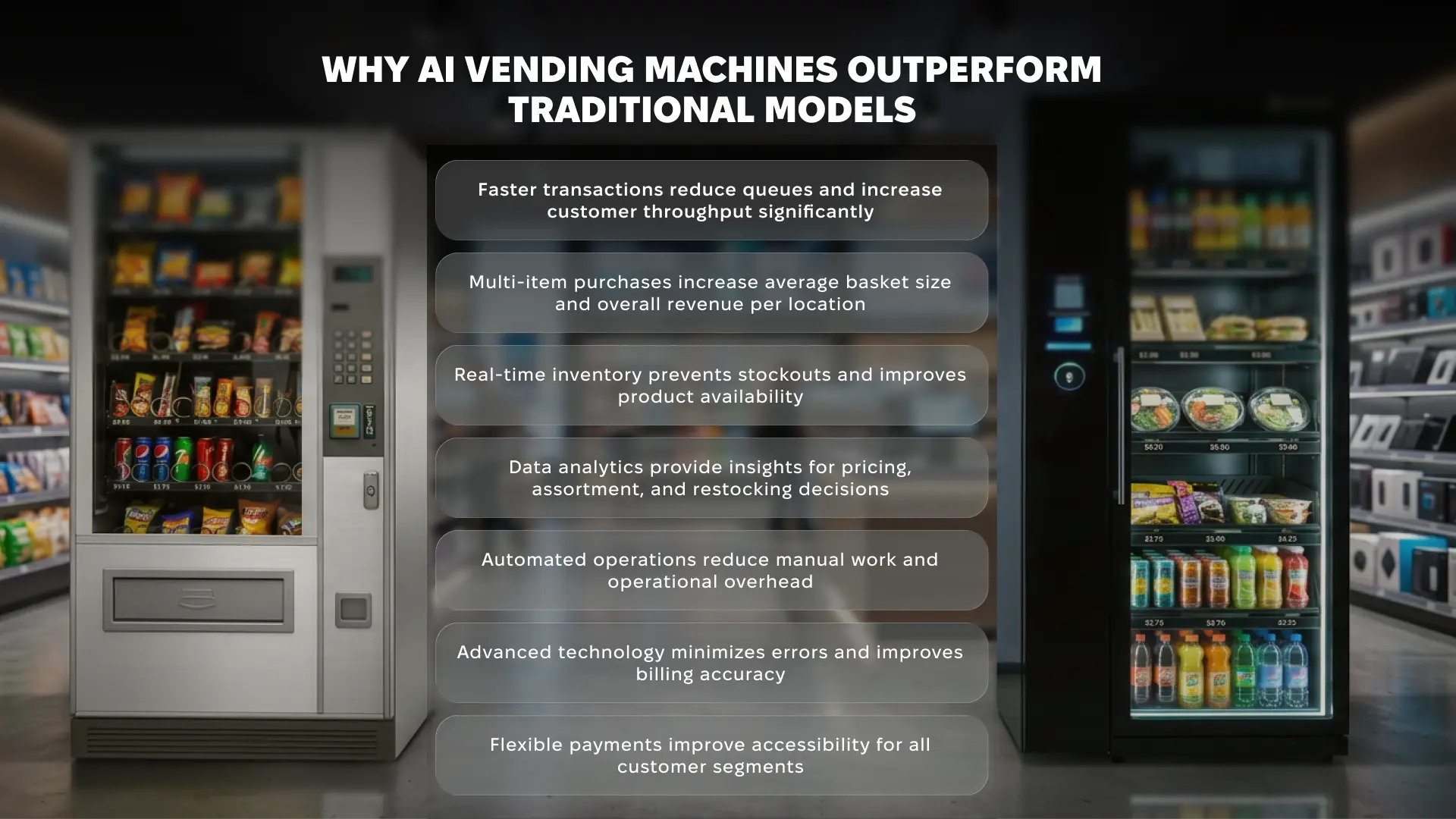
The revenue difference deserves attention. AI vending machines consistently generate 3-4x more revenue per location than traditional models. This comes through faster transactions serving more customers, larger product selections capturing more opportunities, better customer experiences driving repeat visits, and real-time inventory preventing stockouts.
AI vending machines eliminate friction points. These include mechanical failures, slow checkout, limited selections, and reactive maintenance. The result is higher sales, lower costs, and better customer experiences across every metric that matters for vending machine business success.
Need to switch to AI vending?
Consider Neuroshop micromarkets.
Why Neuroshop AI Vending Machines Work Better
Neuroshop integrates proven technologies with proprietary innovations for maximum reliability and profitability, combining technical excellence with practical business support.
Complete technology integration:
- Neural Vision + RFID + Scales triple verification as standard: Every machine includes all three recognition systems for maximum accuracy
- Proprietary mobile app for operators: Custom software provides deeper insights than generic platforms
- 24/7 cloud monitoring and support: Technical teams monitor performance and address issues proactively
- Custom configurations: Solutions adapt to offices, factories, hospitals, and campuses
Self-learning algorithms improve over time, achieving 97-98% accuracy initially and climbing to 99%+ after the first few thousand transactions.
Business support that drives success:
- Comprehensive training: Operators receive training on operation, product selection, and pricing
- Scalable infrastructure: Technology accommodates single locations to multi-site networks
- Flexible equipment: Custom configurations for different product categories
Neuroshop’s self-learning algorithms improve accuracy over time as machines process more transactions. The platform keeps learning to make operations smoother and more efficient.
Ready to explore AI vending machines? See Neuroshop AI micromarkets and schedule a demo.
Final Take
AI vending machines represent a fundamental evolution in retail automation. The integration of computer vision, RFID tracking, weight sensors, and cloud-based management creates shopping experiences that feel natural and effortless. These systems deliver operational insights that traditional machines could never provide. The triple verification approach ensures billing accuracy. The cashierless checkout eliminates friction. Real-time inventory management optimizes profitability.
Understanding how AI vending machines work is the first step. Testing them in your specific environment is how you discover their true value. Whether you’re placing machines in corporate offices, manufacturing facilities, hospitals, or apartment complexes, the technology adapts to location-specific needs. The system maintains consistent performance across all environments. The result is higher revenue per location, lower operational costs, and customer experiences that drive repeat purchases and build loyalty.
FAQ
How do AI vending machines recognize products?
AI vending machines use triple verification: computer vision cameras identify products visually, RFID tags confirm product identity wirelessly, and weight sensors validate items removed. This layered approach achieves 99%+ accuracy by cross-referencing three independent data sources simultaneously.
What makes a vending machine “AI-powered”?
AI powered vending machines use machine learning algorithms that continuously improve product recognition, predict restocking needs, analyze customer behavior, and optimize operations automatically without human programming. The “AI” refers specifically to systems that learn and improve over time rather than following fixed rules.
How long does a transaction take at an AI vending machine?
Complete transactions take 15-30 seconds from door opening to automatic checkout, including multiple item purchases. Traditional vending machines take 45-90 seconds per single item, making AI systems 6-8x faster for typical multi-item purchases.
Can AI vending machines work without internet?
AI vending machines need the internet for payment processing and real-time updates, but many models include offline payment capabilities and store transaction data locally until connectivity returns. This ensures operations continue during temporary network outages without losing transaction records.
What’s the difference between AI and smart vending machines?
Smart vending machines have basic connectivity and cashless payments. AI vending machines add computer vision, machine learning, predictive analytics, and autonomous product recognition—fundamentally changing how the system operates rather than just adding digital features to mechanical systems.
How much does an AI vending machine cost?
AI vending machines for sale range from $8,000 for basic models to $25,000+ for advanced micro market systems with extensive product capacity and premium features. ROI typically occurs within 18-24 months with proper location and product selection. High-traffic locations often achieve profitability faster.
Do customers need an app to use AI vending machines?
No. Customers can use contactless payment cards, mobile wallets (Apple Pay/Google Pay), or QR codes from banking apps. Mobile apps are optional and provide benefits like loyalty rewards, purchase history, and faster authentication, but aren’t required for successful transactions.

