A vending machine keeps its own record of what sold, what it charged, and what went wrong. DEX is the standard that moves that record out of the cabinet and into your accounting system. It has been in service since the late 1980s, and it still sits underneath most vending management software sold in Europe today. For operators, DEX is the difference between counting coins by hand and closing a route in minutes. This guide covers what the format contains, how the data gets collected, and where it stops being useful for modern micromarkets.
What DEX Technology Is
DEX stands for Data Exchange. It is a text file format with a fixed record structure, generated by the Vending Machine Controller. That controller is the board running pricing, dispensing, and payment logic inside the cabinet. Knowing what the format carries makes the rest of the operational picture easier to read.
What a DEX File Contains
A single readout gives you an audit trail for the machine since its last reset. Typical contents include:
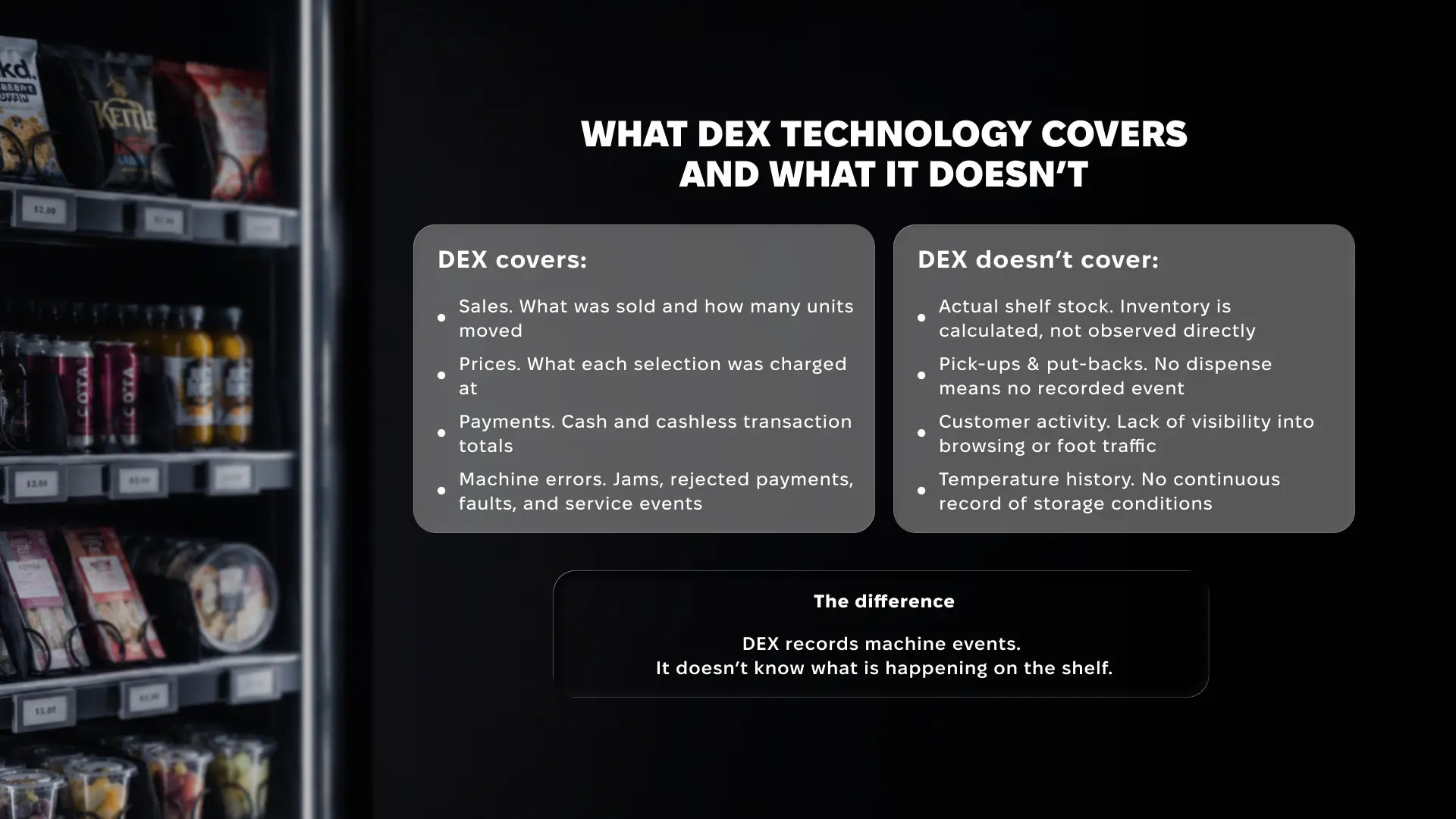
- Units sold per selection. How many items each coil, lane, or shelf dispensed.
- Cash accounting. Coins in, bills stacked, change dispensed, and tube levels.
- Cashless totals. Card and mobile wallet sales, reported separately from cash.
- Price points. The price charged per selection, useful for spotting mispriced slots.
- Error and event codes. Coin jams, bill validator rejections, door openings, and compressor faults.
- Machine identity. Serial number, asset ID, and software version for fleet records.
How DEX Differs from MDB
Operators mix these two up constantly, and the distinction matters when you specify hardware. MDB, or Multi-Drop Bus, is the internal bus connecting payment peripherals to the controller. It lets you add a card reader without rewiring the machine. DEX is the reporting layer that documents what happened after the payment cleared. One handles the transaction, the other records it.
How Operators Collect DEX Data
The format has stayed stable for decades, while the collection method has changed twice. Most European fleets now run some combination of the three approaches below.
- Handheld readout at the machine. A driver plugs a cable into the DEX port, usually a quarter-inch stereo jack, and downloads the file during the route stop. Reliable, though the data is only as fresh as your last visit.
- Telemetry device inside the cabinet. A modem reads the DEX port on a schedule and pushes files to the cloud over cellular. This removes the visit requirement and gives you daily or hourly data.
- Native cloud reporting. Newer machines skip the file entirely and report transactions directly to a platform through an API. DEX stays available for compatibility with existing software.
What DEX Data Changes in Daily Operations
Collecting the file is only half the exercise. The value shows up in five specific workflows where guesswork used to be the default.
- Cash reconciliation. Machine-reported cash totals get matched against what the driver banked. Gaps become visible the same week instead of at year end.
- Demand-driven routing. Sales velocity per selection tells you which machines need a visit and which can be skipped. This is the single largest cost saving for multi-location operators.
- Price auditing. Reported price points confirm that a promotional change was applied to each affected slot across the fleet.
- Fault detection. Error codes flag a failing bill validator or a cooling problem before customers start complaining.
- Shrinkage investigation. Sold units compared against restocked units narrow down where product is disappearing.
If you want the decision-making layer on top of this data, our guide on how to use vending sales data covers the weekly and monthly review routines that turn numbers into action.
Still pulling audit files from machines by hand?
Neuroshop telemetry sends live sales and stock data to one dashboard.
Where DEX Data Runs Out
DEX was built to audit a closed dispensing machine, and it does that job well. Open-format micromarkets, where customers handle products directly, fall outside its design scope. The gaps below come from the format itself, so no software upgrade closes them.
- It reports sales, so stock levels are inferred from restocked quantity minus units sold, and any counting error persists until the next manual audit.
- It cannot record a product picked up and put back, because no dispense event occurred.
- It has no concept of foot traffic, so you cannot separate a low-demand location from a poor product mix.
- It reports at readout, so batch collection gives you yesterday’s picture instead of today’s.
- It says nothing about temperature history, which matters for fresh food compliance in the EU.
| Data point | DEX audit file | Neuroshop vision and telemetry |
|---|---|---|
| Units sold | Per coil or lane | Per SKU, identified visually |
| Cash totals | Full cash accounting | Cashless transactions logged in full |
| Price charged | Yes | Yes, synced to Electronic Shelf Labels |
| Stock on shelf | Estimated from sales counts | Measured directly, updated per pick-up |
| Put-backs | Not recorded | Recorded as a separate event |
| Temperature log | Not included | Continuous, with automated alerts |
| Update frequency | At readout | Real time |
DEX, EVA-DTS and the European Context
Operators buying equipment across borders run into a naming difference here that is worth clearing up. In Europe, the equivalent audit standard is EVA-DTS, the Data Transfer Standard maintained by members of the European Vending and Coffee Service Association. EVA-DTS borrows the DEX record structure and adds transport options common in European machines, including optical and enhanced DDCMP links. In practice the two overlap heavily, and most vending management software reads both.
Neuroshop is a supportive member of the EVA, and our equipment is CE certified and ISO 9001 compliant for EU deployment. If you are still working through market entry, the vending machine licensing rules in Europe guide sets out permits, food safety registration, and payment obligations country by country.
How Neuroshop Produces the Same Audit Trail Without a DEX Cable
Neuroshop equipment sits on the other side of this technology shift, so it is worth being precise here. Our AI micromarkets do not depend on a DEX readout to know what sold. A three-camera computer vision rig identifies each product as a customer lifts it, logs put-backs, and updates the cloud record at each interaction.
The Neuroshop telemetry module covers the equipment side of the same picture. It runs over LTE or Ethernet, supports RS485 for connected refrigeration hardware, and logs temperature, humidity, and energy draw continuously. Those logs generate HACCP and ISO 22000 reports on demand, which a DEX file cannot do.
For mixed fleets, this matters practically. Conventional coil machines keep exporting DEX or EVA-DTS to your existing software, while Neuroshop devices report natively to the cloud dashboard. You can gain live visibility across the network without replacing working equipment. The full breakdown sits in our AI technology stack guide.
Operating food vending machines across Europe?
Neuroshop's AI vending machines produce the compliance records inspectors require.
Final Take
DEX remains the common language between a vending machine and the software that accounts for it. Installed equipment lasts a long time, so the format will stay in service for years. Knowing what the file contains is basic operational literacy for anyone running a fleet. What it leaves out shapes your next equipment decision. Live stock levels, put-back events and temperature history all sit outside the standard, and those data points decide margin at scale.
FAQ
What does DEX stand for in vending? DEX stands for Data Exchange. The machine controller generates a standardised audit file covering sales per selection, cash and cashless totals, prices charged and error codes. The counters run since the last reset.
Do all vending machines support DEX? Most machines built after the mid-1990s include a DEX port. Older equipment may need a controller upgrade. Check with the manufacturer before buying telemetry hardware, since retrofit modules depend on a working port.
What is the difference between DEX and EVA-DTS? EVA-DTS is the European standard maintained by the European Vending Association and it uses the DEX record structure. It adds transport methods common on European machines. Most management platforms read both formats without configuration.
Can DEX data tell me exactly how much stock is left? Not directly. DEX reports units sold, so remaining stock is calculated from your last restock figure. Any counting mistake carries forward until someone audits the machine physically.
Do Neuroshop micromarkets use DEX? Neuroshop AI micromarkets report transactions natively to the cloud through computer vision and telemetry, so no DEX readout is needed. Operators running mixed fleets can keep DEX collection on their conventional machines.

