Micro markets are a measurable segment of the European automated retail economy, installed across corporate offices, logistics facilities, healthcare sites, and residential complexes. The European automated retail market was valued at $3.24 billion in 2025 and is projected to reach $10.15 billion by 2034 at a CAGR of 13.42%. For operators evaluating entry or expansion, the data provides a clear directional view.
What the Market Data Shows
The European automated retail sector is growing at a rate well ahead of conventional retail. Standard European retail volumes are forecast to grow by 0.5% to 3% annually through 2026, while the automated retail category is compounding at 13.42% per year.
Key numbers for operators planning entry or expansion:
- The European automated retail market reached $3.24 billion in 2025, with $3.67 billion projected for 2026
- Micro market locations grew 28% in 2024, generating over $1 billion in global sales and 377 million transactions, a 27% year-on-year increase
- Consumers spent 53% more per transaction at micro markets than at vending machines
- Average daily sales at a micro market run approximately $350 vs $125 for a standard vending machine
- Hardware, covering smart vending machines, autonomous kiosks, and IoT-enabled refrigeration units, accounts for 66.1% of European automated retail revenue
The revenue gap between micro markets and vending reflects a difference in product range and how customers shop. Open shelving and visible fresh product move more volume than a machine carrying around 40 product slots.
Micro Market vs Traditional Vending: Key Performance Metrics
| Metric | Micro Market | Traditional Vending |
| Average daily sales | ~$350 | ~$125 |
| Product range | 150–400 SKUs | ~40 SKUs |
| Cashless transaction share | 96% | Variable |
| Fresh food capability | Standard | Limited |
| Spend per transaction vs vending | +53% | Baseline |
Where European Growth Is Concentrated
Corporate and Office Locations
Corporate sites account for the largest share of micro market installations across Europe. Globally, corporate channels hold approximately 45% of revenue in 2026. Hybrid working is the operating standard across the UK, Germany, the Netherlands, and Poland, which means employers are investing in better on-site food access to make office time more worthwhile.
Operators targeting office buildings with 80 or more daily occupants are working in the most established segment. For high-traffic corporate sites, Neuroshop’s AI micromarkets offer open shelving, fresh product support, and real-time inventory tracking through computer vision technology, the format that consistently produces the higher basket sizes the data shows.
Healthcare and Education
Healthcare facilities and university campuses are the fastest-growing location categories for unattended retail globally, with healthcare projected to lead growth through 2033. Both settings share a defining characteristic: extended operating hours, a captive audience, and limited nearby food options.
A hospital canteen cannot serve a night shift at 3am. A micro market with refrigerated fresh product can. Operators expanding into healthcare and education are recording reliable, high-frequency purchase volumes across all hours of the day.
Logistics, Manufacturing, and Industrial Sites
Large distribution and manufacturing sites deliver consistent traffic from workers on fixed shift patterns. These locations generate predictable daily sales volumes, the environment where demand-based restocking triggered by telemetry alerts reduces route costs compared to calendar-driven visits.
Operating food vending machines across Europe? Neuroshop's AI vending machines produce the compliance records inspectors require.
Technology and Revenue: What the Data Shows
The performance difference between operators using connected machines and those running unconnected equipment is measurable. Smart vending units and AI micro markets are producing better results in three specific areas:
- Product mix accuracy. Real-time sales data at the SKU level lets operators adjust assortment based on what actually sells at each location. Stockouts on high-velocity products drop, slow movers are replaced faster, and revenue per location improves as a result.
- Route efficiency. Demand-based restocking, triggered by stock thresholds, eliminates unnecessary visits. For operators with sites across multiple cities or countries, the fuel and labour savings accumulate quickly.
- Payment conversion. Micro markets now process 96% of transactions cashlessly, with contactless payments accounting for 77% of all cashless sales, up from 65.5% the previous year. Equipment that still relies on coin mechanisms is behind the standard expectation in most European markets.
For operators using Neuroshop’s telemetry platform, live inventory levels, route demand by machine, and payment breakdowns are all visible across the entire network in one dashboard. For a breakdown of which metrics to track and what decisions they support, see the Neuroshop guide on using vending machine sales data.
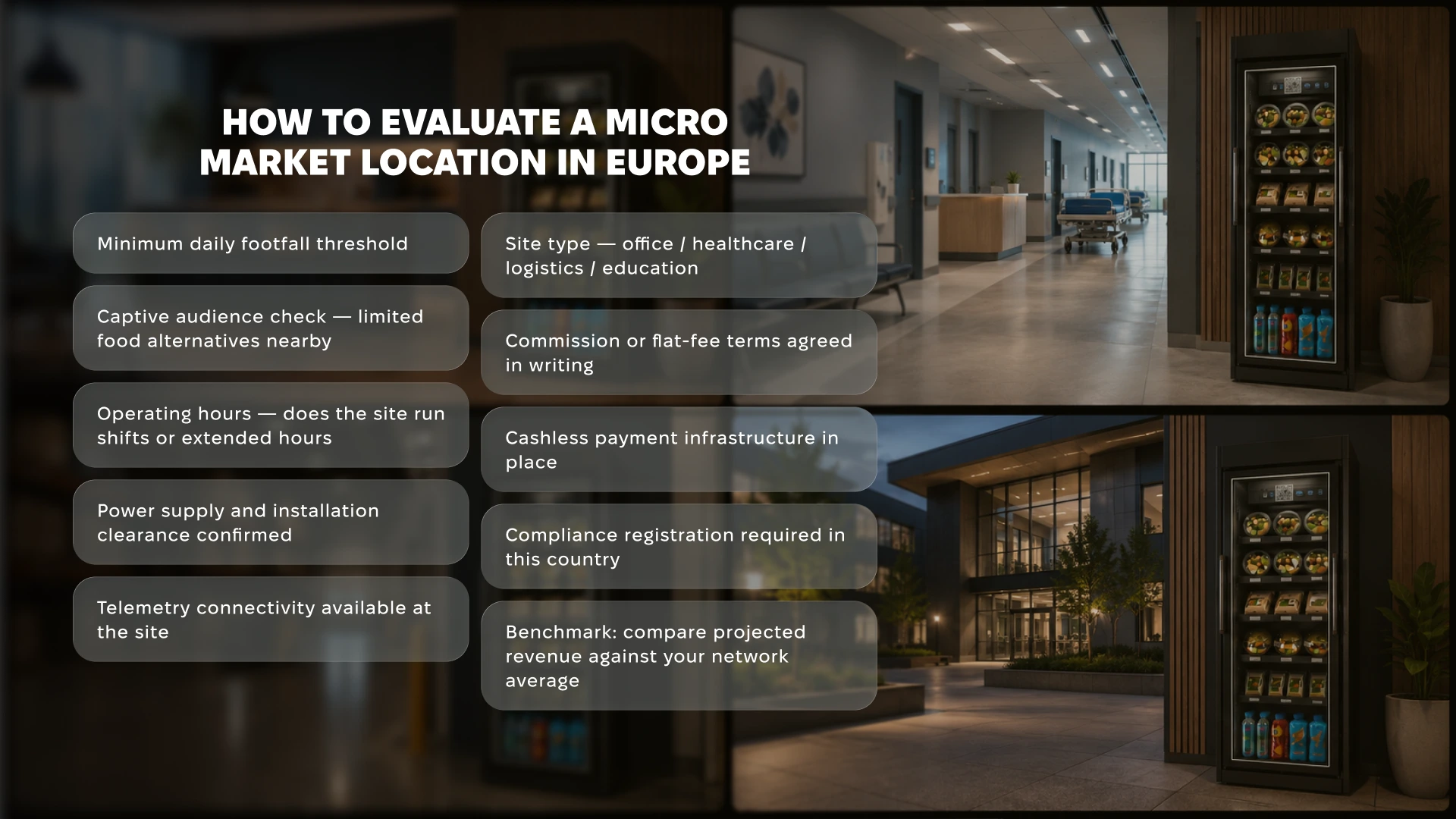 Regulatory and Compliance Requirements Across Europe
Running a micro market in Europe means navigating compliance requirements that vary by country, which matters most for operators expanding across borders.
Key compliance areas include:
- Food business registration in each operating country
- Allergen labelling and disclosure requirements for fresh or pre-packaged products
- GDPR-aligned data handling for cashless payment systems and loyalty programmes
- Country-specific trade licensing and placement permit requirements
What applies in Poland differs from requirements in Spain, Germany, or the UK. Operators building multi-country networks need an accurate picture of each jurisdiction before committing to placements. The Neuroshop guide to vending machine licensing in Europe covers the country-by-country framework in practical detail.
Compliance documentation is also becoming a site-selection criterion for institutional hosts. Corporate clients, hospitals, and public-sector facilities are requesting detailed information on food safety records, payment data security, and maintenance logs before approving an installation. Machines that generate automatic compliance records address that requirement directly.
What Operators Are Prioritising in 2026
Operators building out European networks are concentrating effort in four areas:
- Location diversification beyond offices. Healthcare and education are where the next volume wave is coming from. Germany alone accounts for 23.1% of European automated retail revenue, but healthcare and residential formats are expanding across all major European markets.
- Fresh product expansion. Fresh food consistently outperforms shelf-stable snacks on margin and customer preference. Refrigerated machines with real-time temperature monitoring make this category operationally viable.
- Sustainability credentials. Energy-efficient refrigeration, recyclable packaging, and documented waste reduction are becoming part of the pitch to corporate and institutional clients with their own environmental reporting commitments.
- Analytics-led operations. Operators treating machine networks as data assets, adjusting product mix by location and benchmarking sites against network averages, are generating consistent margin improvement. Searches for micro-markets, such as “micro-market companies near me” and “micro-markets for sale,” continue rising, signalling growth in both new entrants and territory development.
Operating food vending machines across Europe? Neuroshop's AI vending machines produce the compliance records inspectors require.
The European Micro Market Business: Where Operators Stand in 2026
The European micro market sector has structural growth behind it. Demand is driven by workplace behaviour changes, extended-hours facilities, and a widening revenue-per-location gap between connected and unconnected operations. Operators entering or expanding now have better data and broader location diversity available than at any previous point. The businesses building durable networks are treating the data those machines produce as seriously as the machines themselves.
Frequently Asked Questions
What is a micro market and how does it differ from a vending machine?
A micro market is an open-shelf, self-checkout retail installation stocking 150 to 400 products, including fresh food. Traditional vending machines carry around 40 SKUs. Micro markets generate 53% higher spend per transaction and support a broader range of fresh and chilled products, according to the Cantaloupe Micropayment Trends Report 2025.
How large is the micro market and automated retail market in Europe?
The European automated retail market was valued at $3.24 billion in 2025 and is projected to reach $10.15 billion by 2034 at a CAGR of 13.42%, per Market Data Forecast, April 2026. Micro market locations grew 28% in 2024, generating over $1 billion in sales and 377 million transactions globally, per Cantaloupe’s 2025 Micropayment Trends Report.
What location types perform best for micro markets in Europe?
Corporate offices with 80 or more daily occupants, logistics and manufacturing sites, healthcare facilities, and university campuses are the most reliable formats. Healthcare is the fastest-growing segment globally for 2026 through 2033, per Persistence Market Research 2026, and is gaining ground across European markets.
What technology is needed to run a profitable micro market operation?
At minimum: cashless payment terminals, real-time inventory monitoring, and SKU-level sales tracking. Connected machines with telemetry allow demand-based restocking, reducing unnecessary route visits and stockouts on high-velocity products. Micro markets currently process 96% of transactions cashlessly, per Cantaloupe’s 2025 data.
Do I need a licence to operate a micro market in Europe?
Yes. Requirements vary by country and typically include food business registration, allergen labelling compliance, trade licensing, and data protection obligations covering cashless payment systems. Country-specific requirements for major European markets are covered in the Neuroshop vending machine licensing guide for Europe.

