California has no single statewide vending machine license, which surprises most first-time operators. Instead, compliance runs through state tax registration, city-by-city business licenses, and county health permits that only apply to certain machine types. Getting the order wrong, or skipping a step entirely, is how operators end up with fines or forced removals months into running their route.
This guide walks through the actual steps required to start a vending machine business in California, what they cost, and where a smart micromarket changes the math compared to a standard machine.
Why California Is a Strong but Strict Vending Market
California’s population exceeds 39 million people, with dense metro areas, year-round foot traffic, and large workplace populations that support consistent vending machine business demand. That scale cuts both ways, though: enforcement is stricter here than in most states, and requirements shift by city and county rather than following one uniform rulebook.
What makes California different from most states:
- No single statewide vending license exists, unlike states that use a per-machine decal system
- Every city where you place a machine is its own separate licensing jurisdiction
- California LLCs owe an $800 minimum franchise tax regardless of revenue
- County health departments, not the state, regulate food and refrigerated vending
Operators who confirm vending machine license California requirements city by city before installing equipment avoid the fines and delays that catch new entrants off guard.
Step 1: Form Your Business Entity
Before placing a single machine, you need a legal business entity. Most California vending operators choose a limited liability company, which separates personal assets from business liability.
- Register your LLC through the California Secretary of State’s website.
- Get a free EIN from the IRS for tax purposes and business banking.
- Budget for the $800 annual franchise tax the Franchise Tax Board charges every California LLC, regardless of revenue or whether machines are installed yet. The prior first-year exemption under AB 85 expired at the end of 2023, so new LLCs no longer get a pass on this fee.
- Open a dedicated business bank account to keep vending income separate from personal finances.
That $800 franchise tax is the cost that catches most first-time operators off guard, since general business formation guides rarely mention it.
Step 2: Register for State Sales Tax
California regulates vending primarily through tax registration rather than a dedicated vending license.
- Register with the California Department of Tax and Fee Administration (CDTFA) to collect and remit sales tax on vending sales.
- This applies regardless of how many machines you operate or which cities you’re in.
- The narrow exemption for items sold at 15 cents or less hasn’t applied to real-world pricing since roughly 1975.
- If you’re selling anything at current prices, chips, water, energy drinks, you need the CDTFA seller’s permit.
Operating without a required seller’s permit creates back-tax liability, so this step shouldn’t wait until after your first machine is installed.
Step 3: Get City and County Licenses
This is where a California vending machine business gets genuinely complex, because licensing happens per jurisdiction rather than once at the state level.
| Requirement | Applies When | Typical Cost |
|---|---|---|
| City business license | For each city where a machine is placed | $50 to $300 per city, per year |
| County health permit | Machines dispensing food or refrigerated items | Varies by county, plan review may apply |
| Zoning or location approval | Some cities require this before installation | Varies, often bundled with business license |
| CDTFA seller’s permit | All vending operators statewide | Free |
If you place machines in three different cities, such as Los Angeles, San Diego, and San Jose, that’s three separate business licenses, three renewal dates, and three fee schedules. Fresh food and refrigerated vending routes should budget extra time for county health department plan review, since it isn’t a fast process.
Operating food vending machines across Europe?
Neuroshop's AI vending machines produce the compliance records inspectors require.
Step 4: Budget for Realistic Startup Costs
California vending machine business startup costs run higher than the national average, largely due to the franchise tax and per-city licensing fees stacking on top of equipment costs.
Typical first-machine costs in California:
- Machine cost: $2,000 to $10,000, depending on new versus refurbished and machine type
- Per-machine setup in dense metros like San Francisco often runs $3,000 to $6,000 including card reader and installation
- Initial inventory: a few hundred dollars per machine
- City business license fees: $50 to $300 per city
- California LLC franchise tax: $800 annually, independent of revenue
Most successful operators start with one or two machines to prove out a location before adding more, rather than buying a full fleet upfront. Choosing equipment with built-in remote telemetry from the start also avoids the cost of retrofitting older machines later.
Step 5: Choose Locations and Equipment
California’s high-traffic sectors are broad. Offices, healthcare campuses, manufacturing and logistics centers, colleges, gyms, and municipal facilities all support consistent vending machine business demand across the state’s major metros.
What performs well for vending machine locations in California specifically:
- Sites with 50 or more employees give the most reliable daily traffic
- Cashless payment is close to mandatory given the state’s high cost of living and cashless-leaning consumer habits
- Remote monitoring reduces driving time across California’s spread-out metro areas, where a route can span significant distance between stops
For operators considering a step up from a single snack machine, Neuroshop’s AI micromarkets offer a wider assortment with self-checkout via computer vision, which performs especially well at large California office campuses and residential complexes. Neuroshop’s fridge vending machines cover cold drinks and fresh food in a smaller footprint, useful for sites that don’t yet justify a full micromarket but still need refrigeration.
Vending Machine Business Profit Potential in California
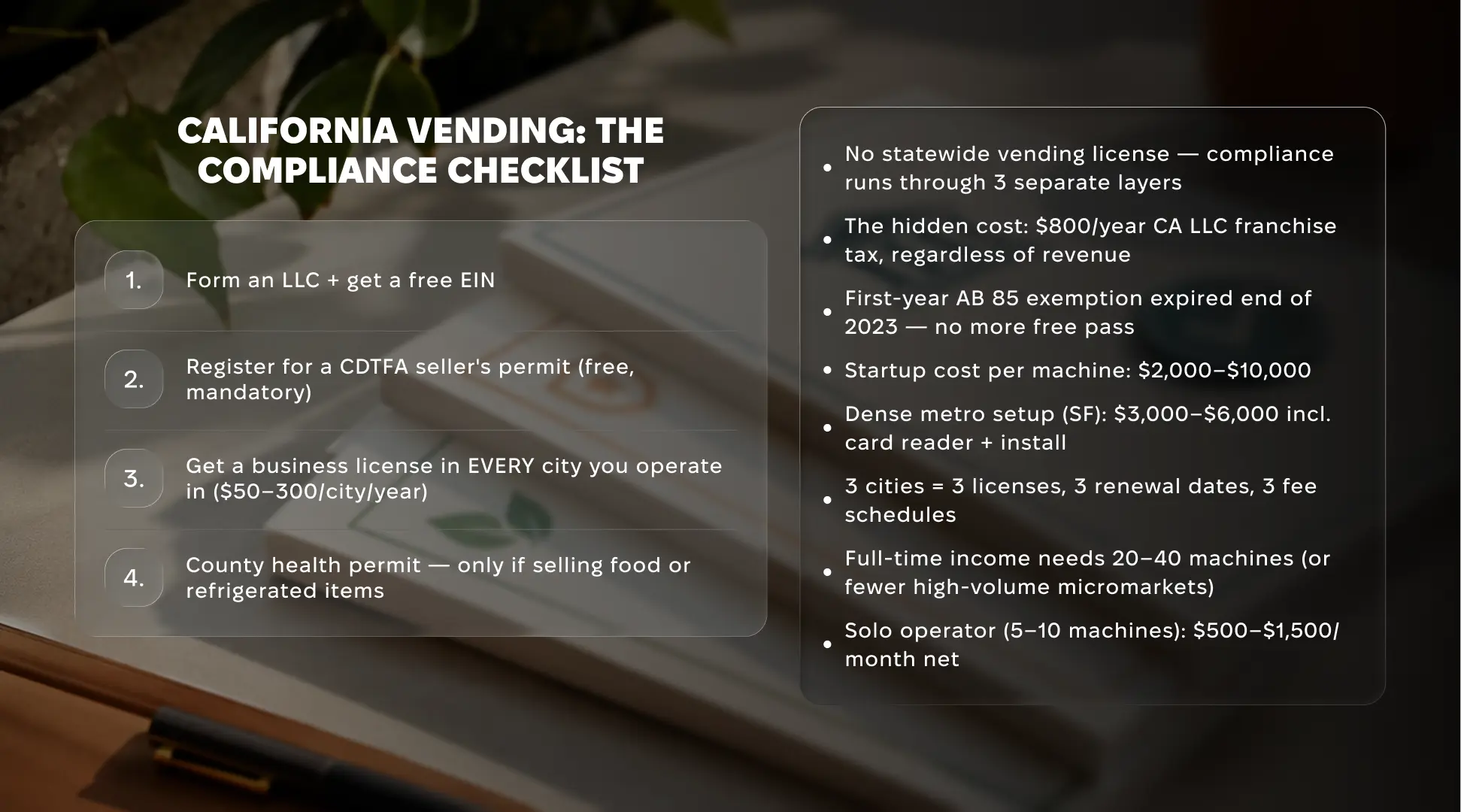
Given California’s higher operating costs, reaching full-time income typically requires more scale than in lower-cost states.
- Solo operators with 5 to 10 machines commonly net $500 to $1,500 per month
- Larger routes of 25 to 50 machines can net $3,000 to $8,000 per month, though this requires near full-time work
- Full-time income in California generally requires 20 to 40 machines, or a smaller number of high-volume, premium locations like micromarkets
- Route work stays labor-intensive, roughly 1 to 2 hours per machine per week for restocking, cleaning, and cash handling, until an operator scales enough to hire route drivers
The Neuroshop guide on common vending machine mistakes covers setup errors worth avoiding before scaling a California route, and the guide on vending machine sales data explains how to identify which locations are worth expanding into micromarkets.
Operating food vending machines across Europe?
Neuroshop's AI vending machines produce the compliance records inspectors require.
Conclusion
Starting a vending machine business in California means working through state tax registration, city-by-city business licenses, and county health rules rather than applying for one statewide permit. The $800 annual LLC franchise tax and per-city fees make California’s true startup cost higher than many general guides suggest. Operators who confirm requirements before installing equipment, and who choose connected equipment suited to their location’s traffic, build routes that scale without compliance surprises along the way.
Frequently Asked Questions
Do I need a vending machine license in California?
No single statewide vending license exists. Instead, operators register for a CDTFA seller’s permit, obtain a business license in each city where machines are placed, and secure a county health permit only if selling food or refrigerated items.
How much does it cost to start a vending machine business in California?
Expect $2,000 to $10,000 per machine depending on type and condition, plus $50 to $300 per city business license and an $800 annual California LLC franchise tax. Dense metro installs can run higher once card readers and setup are included.
How many vending machines do I need for full-time income in California?
Most operators need 20 to 40 well-placed machines to reach full-time income in California, given the state’s higher operating costs. A smaller number of high-volume locations, such as micromarkets, can reach similar income with fewer individual units.
Do all vending machines in California need a health permit?
No. Health permits apply specifically to machines dispensing food or refrigerated items, regulated at the county level. Machines selling only packaged, shelf-stable snacks or drinks typically don’t require the same health department review.
Is the California LLC franchise tax mandatory for vending businesses?
Yes. Any LLC formed to operate a California vending business owes the state’s $800 minimum annual franchise tax, regardless of revenue, profit, or whether machines have been installed yet. The prior first-year exemption expired at the end of 2023.

