Travelers rush through airports with one eye on departure boards and the other on their watches. They need water, snacks, headphones, phone chargers, essentials that shouldn’t require a 15-minute detour. But airport retail forces them to choose: miss their flight or skip the purchase.
Staffed shops have lines that stretch into concourses. Prices are inflated. Traditional vending machines offer limited selection and unreliable service. The entire experience penalizes travelers for needing basic items.
Airports are waking up to a better solution: airport micromarkets that serve passengers 24/7 without staff, without lines, and without the friction that makes airport shopping miserable. This is grab-and-go retail built for terminals, not adapted from a mall food court.
The stakes are significant. The global airport retailing market is projected to grow from $32.5 billion in 2025 to $36.25 billion in 2026, an 11.5% annual growth rate, according to Research and Markets. At the same time, the intelligent vending machine market, which includes the cashless and telemetry systems micromarkets run on, is forecast to grow at an 11.6% CAGR through 2036, per Future Market Insights. Airports that don’t modernize their concession format are leaving a fast-growing category of revenue on the table.
The Airport Retail Problem Nobody Solved
Airport operators face a puzzle that traditional retail can’t solve. Passenger flow, real estate economics, staffing, and time pressure all pull in different directions, and most concession models were never designed to reconcile them.
- Passenger volume fluctuates wildly. Morning rush, mid-day lull, evening surge, overnight quiet. Red-eye flights depart at 2 AM. Staffed stores close at 10 PM. Thousands of passengers have no access to essentials during off-peak hours.
- Real estate costs are astronomical. Every square foot of terminal space carries premium rent. Traditional retail requires large footprints: checkout counters, storage areas, staff zones. The math rarely works for smaller, high-traffic locations.
- Labor is expensive and scarce. Airports require background checks, security clearances, and overnight shifts. Finding reliable staff for airport retail is harder and costlier than almost any other location.
- Passenger dwell time is short. Travelers won’t wait in line for 10 minutes to buy a bottle of water. They’ll either pay premium prices at grab-and-go locations or go without.
- Speed is everything. Flight delays, gate changes, and tight connections mean passengers need to shop in under two minutes, from entry to exit. Most airport retail isn’t designed for this reality.
These constraints explain why airport shopping feels so broken. The environment demands speed, availability, and efficiency all at once, and traditional retail struggles to deliver all three together.
How Smart Micro Markets Solve Airport-Specific Challenges
Smart micro markets were built for exactly this environment: high traffic, space constraints, 24/7 operation, and customers in a hurry. Rather than adapting a standard retail format to airport conditions, the format was designed around the constraints from the start, which is why the pieces below solve problems traditional concessions never fully addressed.
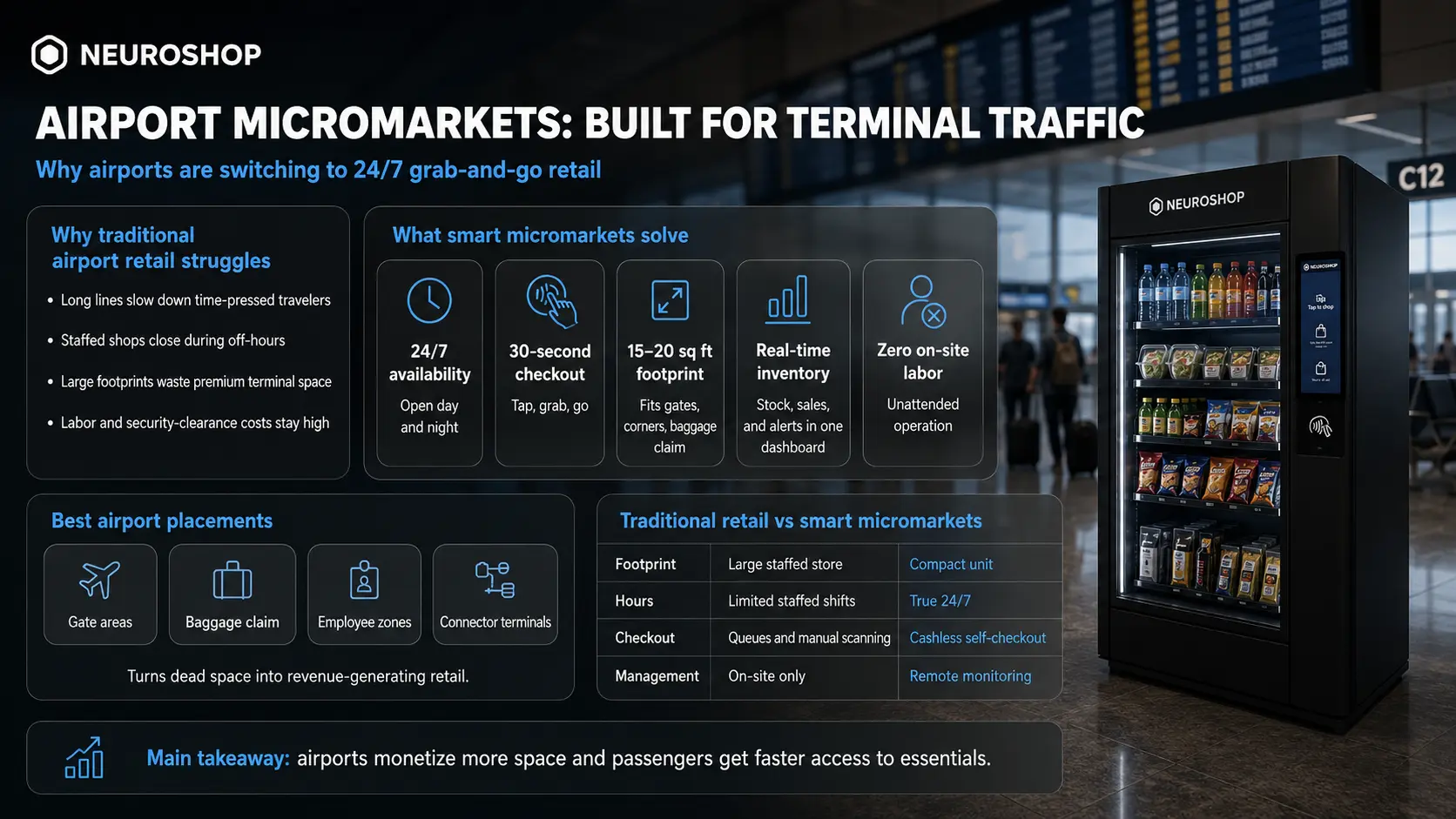
True 24/7 Grab-and-Go Availability
Airport micromarkets operate continuously. No opening hours. No “closed for restocking” signs. No staff shifts to manage.
A passenger landing at 3 AM finds the same access as someone departing at 3 PM. Red-eye travelers get what they need. Early morning connections aren’t stuck without coffee. Late-night delays don’t mean going hungry.
This alone recovers revenue that disappears when traditional stores close. Airports run around the clock, and 24/7 airport retail should too.
30-Second Transactions for Time-Pressed Travelers
Using a micro market in an airport is simple: tap a card or scan a QR code, the door unlocks, grab what you need, close the door and walk away.
The system detects what you took using computer vision and weight sensors, then charges you automatically. Total time: about 30 seconds. No cashiers, no scanning barcodes, no lines behind you. This is frictionless shopping that moves faster than a traditional self-checkout, which still requires scanning every item by hand.
For travelers watching departure times, that speed is the entire value proposition.
Space Efficiency That Maximizes Revenue Per Square Foot
Airport micro markets fit into compact spaces that traditional retail can’t use profitably: gate areas, terminal corners, baggage claim zones, even airside locations between security and gates. A single unit occupies roughly 15 to 20 square feet, a fraction of what a staffed concession needs once checkout counters, storage, and back-of-house space are factored in.
What a micro market footprint removes compared to a staffed store:
- No checkout counter or point-of-sale station
- No dedicated staff area or break space
- No queue space, since transactions happen at the shelf
- No storage room beyond what fits inside the unit itself
That smaller footprint is exactly what makes previously unusable terminal corners commercially viable. Neuroshop’s AI micromarkets are designed around this constraint specifically, fitting into spaces airports would otherwise leave empty or use for signage. For locations that need refrigerated grab-and-go items in an even smaller footprint, Neuroshop’s fridge vending machines cover cold drinks and fresh food without the full micromarket footprint.
Micro markets in airports turn dead space, the awkward corners too small for conventional stores but too valuable to leave empty, into a working part of the concession mix.
Product Mix That Adapts to Passenger Behavior
Real time inventory data from AI-powered micro markets reveals exactly what passengers buy, when they buy it, and what they browse but don’t purchase. That level of detail is not something a staffed kiosk running manual stock counts can match.
How passenger behavior shifts by flight pattern:
- Morning departures drive coffee, breakfast items, and grab-and-go pastries
- International flights see toiletries and travel accessories spike ahead of security
- Evening and red-eye flights show more electronics, snacks, and entertainment products
- Delayed flights increase dwell-time purchases across every category
Operators adjust inventory based on these patterns instead of restocking the same fixed assortment regardless of terminal or time of day. The Neuroshop guide on using vending machine sales data to make business decisions covers how operators turn this kind of sales data into concrete restocking and pricing decisions rather than letting it sit unused in a dashboard.
Traditional vending relies on guesswork about what a location needs. Smart airport retail relies on the actual sales record from that specific gate, terminal, or concourse.
Zero Labor Costs, Zero Staffing Headaches
Unattended retail solutions for airports eliminate the largest operational cost in terminal concessions: labor. Staffing an airport location costs meaningfully more than staffing an equivalent retail spot outside the terminal, for reasons specific to the environment.
Why airport labor costs run higher than typical retail staffing:
- Security clearances and background checks add weeks to hiring timelines
- Overnight and weekend shifts require premium wages to fill reliably
- High staff turnover means the clearance and training cost repeats often
- Call-outs leave a staffed kiosk unstaffed with no backup on-site
A micromarket removes every item on that list because there’s no cashier to schedule, clear, or replace. Neuroshop’s AI micromarkets run unattended around the clock, with remote monitoring standing in for a physical staff presence. That savings flows directly to the bottom line, which is what makes locations profitable that a staffed concession could never justify opening in the first place.
Smart investment, strong returns
With Neuroshop, you get more than a store, you get a long-term growth partner.
How Airport Micromarkets Improve Passenger Experience
Airport retail doesn’t only affect revenue. It shows up directly in how passengers rate their experience, and terminals are increasingly judged on convenience the same way they’re judged on wait times at security. Smart airport retail improves those scores in ways traditional concessions can’t match.
- Reduced congestion. No lines forming in concourses. Passengers flow smoothly through terminals instead of clustering at checkout counters.
- Faster service. Passengers spend less time shopping and more time boarding, reducing gate delays and improving on-time departures.
- Accessible pricing. Airport micromarkets compete with normal retail pricing, not the inflated airport premiums travelers expect. This improves the overall perception of value.
- Consistent availability. Products don’t run out unnoticed. Real time inventory alerts operators when stock drops below thresholds, keeping popular items in place.
- Contactless transactions. Post-pandemic passengers prefer minimal physical interaction, and cashless airport retail delivers a fully contactless shopping experience from start to finish.
These improvements show up in passenger surveys, online reviews, and repeat traffic. Travelers remember airport lounges and terminals that made shopping easy.
Where Airport Micromarkets Generate the Most Revenue
Airport micromarkets don’t only replace existing retail footprints. They open up locations that were previously impossible to serve profitably, which is where much of the incremental revenue actually comes from.
- Airside expansion. Place units between security and gates, where travelers have limited options and high dwell time. Capture sales that previously went to overcrowded gate-area shops.
- Baggage claim locations. Serve passengers who’ve just landed and need immediate essentials: phone chargers, water, snacks. Traditional retail rarely operates here profitably due to space and staffing costs.
- Employee areas. Airport staff need access to food and basics during shifts. Micro markets serve this market 24/7 without requiring dedicated staff facilities.
- Connector terminals. Tight connection areas where passengers rush between gates benefit from grab-and-go retail that doesn’t require a detour to the main concourse.
Each placement generates revenue from travelers who would otherwise skip the purchase or leave the airport ecosystem entirely. Operators planning multi-terminal or cross-border deployments should also review the Neuroshop guide to vending machine licensing in Europe, which covers registration and food compliance requirements that vary by country and matter directly for airport concessions.
Airport Micromarket Implementation: Faster and Simpler Than Traditional Retail
Deploying airport retail solutions at terminal scale is a different process from building out a traditional store, and it starts from a different baseline: hours instead of months. Neuroshop units deploy in hours, not months.
No construction is required, no POS systems need integrating, and no staff training is necessary. The micromarket arrives, connects to power and network, and operates immediately.
Remote management means airport operators monitor all units from a single dashboard: inventory levels, sales data, maintenance alerts, and product performance. Neuroshop’s telemetry platform is what makes this possible at terminal scale, feeding live data from every unit into one view so multiple locations across terminals are managed as efficiently as one. Updates and optimizations, including new payment methods and feature additions, deploy remotely without technician visits. Traditional retail requires contractors, permits, buildouts, hiring, and training. Airport micromarket solutions skip all of it, and Neuroshop’s team works directly with airport operators on placement, power requirements, and rollout timing before a single unit ships.
Traditional Airport Retail vs. Smart Micromarkets
The economics of the two formats differ enough that comparing them side by side explains why previously unprofitable terminal spaces are now viable for automated airport retail.
| Factor | Traditional Airport Retail | Airport Micromarkets |
|---|---|---|
| Footprint | Large: checkout counters, storage, staff zones | Minimal, roughly 15 to 20 sq ft |
| Labor | Wages, benefits, security clearances | Zero labor costs |
| Operating hours | Limited to staffed shifts | True 24/7 airport retail |
| Time to open | Weeks or months | Installation in hours |
| Management | On-site staff per location | Remote management at scale |
| Payment | Often cash-heavy, slower checkout | Cashless payments, self checkout technology |
Airports monetize more space, serve more passengers, and generate revenue around the clock, while operators gain real time visibility into sales data across every location.
Real-World Impact: Airports Already Making the Switch
Airports globally are deploying smart micromarkets in high-traffic zones, and the early results are consistent enough to treat as a pattern rather than an anomaly. Passenger traffic itself is part of the driver: Ahmedabad’s Sardar Vallabhbhai Patel International Airport recorded a 9.3% jump in passenger traffic in 2025, adding nearly 1.2 million travelers in a single year, according to Grand View Research. Every additional million passengers is additional conversion opportunity for retail formats that can actually serve them without a staffed line. The results airports report after deploying smart micromarkets include:
- Higher revenue per square foot than traditional vending
- Passenger satisfaction scores improve in terminals with smart micromarkets
- 24/7 availability eliminates complaints about closed shops during off-hours
- Operators report better margins than staffed convenience stores
This is proven infrastructure that airports are scaling rapidly as part of a broader digital retail transformation across travel retail.
Ready to modernize your terminal?
Neuroshop micromarkets bring 24/7 grab-and-go retail to any airport space.
Conclusion
Travelers expect the same frictionless shopping they get everywhere else: scan, take, go. Traditional airport retail was never built for that pace, but airport micromarkets are. Speed, 24/7 availability, minimal footprint, and AI-powered inventory give airports a retail format that fits their actual constraints instead of fighting them. Airports that deploy them see immediate returns: higher revenue, better passenger scores, and operations that scale without adding staff.
Frequently Asked Questions
What is an airport micromarket?
An airport micromarket is an unattended, open-shelf retail space where passengers select items and check out themselves using computer vision or weight sensors. It offers a wider assortment than a vending machine while requiring no on-site staff to operate.
How is a micromarket different from a traditional vending machine?
Vending machines dispense a limited set of pre-slotted items through a mechanical process. Micromarkets let passengers browse and pick up any product directly from open shelves, then use automated checkout, offering more variety and a more natural grab-and-go shopping experience.
Are airport micromarkets available 24/7?
Yes. Airport micromarkets operate continuously with no opening hours, staff shifts, or closures for restocking. This makes them especially valuable for red-eye flights, early departures, and late-night delays when staffed shops are typically closed.
How fast is checkout at an airport micromarket?
Most transactions take about 30 seconds. Passengers tap a card or scan a QR code, take what they need, and walk away, while computer vision and weight sensors detect the items and charge automatically without scanning barcodes.
How quickly can an airport install a smart micromarket?
Deployment typically takes hours rather than the weeks or months required for traditional retail buildouts. Units connect to power and network on arrival, require no POS integration or staff training, and can be managed remotely across multiple terminal locations.

