Inventory decisions determine vending margin, because every empty slot is a lost sale and every expired item is stock purchased twice. Most operators begin with manual counts and working knowledge of what sells. That approach remains workable at three machines and becomes unreliable past ten. A vending machine inventory management system replaces it with slot-level figures your team can act on.
This guide covers how to track vending machine inventory, how to set par levels, and how to restock against demand. It also covers stockout prevention, expiry control and the route planning built on that data.
How to Track Vending Machine Inventory: Four Methods Compared
Four tracking methods are in general use, and they differ in accuracy and in the driver time they require. Fleet size is usually the deciding factor.
- Manual counting. A driver records what went in and what came out, then reconciles against cash at the end of the route. Accuracy depends entirely on procedural discipline, and the figures are out of date by the time they reach a spreadsheet.
- DEX polling. The controller logs every vend, so the figures arrive without driver input. DEX records motor activations, which can differ from the units that reached the customer.
- RFID tagging. Each unit carries its own identifier and expiry date, which gives the operator a per-item record of shelf contents and remaining shelf life. The method suits mixed assortments with short shelf life.
- Computer vision. Cameras identify each item removed from an open shelf, which covers irregular packaging and fresh formats that coils cannot handle.
The table below compares the four methods on the criteria that matter for restock planning.
| Tracking method | Data captured | Reporting frequency | Typical application |
|---|---|---|---|
| Manual counts | Units in and out per visit | At the end of each route | One to five machines |
| DEX polling | Vend events from the controller | Continuously, where telemetry is fitted | Coil machines at scale |
| RFID tagging | Individual tagged items with dates | On each door close | Mixed SKUs, short shelf life |
| Computer vision | Items taken from an open shelf | In real time, per transaction | Micromarkets and fresh food |
The chosen method sets the accuracy limit for every calculation that follows, since par levels and restock triggers both read from this data. Neuroshop computer vision reports at the item level, which removes the reconciliation step.
How to Set Vending Machine Par Levels per Slot
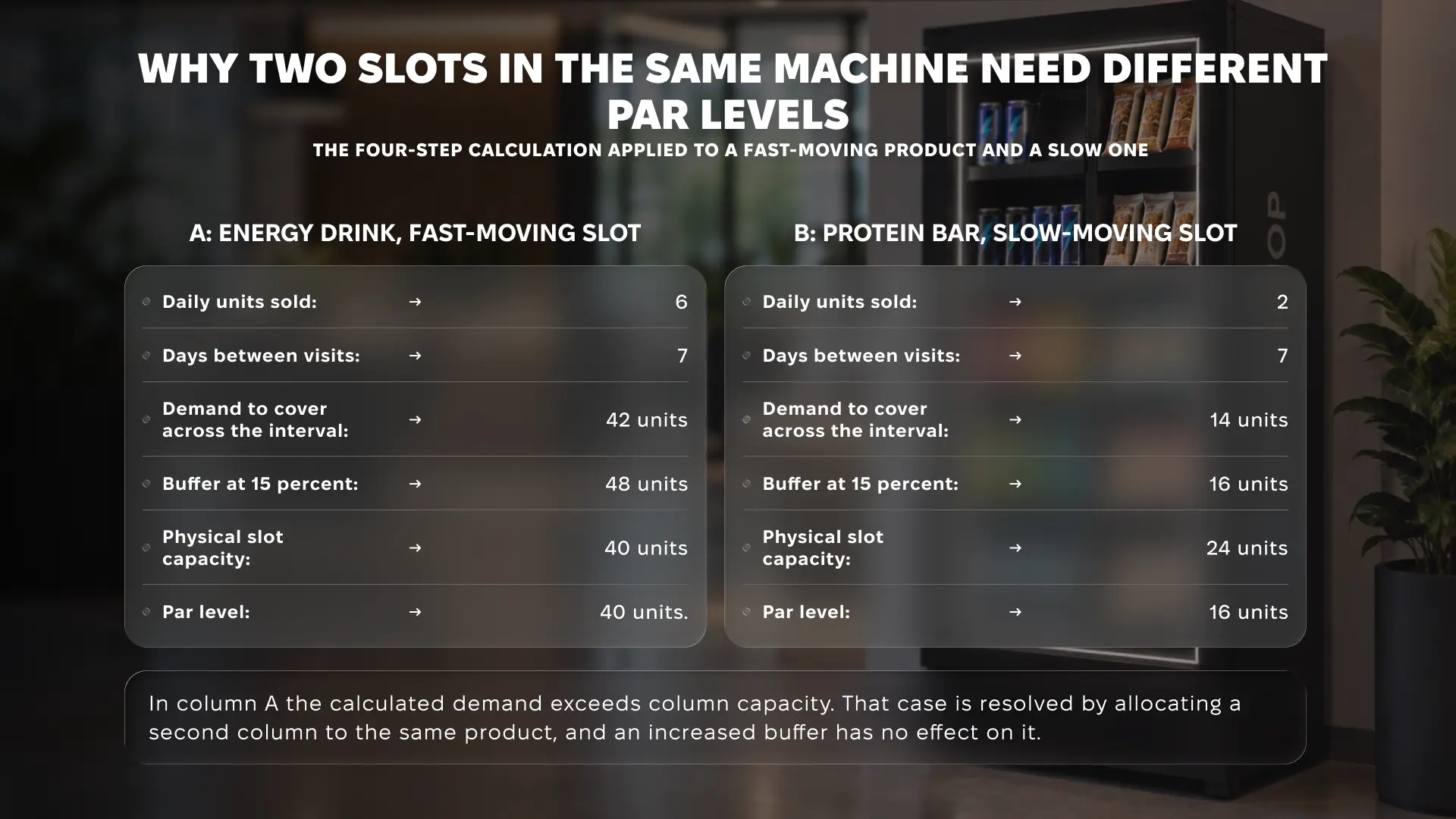
A par level is the quantity a slot holds when full, set against how fast that slot sells. Sales velocity determines the base figure, and the service interval provides the multiplier. Calculate it slot by slot, because two columns in the same cabinet rarely move at the same rate.
- Measure daily units sold for that slot across at least two full service cycles, so a single unusual week does not set the figure.
- Multiply by the days between visits to that location, which gives the demand the slot has to cover.
- Add a buffer of 10 to 15 percent for demand spikes and for visits that slip a day.
- Cap the result at physical slot capacity, then flag every slot where demand exceeds what the column holds.
A slot that hits its cap every cycle needs a second column allocated to the same product. From our work with multi-site operators, par levels drift within a quarter as seasons and site headcount change. A quarterly review keeps the figures aligned with current demand.
Still Counting Stock by Hand on Every Route?
Neuroshop machines report slot-level stock to your dashboard between service visits.
Vending Machine Restocking Schedule: Demand Triggers vs Fixed Calendar
Calendar restocking sends a driver to every machine on the same day each week, whatever the stock level. Demand-based restocking sends the driver where the data shows stock has fallen below its trigger point.
The difference shows up as two separate costs. Machines that are still 80 percent full absorb a visit that earns nothing, while fast locations run empty before their scheduled day arrives. Mordor Intelligence reports that connected machines reduce out-of-stocks by 40 percent and cut route trips by around a quarter.
A workable trigger sits at 25 to 30 percent of par for fast movers, and lower for slow ones. Once the trigger is reached, the machine is added to the next route, and the pick list is generated from the shortfall recorded per slot.
How to Prevent Vending Machine Stockouts and Overstock
Both problems originate in a par level set from estimation, although their costs differ in form.
- Stockouts cost the immediate sale and the repeat visit. A customer who finds an empty column twice stops checking the machine.
- Overstock ties up working capital in a cabinet, and on dated products it converts to write-off.
- Silent stockouts are the expensive variant. A jammed coil or a disabled column reports full inventory while selling nothing.
Silent stockouts are the reason inventory data and fault data belong in the same dashboard. A column showing zero sales for two days indicates either a dead product or a failed motor. Fault data separates the two cases.
Expiration Date Tracking and FIFO Rotation in Vending
Dated stock needs a rotation rule and a date field in the system. FIFO handles the rotation, because new stock loads behind existing stock and the oldest unit sells first.
The type of date printed on the pack determines how the slot is handled. Under EU rules a use by date marks a safety limit, while a best before date marks quality. The European Commission guidance on date marking sets out how operators should apply each one.
Set an internal pull date ahead of the printed one, usually one to two days for chilled items. Machines that hold a date per item enforce this without a manual check. Neuroshop fridge vending machines track expiration per SKU and can block or discount items approaching their date.
Vending Machine Product Performance and Slot Profitability
Each machine holds a fixed number of columns, so the product mix has to be reviewed on measured performance. Rank products by units sold and by gross margin per slot per week. A high-volume item on thin margin can return less than a slower premium line.
- Give a new product two full service cycles before judging it
- Test one slot at a time, so the rest of the machine stays comparable
- Replace anything in the bottom decile after its second cycle
- Adjust the mix by site type, since demand at a gym differs from demand on an office floor
Ranking by margin also changes which stockouts matter. An empty column on a top-margin line costs more per hour than one on a low-margin filler, and the restock order should reflect that. Our guide on using vending machine sales data covers the reporting side.
Vending Telemetry and Route Optimization Software
Telemetry connects inventory data to route planning. Machines report slot-level stock, so the system compiles a service list from measured shortfall and then orders the stops by geography.
Three operational changes follow. Pick lists are compiled per machine before the truck is loaded, so drivers carry what each stop requires. Visits to near-full machines drop out of the schedule. Fault alerts travel alongside the stock data, so a driver arrives with the right product and the right part on the same trip.
Neuroshop telemetry supplies this data from the cabinet, and our guide on vending route efficiency covers the planning methods that use it.
Planning Routes Without Knowing What Is in Each Machine?
Neuroshop builds your service list from real stock levels, not from a fixed calendar.
Final Take
Vending machine inventory management rests on four figures per slot: sales velocity, column capacity, restock trigger and expiry date. Par levels convert those figures into a stocking plan, and restock triggers convert the plan into a service route. Operators working from machine data make fewer trips per sale and write off less stock, because each decision is taken before the truck is loaded.
FAQ
What is vending machine inventory management?
It is the practice of tracking stock at slot level, setting par quantities, and restocking against measured demand. It also covers expiry control and product ranking, which establishes whether each column justifies its space.
How do I track vending machine inventory?
Small operators reconcile manual counts against cash after each route. Larger fleets use DEX polling or computer vision, which report stock continuously without driver input and remove the reconciliation step.
What is a good par level for a vending slot?
Multiply daily units sold by the days between visits, then add 10 to 15 percent as a buffer. Cap the figure at physical slot capacity and review it each quarter as demand shifts.
How often should vending machines be restocked?
Frequency follows sales velocity at each site. Set a trigger at roughly 25 to 30 percent of par, then add the machine to the next route once that level is reached.
What causes a silent stockout?
A jammed coil or a disabled column reports full inventory while selling nothing. Pairing stock data with fault alerts identifies the cause, since a column at zero sales indicates either a dead product or a failed motor.

