The vending industry has transformed dramatically. Food vending machines in 2026 are sophisticated retail platforms powered by artificial intelligence and IoT connectivity. The intelligent vending machine market is projected to reach $53.15 billion by 2035. This guide walks you through machine types, essential features, location strategies, and cost considerations to help you choose the right solution for your business.
Understanding Food Vending Machine Types
Not all vending machines work the same way. The type you choose affects your product options, maintenance requirements, and profit potential.
Type 1: Traditional Snack and Food Machines
Traditional vending machines use spiral coils to dispense packaged items. Press a button, watch the coil rotate, and wait for your snack to drop.
These machines typically offer 30-50 selections with glass fronts for product visibility. They work fine for durable packaged goods but have serious limitations. The mechanical dispensing system restricts product dimensions. Fragile items like pastries risk damage during the drop. Additionally, mechanical parts wear out over time.
Best applications: standard packaged snacks, canned beverages, candy and gum, non-perishable items.
Type 2: Refrigerated Food Vending Machines
Refrigerated machines add temperature control for perishable foods. They maintain consistent cooling between 32-40°F for food safety compliance.
Better models offer dual-zone capabilities. You can set different temperatures for separate compartments. Keep sandwiches chilled while freezing ice cream in another section.
Common applications: fresh sandwiches and wraps, salads and cut fruit, dairy products, ready-to-eat meals, breakfast items.
The challenge? Traditional refrigerated machines still use mechanical dispensing with the same size and fragility limitations.
Type 3: Combo Vending Machines
Combo machines split their capacity between food spirals and beverage columns. A single unit dispenses both snacks and drinks, typically offering 70+ total selections.
The main advantage is space efficiency. Hotels, small offices, and hospital wings often lack room for separate machines. However, combo machines inherit the same mechanical limitations as traditional vendors.
Best for locations with limited floor space under 3 sq.m, facilities serving under 100 people, budget-conscious installations, and simple product needs.
Type 4: Smart Food Vending Machines (Micro Markets)
Smart vending machines eliminate mechanical dispensing entirely. Often called micro markets, they use open shelving with glass doors, computer vision, and AI-powered product recognition.
Customers authenticate with a payment card or mobile app, open the door, take what they want, and close it. The system automatically identifies products through AI neuro vision technology, calculates the total, and charges their account.
This approach changes what you can sell. No mechanical constraints. No size restrictions. No dropped products.
Advanced capabilities:
- Visual product recognition through neural networks
- Weight-based verification with precision scales
- RFID tag tracking for instant inventory updates
- Real-time stock monitoring and automated alerts
- Remote management through cloud dashboards
- Multi-zone temperature control for mixed products
Transaction speed improves dramatically. Traditional machines need 20-40 seconds per purchase. Smart systems complete shopping trips in under 10 seconds.
Neuroshop’s micro market solutions combine computer vision, intelligent scales, and RFID systems to create the most accurate, flexible food vending experience available today.
Fresh Food Vending: Salads, Sandwiches, and Ready Meals
Fresh food changes the economics of a location. Salads, sandwiches, and ready meals carry higher margins than packaged snacks, and they bring back the same customers every working day.
A meal vending machine needs more than cooling. Products have short shelf life, fragile packaging, and strict rotation rules. Mechanical spirals crush a sandwich box and cannot hold a bowl at all.
Open-shelf smart food vending machines remove that barrier. Any container works: bowls, wraps in film, glass jars, paper boxes. Customers see the product before they take it, which matters a lot when someone judges whether a sandwich looks fresh.
Typical fresh assortment: salads and grain bowls, sandwiches and wraps, yoghurt and fruit cups, cold pasta, soups, breakfast items.
Rotation is where most operators lose money. A salad vending machine holds stock with a two or three day window, so expiration tracking has to be automatic instead of manual.
Neuroshop builds fresh food vending around this problem. Every item is tracked by camera, scale, and RFID tag, so the platform knows the exact age of the stock on each shelf and pulls expired products from sale before a customer ever sees them.
Key Features to Consider When Buying
The features you prioritize determine your machine’s profitability and operational workload.
Factor #1: Payment Technology
Cash is dying. In 2026, expecting customers to carry coins limits your sales significantly.
Cashless payment systems are advancing at 12.65% CAGR. Modern food vending machines must accept credit and debit cards, mobile wallets like Apple Pay and Google Pay, QR code scanning, contactless NFC payments, and wearable device payments.
Smart micro markets from Neuroshop support all these methods by default. Traditional machines often require expensive retrofits to add modern payment systems.
Factor #2: Temperature Control and Food Safety
Temperature management is mandatory for health compliance. Cold food requires 32-40°F. Frozen items need below 32°F. Multi-zone systems divide the machine into separate climate-controlled sections.
Neuroshop’s smart fridges track temperatures continuously, alert operators to deviations, and maintain detailed logs for compliance documentation. Traditional refrigerated machines offer basic cooling but rarely provide zone-specific control or automated tracking.
Factor #3: Inventory Management Technology
Traditional machines track inventory through motor rotations and manual counts. Operators make unnecessary trips or arrive to find machines already empty. Products sit past expiration dates.
Smart inventory management offers real-time stock monitoring, automated reorder alerts, sales pattern recognition, predictive analytics, remote dashboard access, and mobile app control. Inventory vending machine data updates the moment a door closes.
Neuroshop’s platform uses computer vision and weight sensors to track every item. When a customer takes a sandwich, the system records it and updates inventory immediately.
Factor #4: Security and Anti-Theft Features
Without proper security, theft erodes profit margins quickly. Traditional machines offer limited protection.
Smart vending machines provide locked access until payment completes, computer vision monitoring, weight verification, automatic alerts for unusual activities, and surveillance integration.
Neuroshop’s technology recognizes when someone takes three sandwiches but gets charged for one. The system blocks future access for that account and alerts the operator immediately.
Before installation, check two things at the location: stable electricity and a stable internet connection. Both are required for remote control, which lets owners monitor the machine from any place.
To prevent acts of vandalism and theft, Neuroshop vending equipment is supplied with a modern security system, which includes:
- CCTV cameras;
- Door opening control sensors;
- Motion sensors;
- Scales for additional control, which determine what is taken out of the refrigerator.
In the event of such situations, the system automatically blocks the machine, and a notification is sent to the owner. The same system constantly analyses the number of products inside, and informs the owner when stocks need replenishing.
Want a vending business that runs itself?
Talk to the Neuroshop team about our machines, security systems, and remote management tools.
Location-Based Selection Guide
Location requirements drive your selection process.
Office and Corporate Environments
Office vending serves employees who want convenient meals without leaving the building. Stock fresh salads and grain bowls, sandwiches and wraps, protein-rich snacks, healthy beverages, and breakfast items.
Neuroshop’s office micro markets excel here. Employees authenticate once through the mobile app, then access machines instantly. Ten-second transactions mean no lunch lines even when everyone breaks simultaneously.
Educational Facilities
Schools and universities face tight budgets, nutritional requirements, and fluctuating usage patterns between classes. Balance nutrition with student preferences through healthy snacks meeting school guidelines, energy-boosting items, affordable pricing, allergen-aware selections, and quick transaction processing.
Students expect modern services that work with mobile payment apps. The technology considerations matter as much as product selection.
Healthcare Facilities
Hospitals need 24/7 food access for staff, patients, and visitors. Dietary restrictions are common. Hygiene standards are strict. Smart micro markets offer maximum flexibility with healthy options, clear nutritional labeling, compliance features, quiet operation, and touchless payment systems.
Neuroshop’s contactless payment systems align with healthcare’s focus on minimizing germ transmission. Customers never touch shared buttons or screens.
High-Traffic Public Spaces
Airports, train stations, and shopping malls present different challenges. Traffic is high but rushed. Competition is intense. You need high-capacity machines, rapid transaction processing under 10 seconds, diverse product range, durable construction, and weather resistance.
Smart vending handles high-traffic scenarios better. Open-shelf design lets multiple people browse visually. Fast transactions prevent bottlenecks. Remote monitoring enables immediate response to issues.
Technology and Innovation in 2026
The technological gap between traditional and electronic vending machines has widened considerably.
AI and Computer Vision Systems
Computer vision represents the fundamental breakthrough enabling modern food vending. High-resolution cameras capture images constantly. Neural networks analyze these images to identify exactly what customers select by shape, color, and packaging design.
This eliminates mechanical dispensing entirely. You can stock any product regardless of size, shape, or fragility. Transaction speed drops from 40 seconds to 10 seconds. Product variety expands without physical constraints. Maintenance needs decrease without mechanical parts.
Neuroshop’s AI neuro vision technology combines computer vision with weight sensors and RFID tags for 99.9%+ accuracy.
IoT Integration and Remote Management
Internet connectivity transforms vending into a data-driven operation you manage from your phone. Connected machines send continuous data to cloud platforms.
Operators monitor real-time inventory, receive instant alerts, adjust prices remotely, review sales analytics, schedule maintenance, and track temperature compliance. Neuroshop’s IoT platform gives operators complete control from anywhere.
Data Analytics for Optimization
Smart machines constantly learn. Every transaction generates data. AI algorithms analyze patterns and optimize operations automatically.
Analytics identify sales patterns, reveal peak hours, forecast seasonal demand, track product performance, enable personalized recommendations, and support dynamic pricing strategies. Neuroshop’s analytics platform identifies cross-selling opportunities to increase revenue, and shows which products deserve more shelf space at each individual location.
Business Advantages of Smart Food Vending
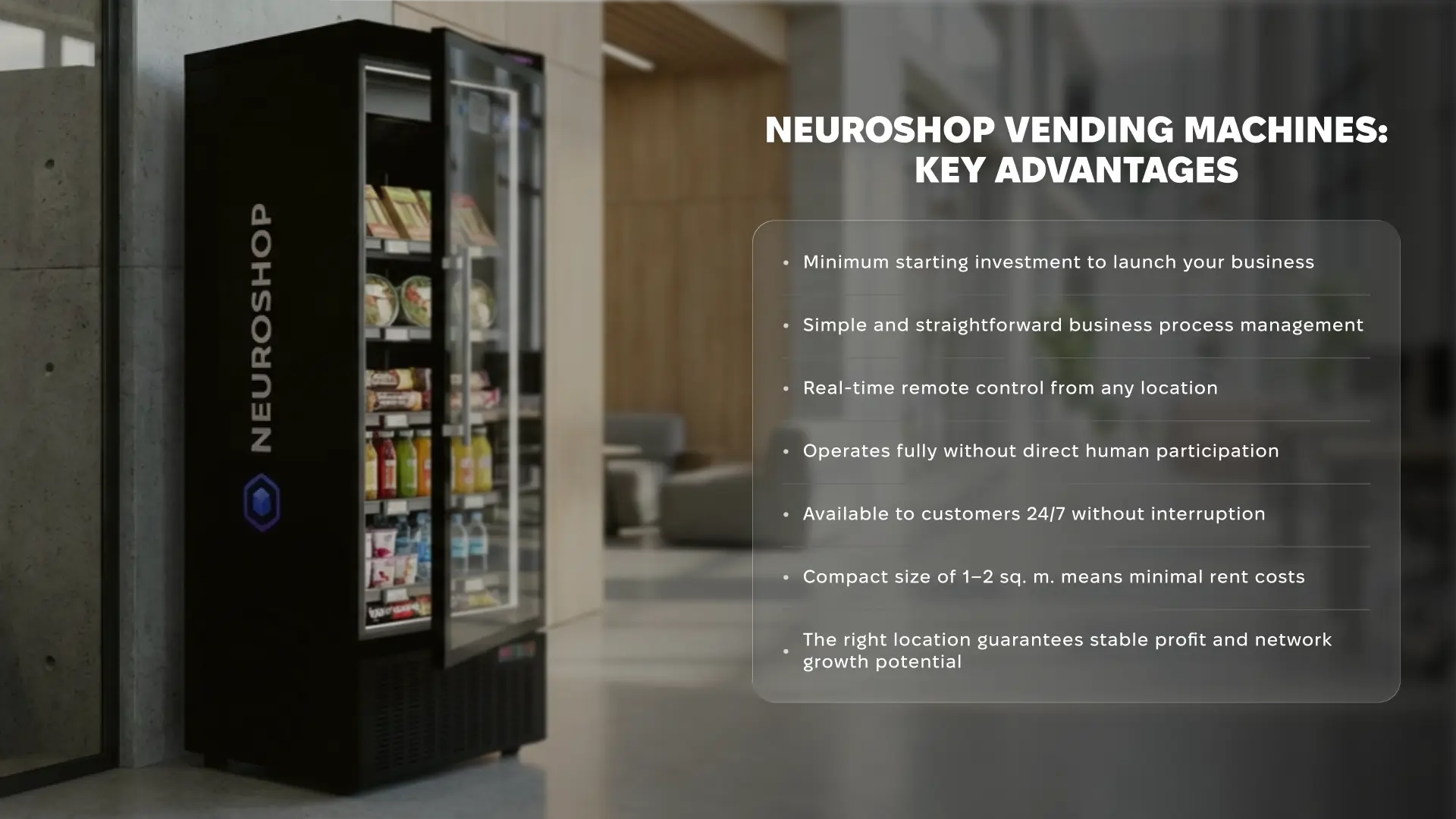
A huge variety of products are presented in vending machines today. It is easier to say which products you cannot find in them. Modern product vending machines from Neuroshop are as easy to use for customers as they are to manage for owners, they cost far less than a retail store, and with the right installation they bring stable income.
Neuroshop vending machines advantages:
- Minimum starting investment;
- An easy way to organize business processes;
- Remote control in real time;
- Work without direct human participation;
- Access 24/7;
- Minimum rent, since smart fridges occupy a small area;
- Stable profit and the prospect of network development when the place is chosen well.
Food vending machines from Neuroshop do not require large areas for installation, about 1-2 sq. m. This significantly saves resources for rent, and expands the possibilities of locations for installation. A grocery vending machine fits into a lobby corner, a corridor, or spare wall space in a canteen.
Cost Considerations and ROI
Price matters, but total value over time matters more.
Initial Investment Range
Typical price ranges: basic snack machines $2,000-$5,000, refrigerated food machines $4,000-$8,000, combo machines $6,000-$12,000, smart micro markets $10,000-$25,000+.
Smart micro markets cost more upfront but deliver operational savings and revenue advantages.
Operating Costs and Revenue Potential
Monthly expenses include electricity, product inventory, location fees, maintenance, insurance, and labor. Smart machines reduce several costs through energy efficiency, lower maintenance needs, and eliminated unnecessary service trips.
Realistic monthly revenue: office location with 100 employees $500-$1,500, high-traffic public space $2,000-$5,000+, educational facility $800-$2,000, healthcare facility $1,000-$3,000.
Smart micro markets consistently generate higher revenue. Average payback period runs 12-24 months. High-quality locations achieve payback in under a year.
Common Mistakes to Avoid
Mistake #1: Underestimating Location Importance
Even the best machine fails in poor locations. Quality of foot traffic matters more than quantity. Secure your location first, negotiate favorable terms, then select the machine that maximizes potential.
Mistake #2: Ignoring Payment Technology
Cash-only machines miss half of potential sales. Customers expect mobile wallet support, contactless payments, and app-based options. Smart platforms like Neuroshop’s micro markets build comprehensive payment support in from day one.
Mistake #3: Overlooking Product Freshness
Food vending requires strict rotation schedules and expiration monitoring. Neuroshop’s platform tracks expiration dates for every item, alerts you before products expire, and prevents sales of items past their date.
Mistake #4: Neglecting Maintenance Plans
Without maintenance plans, breakdowns mean lost sales and emergency repairs. Smart micro markets have fewer mechanical parts to break. Neuroshop’s IoT platform monitors machine health continuously and alerts operators to developing problems.
Mistake #5: Choosing Based on Price Alone
The cheapest machine often costs the most over its lifetime. Evaluate total cost of ownership over 3-5 years instead of the purchase price alone. The machine that maximizes long-term profitability is the smart investment.
Future Trends in Food Vending
The industry continues evolving rapidly. Sustainability focus drives eco-friendly refrigeration systems, energy-efficient components, biodegradable packaging, and carbon-neutral operations. Health and wellness integration connects machines to employee wellness apps, nutritional tracking, and fitness platforms. Expanded product categories include meal kits, hot food preparation, local and organic products, and restaurant partnerships.
Smart micro markets handle this diversity easily. Traditional machines can’t accommodate the variety or special handling requirements. Neuroshop develops its vending equipment with these shifts in mind, so operators can add new product categories to an existing fleet through a software update rather than a hardware replacement.
Making Your Decision
Choosing a food vending machine comes down to matching technology to your business goals. Start by analyzing your target location thoroughly. Understand customer demographics, traffic patterns, and competitive landscape. Secure a strong placement agreement. Neuroshop’s intelligent vending solutions combine AI-powered recognition, IoT connectivity, and remote management into platforms that compete with traditional convenience stores.
Ease of use, efficiency, and market demand pushed Neuroshop to integrate these vending systems into city services, including in Kyiv. We provide various types of machines depending on the specifics of the business and the owner’s preferences. By ordering a vending machine for food from Neuroshop, you receive high quality service and a business area that brings real benefits to you and your customers.
FAQ
What’s the difference between traditional and smart food vending machines?
Traditional machines use mechanical spirals and basic payment systems with significant product limitations. Smart machines employ AI, computer vision, and open-shelf access for superior flexibility. They eliminate size restrictions, reduce transaction times from 40 to 10 seconds, and enable remote management. Smart systems also provide real-time inventory tracking and automated compliance documentation.
How much profit can I expect from a food vending machine?
Monthly revenue depends primarily on location and foot traffic. Office locations with 100 employees typically generate $500-$1,500. High-traffic public spaces reach $2,000-$5,000+. Educational facilities average $800-$2,000. Smart machines consistently generate higher revenue through faster transactions, greater product variety, and superior customer experience. Expect 12-24 month payback periods.
What payment methods should my food vending machine accept in 2026?
Essential options include credit and debit card readers, mobile wallets like Apple Pay and Google Pay, contactless NFC payments, QR code scanning, and wearable device payments. Cash is increasingly optional but may remain relevant in some locations. Machines without comprehensive digital payment support miss substantial sales opportunities in today’s market.
How do smart vending machines handle food safety compliance?
Smart systems track temperatures continuously across multiple zones, maintain detailed logs for health inspections, monitor expiration dates for all products, send automatic alerts for any deviations, and prevent sales of expired items. Traditional machines require manual temperature checks and expiration tracking, which increases compliance risks and operational workload.
How do smart vending machines prevent theft?
Access stays locked until payment is authorised. Cameras, door sensors, motion sensors, and internal scales record what leaves the fridge. When the figures disagree, the machine blocks that account automatically and sends the owner a notification.
How much space does a food vending machine need?
A smart fridge occupies about 1-2 sq. m including door clearance. Combo machines need up to 3 sq. m. Stable power supply and a reliable internet connection matter as much as the floor area itself.
Can I start with one machine and expand later?
Starting small lets you test markets and refine operations before major investment. Choose machines from manufacturers where parts are interchangeable across models for easier scaling. Focus on securing high-quality locations first. Smart platforms like Neuroshop provide remote management tools that make operating multiple machines as simple as managing one location.

